Key Montessori Organisations
The National Center for Montessori in the Public Sector NCMPS
Based in Connecticut, USA, an independent non-profit organisation supporting the growth and development of high-quality public Montessori programmes. Read more about NCMPS About Montessori
North American Montessori Teachers’ Association NAMTA
A membership organisation and AMI affiliate founded in 1970 promoting Montessori in North America; offers national professional development events, a professional journal, and a number of other services and resources.
The Montessori Foundation
A nonprofit organisation dedicated to the advancement of Montessori education. It sponsors a number of activities, including the periodical Tomorrow’s Child, a help line, a resource library, and a membership organisation, the International Montessori Council (IMC). Montessori 101, by Tim Seldin, president of the Montessori Foundation.
Public Montessori in Action PMAI
Works hand in hand with schools and districts to ensure fully-implemented Montessori education in public schools of the global majority.
The Montessori Public Policy Initiative MPPI
A joint collaboration of the American Montessori Society (AMS) and the Association Montessori International (AMI/
Montessori Educational Programs International MEPI
Founded in 1995 and offers teacher training and professional development: “MEPI fosters and generates authentic Montessori education by developing and offering programs to educate and certify Montessori professionals and provides continuing development and enable networking opportunities.”
Association Montessori Internationale AMI
An international organisation founded in 1929 by Maria Montessori to promote and further her work.
American Montessori Society AMS
Founded in 1960 and is now the largest Montessori organisation in the U.S., training teachers and promoting Montessori education. What Is Montessori?
AMI USA
Founded in 1972 by Mario Montessori to address specific educational, philosophical, and organisational needs in the United States, it has become the primary U.S. operational affiliate. Why Montessori?
Teacher Training
As well as the organisations listed above, the following also run teacher-training courses or provide information on the training.
The Montessori Accreditation Council for Teacher Education
MACTE is the premier international accrediting body for Montessori educator preparation programmes, recognised by the U.S. Department of Education. Founded in 1995, it serves as an umbrella agency that sets quality standards for adult training centres across various affiliations - including AMS and AMI - ensuring that teacher credentials meet high academic and professional benchmarks. By evaluating programmes based on candidate competency, faculty expertise, and institutional capacity, MACTE provides the essential bridge between specialised Montessori pedagogy and broader state or international licensing requirements, making its accreditation the gold standard for professional portability in the field.
MACTE Recognized Organizations (MROs) provide guidance and ongoing support for the development and running of Montessori educator preparation programmes. This can include guidelines for areas like curriculum and professional development. Document Library here.
International Association of Progressive Montessorians IAPM
Founded in 1962 in London and continues to train teachers and affiliate schools.
Pan-American Montessori Society PAMS
Founded in 1973 and provides teacher training and school accreditation.
The International Montessori Society IMS
“Established by Lee Havis in 1979, IMS Montessori teaching is unique in the field, since it follows laws of nature, rather than “personality” or “culture” as common elsewhere in the conventional Montessori community.”
The Center for Montessori Studies CMS
Based in the University of Hartford, CMS “offers comprehensive Montessori online training programs for interested Montessori teacher candidates.” They have also created the Montessori Glossary Community Project, “A collaborative project to co-create an open-access, community-driven glossary of Montessori concepts, grounded in knowledge equity and practices of care.”
If you need a little more guidance …
The Center for Guided Montessori Studies CGMS
“Since 2006, CGMS has been leading the charge in distance education for Montessori training.”
Arlington Public Schools
This report compares two main Montessori models in the U.S.: AMI and AMS. AMI is considered the more orthodox, traditional model, adhering strictly to Maria Montessori’s original philosophy and resisting modern educational trends. AMS, founded as a U.S.-based offshoot, is more flexible and adaptive, integrating technology, current events, and evolving research into its pedagogy. Despite these philosophical differences, both organisations share core goals, including advocacy for Montessori education in the public sector. In the Mid-Atlantic region, AMS has a larger presence, with more affiliated schools and training centres than AMI. No research directly compares student outcomes between the two models, and both are considered valid approaches, though they differ in classroom flexibility and adherence to tradition. Teacher training for both includes significant classroom and practicum hours, though AMI requires more in-class hours (400 vs. 300) and offers formal assistant certifications, while AMS mandates ongoing professional development (50 hours every five years). AMS accepts teachers trained under either model for accreditation, suggesting cross-compatibility.
Montessori School of Flagstaff
Matt Bronsil
Montessori Albums
Montessori Nuggets
This website has the most comprehensive list of albums that I’ve seen, separated by age: 0 - 3, 3 - 6, 6 - 12, and 12 - 15. This is from the introduction to their blog post: “Montessori Albums at each plane or sub-plane of development, for purchase by homeschoolers or those who cannot access a full training. Please see our Nugget on Montessori album subject areas for more detailed information on what to look for to meet your particular needs. I am only including options for obtaining a complete set of albums at that age for less than $1000 per age level; most options are much less expensive than this benchmark. For our purposes here, we stay with Dr. Maria Montessori's planes of development research - elementary is a 6-year age span.”
Hometessori
“Hometessori is an all-in-one source of authentic Montessori albums (or curriculum guides), with printable materials for homeschoolers. It simplifies the Montessori method without compromising on the natural progression of lessons and making it more affordable for all families, regardless of their budget or prior Montessori experience. Looking for Montessori curriculum manuals or teaching guides? I’ve listed free and paid Montessori albums from over different providers for each different planes of development.”
Maitri Learning
‘Elevate your teaching with Maitri Learning's research-backed teacher education manuals. Each manual includes lesson plans for a complete curriculum. Rooted in the AMI/
Montessori AMI 3 to 6
Anna Claravall: ‘Welcome to my blog and thank you so much for stopping by! My name is Anna and I am an AMI Montessori guide/ directress. This is a blog about the materials created by Maria Montessori for children from 3 to 6 years old. This blog is for teachers and for parents, as well.’
Montessori Helper
‘Montessori Helper now has a full guided curriculum for Age 3 to 6. It allows you to track and monitor your child or student’s progress and record observations direct from your login view. You will love how easy it makes Montessori for you.’
The Little List
“If you’re just beginning your Montessori journey as we are, you know how overwhelming the process can be. I got more than a little frustrated looking at all of the different activities and materials needed to facilitate Montessori teaching at home. So much for this momma to learn! However, when I began researching, I quickly discovered that there is a wealth of free Montessori albums online (think of these as teacher’s guides) and I want to pass along some wonderful resources for those of you who would like to begin, but aren’t sure how to go about it.”
Mentoring
Maitri Learning
Julia Volkman reflects on her evolution from a novice mentor with a "deficit mindset" to a researcher who designed an evidence-based programme that yielded positive results. The core of her approach shifts the focus from "fixing" teachers to building on their existing capabilities, using open-ended questions, and fostering collaborative communities rather than relying on one-on-one coaching alone. Ms. Volkman outlines several key design elements for an effective mentoring community including a strengths-based approach that counters our natural negativity bias, SMART goal setting to make aspirations achievable, and the creation of peer learning communities where teachers learn from each other. By guiding mentees to find their own answers and maintaining a supportive atmosphere, mentors can help cultivate the kind of professional development that leads to lasting, positive change.
She also wrote a book on her experience with mentoring, Teacher Mentoring Communities
“This easy read tells the story of two different year-long teacher mentoring programs. You'll learn the key aspects of evidence-based mentoring including positivity, setting SMART goals, open-ended questioning, and presenting content based on what the mentees need at that moment. You'll also learn about the benefits of mentoring in communities of practice rather than one-on-one.”
Greenspring Center for Lifelong Learning
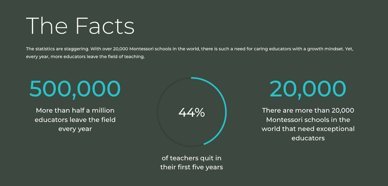
‘While there are strong training centers out there preparing teachers to take their first steps into the world of education, once they are through training, support can be minimal. Many new educators leave the profession before becoming seasoned professionals. Every challenge, even one of this magnitude, can be overcome when a community of lifelong learners comes together to share successful structures and strategies. Grounded in more than 60 years of experience at Greenspring Montessori School and with a rich network of leaders in the field, we have created the Greenspring Center for Lifelong Learning. Our initiatives focus on creating educational opportunities to elevate and support the vital work of educators, leaders, and schools.’
Tools for Teachers
Public Montessori in Action
PMAI offer a range of ‘Free Tools for Montessori Practitioners.’
The National Centre for Montessori in the Public Sector
Have a Classroom Assessment Rubric and also created the Developmental Environment Rating Scale: “DERS is a classroom observation and coaching tool that measures environmental and behavioral qualities proven to support executive functions, linguistic and cultural fluency, and social-emotional development in children.”
Montessori Educational Programs International
MEPI have a range of useful forms, including ‘Demonstration and Inventory Checklists’.
The Montessori Public Policy Initiative
MPPI offer a variety of tools, links and research.
Maitri Learning
Julia Volkman has a thought-provoking Pedagogy Blog.
Kidsgardening.org
Offer curriculum ideas, classroom projects, and more, that will help connect students - and teachers - to the earth.
Montessori Answers
Answers for a wide selection of questions about the Montessori approach, from an experienced AMS graduate. Includes very useful book selections and links to Montessori organisations.
Assorted Useful Resources
Dr. Angeline Lillard
Author of ‘Montessori: The Science behind the Genius’, she “presents Montessori’s theoretical principles, the science research that has followed them, and how they are implemented in a Montessori classroom.” Lots of interesting articles.
Atalante Montessori
A website devoted to collecting historical records related to Maria Montessori, “divided into five sections: texts, images, historical journals, list of headwords, and an international bibliography.” The ‘Historical journals’ section “collects files of journals directed and/
Caroline Bowen
‘The website offers balanced, theoretically sound, and wherever possible evidence-based guidance on the assessment and treatment of communication difficulties. The aim is simple: make trustworthy information genuinely useful to the people who need it.’ The resources section contains a heap of Useful Links, a Glossary, Bibliography and Directory, as well as Worksheets and Word Lists.
The Center for Montessori Studies
CMS created the Montessori Glossary Community Project, “A collaborative project to co-create an open-access, community-driven glossary of Montessori concepts, grounded in knowledge equity and practices of care.”
The Montessori Notebook
“The cosiest place to learn everything about Montessori at home. Easy-to-follow, simple steps for busy families like you. Plus, in-depth explorations of Montessori theory to enrich your practice. Whether you are brand new to Montessori or want to go deeper, you will come away with practical ideas you can try today.”
Aid to Life (AMI)
‘Offers clear, simple, straightforward parenting advice for the child between birth and three.’
Research
Montessori Public Works
There’s been a great deal of research into the efficacy of the Montessori Approach, and a useful starting point is MPW’s ‘Research-Based Evidence on the Effectiveness of Montessori,’ a 6-page collection of some of the most interesting/
The National Centre for Montessori in the Public Sector
Compiled some ‘Recent Research on Montessori Outcomes’ and have more articles, guidelines and webinars here.
Paula Lillard Preschlack
For anyone who wants to take a deep dive into the research, ‘Paula’s Research Guide’ does exactly that.
AMI
‘Our Global Research Group established AMI Research Threads to curate, highlight and comment upon the increasingly rich and diverse body of research into the Montessori approach. We will publish insights from researchers around the world as well as providing thought-provoking articles from AMI trainers and the worldwide research community to stimulate discussion and engagement. This compelling, accessible and unique combination provides a vital resource for anyone looking to understand how research informs a deeper understanding of the effectiveness and benefits of Maria Montessori’s educational philosophy.’