Montessori nurtures curiosity, independence, and individual pacing, while a Scope and Sequence provides structure and measurable progress, serving as a compass rather than a timetable, used to inform observation, not to dictate lessons. Replacing uniform tests with portfolio assessment, observation records and work samples that map each child’s progress to the scope and sequence proves compliance while preserving intrinsic motivation. By using Montessori as the method and scope and sequence as the framework, the Montessori environment remains the living heart of the room, and external benchmarks are met organically, without sacrificing the child’s freedom to learn. Balancing a Montessori curriculum and a traditional Scope and Sequence comes down to a simple shift in perspective: treat the scope and sequence as the destination and Montessori as the pathway to get there.
Inevitably, there is a great deal of overlap between the Montessori Curriculum and the Scope and Sequence, and the resources in this section deal both with the pathway, which is largely focused on Presentations, etc.- and the destination, where the focus is on developmental milestones, benchmarks, etc.
The Montessori Foundation
‘The new (2012) expanded and updated Montessori Curriculum Scope and Sequence […] is a practical tool to help manage curriculum planning, implementation, and recording in the Montessori classroom from birth to age 12. From our interaction with hundreds of Montessori schools, as consultants and teacher trainers for over more than thirty years, we have discovered that many Montessori schools do not have (or follow) a clear curriculum policy, nor do they have a formal curriculum Scope and Sequence guide. Administrators often indicate that their teachers’ albums serve as their guides.
In today’s world, it is increasingly important to have a formal written guide to serve as a common frame of reference for each classroom, especially from one age level to the next. While our Montessori lesson albums are invaluable tools, they are not what is truly meant by curriculum guides, nor do they provide a coherent Scope and Sequence that is clearly understood by everyone, particularly those without formal Montessori training.
The Montessori Foundation’s Scope and Sequence is the result of many years of painstaking analysis of the Montessori tradition to evaluate the age ranges at which we believe Montessori children should commonly reach major milestones and develop a language that is performance oriented and understood by traditional educators.”
Interview with Tim Seldin and Anita Amos from The Montessori Foundation on the Montessori Curriculum.
‘The curriculum can be thought of as having two aspects:
- The school’s basic expectations for what will be first introduced, worked on, or reviewed and targeted for mastery by 85 to 90 percent of all students at each age/grade level.
- The lessons that arise out of the children’s natural curiosity. While we follow a planned syllabus to give us cohesion and structure, we should never be satisfied with a year spent giving students set lessons from a prescribed syllabus. By providing children with all sorts of books, pictures, specimens, and artifacts, we can almost guarantee that we will encourage their curiosity and expand their scope of learning. By this, we mean to suggest that, instead of moving through the set curriculum more quickly, we allow children to explore additional related topics that capture their interest.’
South African Montessori Association
‘The Montessori Curriculum brings together in one document the educational goals and curriculum content applied in Montessori schools to support the development of infants, children and young people from birth to adulthood. This is an international curriculum shared by Montessori schools throughout the world. The curriculum is introduced with an overview of the pedagogical principles that guide practice in Montessori schools, principles that emerged from the pioneering research and insights of Dr Maria Montessori.
The Montessori curriculum presented in this document provides infants and young children with everyday social skills and accomplishments, trains sensory perception and movement systematically, and provides a strong foundation in literacy and numeracy. […] This document is only one element of the comprehensive, integrated approach that is Montessori education. For the curriculum outlined in this document to be implemented in a way that achieves the full potential of the Montessori approach, it must be supported, not only by the preparation of learning environments to meet detailed Montessori specifications, but also expert presentation of the activities and resources detailed in this document.”
The same organisation also offers the AMI Montessori Curriculum 6 - 12PDF
Sharon Caldwell
Includes a useful list of references.
Montessori Australia
‘The scope and sequence of the Montessori Children’s House curriculum is embodied in the sets of materials displayed on open shelves at the children’s level in the Children’s House and in the sequence in which these materials are typically presented to the children.’
The National Center for Montessori in the Public Sector
While Montessori education is traditionally assessed through developmental progress, specialized frameworks like the NCMPS Montessori Curriculum to Standards Alignment (MCSA) provide a comprehensive alignment between Montessori curriculum and nationally recognized standards, bridging Montessori albums with modern educational benchmarks, ensuring that exploratory, self-directed learning covers required academic competencies. They’ve produced a video on this topic: Introduction to the Montessori Curriculum to Standards Alignment
This NCMPS document outlines a framework for integrating Montessori education into public school systems and accountability structures, covering three main areas:
The Problem with Alignments
Highlights the structural mismatch between conventional education (which maps backward from grade-level standards) and Montessori education (which maps forward based on multi-year developmental stages).
A Comprehensive System
Proposes a model that balances standard educational metrics (like math and literacy) with core Montessori developmental goals, such as executive functions and social-emotional skills.
Examples and Tools
Provides practical examples of work-in-progress tools, including crosswalks that link Montessori activities directly to Common Core State Standards and a skills inventory for tracking student development.
The Maria Montessori Training Organisation/The Maria Montessori Institute
‘The curriculum in this document refers to the planned activities organised in order to promote learning, personal growth and development (the Intent). It includes not only the formal requirements of the Montessori Programme, but also the additional educational activities that the school organises in order to extend the experience of the children. The Montessori Programme is value based (the implementation) and therefore also encompasses an ‘implicit’ programme which derives from the way the children are treated, the way they are expected to behave with one another and other adults and the way they interact with their environment. We aim to teach children how to grow into positive, responsible people, who can work and co-operate with others while developing knowledge and skills, so that they achieve their true potential (the impact.)’
Montessori School of Lake Forest
‘A Scope and Sequence is a practical tool to help manage curriculum planning, implementation, and recording in the Montessori classroom. The Montessori community has developed these guides as invaluable tools to evaluate the age ranges at which we believe Montessori children should commonly reach major milestones and develop a language that is performance oriented and understood by parents and described in conventional educational terms.
The word curriculum is used to mean a number of different things. It is important to note that the Scope and Sequence, along with the lesson plans, observation, lesson tracking, assessments, and reporting methods that support it, are all components of a complete educational curriculum at MSLF. Although Maria Montessori had a complex vision of curriculum, she never compiled a single, comprehensive, practical curriculum statement that would be recognized as such in today’s educational context. There was a good reason for this - she intended that the teacher be responsive to the developmental and individual needs of each child, rather than strictly follow a syllabus of work.
The Montessori teacher is expected to understand both the developmental needs and abilities of the children in her care, as well as a broad range of content, along with the methodology necessary to present the appropriate materials or lessons to the children. The exact content was intended to be organic, flexible and adaptable to local conditions.’
Bloomington Montessori
‘The Montessori curriculum covers a breadth of information, in three-year multi-age cycles. We are not standards-based. We meet each child where they are, communicating with students' teams around goals and progress. The BMS Curriculum Guides (full school or divided by age group) are meant to communicate general goals for each classroom level (Early Childhood, Lower Elementary, and Upper Elementary) and overview the curriculum content for families. Some children will exceed these goals. Some children may not master all of these goals during their time in the classroom, even with extra support.
The vital focus is communication around expectations, progress, challenges, and achievements with families, all members of a child's teaching team, other involved professionals, and transitioning partners. In progress reports (sent quarterly), families will not see grades; elementary work is given notes for revision, not scores. Instead, families see a child's current level of mastery within a concept (from exceeding goals to needing extra support), as well as a narrative written by the teacher regarding observations of the child's current stage of development and progress toward learner outcomes. The links below will take you to documents offering detailed overviews of the BMS curriculum.PDF(3 - 12)PDF(3 - 6)PDF(6 - 9)PDF(9 - 12)
Rationale
From 2018 to 2020, Bloomington Montessori School worked with Grow Wise Consulting to develop school-wide benchmarks related to our learner outcomes.
The goals of this project included:
- clear communication of learner outcomes to parents
- tools to communicate effectively between teachers and other educational professionals regarding student expectations and progress
- development of benchmarks that authentically reflect Montessori philosophy and BMS’s holistic learner outcomes
- to aid in the effective collection of data at the student, classroom, and school levels for the purpose of informing instruction and to ensure accountability
- to help ensure consistency between classrooms and smooth transitions between program levels within the school
- to create consensus around goals for typical students and help facilitate discussions around implementation of student services for those who need extra support.
We wanted to reflect holistic benchmarks that represented application opportunities instead of isolated skills, and that honoured the complete development of a child and not only academics. Data is collected to help us assess and track benchmark progress. Data sources in a Montessori environment include:
- student work (projects, research, work journals, portfolios)
- observation
- teacher records
- cumulative student files
- informal assessments
- standardized tests (annual for grades 3-6)
It is important to note that these benchmarks are written to represent the classroom goals for a “typical” child in their third year of each program level. It is not cause for alarm if a child is still working on a few of the benchmarks at the end of the three-year cycle. It simply informs the next teacher regarding where to focus learning. However, if a child is struggling to demonstrate competency with a significant number of benchmarks, this may be a reason for teachers and parents to begin discussions about the need for additional classroom supports, an Accommodation Plan, or Individualized Service Plan (see Student Services in the BMS Parent Handbook). Please remember that continual teamwork and communication is the best support for the success of any student. Our curriculum can be discussed as integration of both skill-based lessons and experiential lessons.
Skill-based lessons are those, typically in the areas of language and math, that must be mastered before the next lessons on a given concept can be taught. Beginning skills are foundational to later skills. It is essential that children are provided extra support and time to master these concepts, and they are most often taught at the individual or small-group level. These skill-based lessons are assessed throughout a child’s time in the classroom and data is used to inform future teaching.
Additionally, Montessori believed that we should “give children the Universe”, and we have an expansive curriculum of integrated cultural (science, geography, and history) and social (interpersonal, intrapersonal, social responsibility) lessons. These lessons are laid out in a spiral, building deeper and deeper layers of knowledge each year throughout the three-year classroom cycles. We present much more information on every topic each year than we expect children to retain long term. Instead, the goal is to spark their interest and introduce them to the immenseness of the Universe and the limitless possibilities of learning. Children then choose passion projects to dive deeper into the areas that most spark their interest. Social skills listed are introduced with explicit lessons and guided practice, though we recognize mastery of these skills is lifelong work for all of us.’
The Montessori Teachers Collective
Have an overview of the Montessori Curriculum from ages 3 to 12: ‘The MTC makes no claims as to the absolute authority of this document or its content. It is simply the result of some regular folks' dedicated research, interpretation, and experiences of the Montessori Method.’
Simone Davies and Junnifa Uzodike
Interest-led activity guide, exploring topics including insects, rainbows, space, art, music, handwork, nature, writing, inventions, and robotics. Each activity suggests related developmental areas such as science, language, motor skills, social development and they range across all areas of the curriculum.
Organising the Curriculum
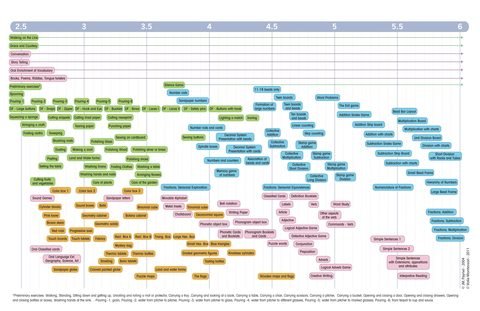
The presentations are just one aspect of the curriculum, but an important part and a complex part, so it is useful to organise them. The materials on the shelves are organised by area (Sensorial, Language, etc.) but also by sense (Tactile, Kinesthetic) or topic (Reading, Writing), and they are also arranged from simple to complex, building on what has come before. A simple but effective way to organise the entirety of the presentations is by time, and I’ve found that dividing them into six distinct blocks allows for flexibility, whilst ensuring I can spot any gaps that I may have missed. The following posts delve into this topic, and the graphic to the right illustrates it.
Our Montessori Story
“As I mentioned recently, my oldest daughter is ready for some new challenges in the classroom. I pulled out a bunch of new math works but have felt uncertain about the sequence in which I should present them. That has led me back to the beginning, taking a fresh look at the Sequence of Montessori Work from David Gettman's book (which is very similar to other "scope and sequence" lists made available by multiple different authors and sources). I thought other homeschooling Montessorians might find it useful, as well. You can download a Word version here. Otherwise, I've typed up the sequence below.”
Montessori Nuggets Word
‘This is just one of many possible ways to organize the primary Montessori experiences (primary being ages 2.5-6 years of age, or the developmental equivalent). Eight intervals across the 3.5-4 years of Primary Montessori (a child could potentially be in primary from the age of 2.5 until almost 6.5). […] As defined here, an interval is approximately a 6-month span of time when a child begins at 2 1/2 years of age. If a child starts later, then we begin with the first interval and proceed at the child's pace (which is what we do anyway - it just means that it might be faster; or it is ok if a child does take a full 6 months).’
Created an extremely detailed list of every presentation, separated into 6-month intervals.
Rhyme and Reason MontessoriPDF
‘Scope and Sequence - In the Montessori Elementary program children learn from all areas of a classical curriculum in a mixed age classroom. The entire six-year program is taught by a highly trained teacher who has specialized training in all subject areas. In broad strokes, this is the elementary scope and sequence used at Rhyme and Reason Academy. A student who attends all six years of the elementary program can be expected to have mastered all the basic skills that would be taught in conventional programs and have been introduced an even greater breadth of material than at a conventional school.’
Montessori School of Fort Myers
‘We follow the Montessori Foundation's scope and sequence. While the full version of the documents are licensed, an overview for each age group is available here.’
Wilmington Montessori School
‘The documents on this page will guide you as you learn more about the path that children generally follow when gaining reading, writing and mathematical skills. The continua below are used by WMS teachers to monitor student progress. They contain a list of descriptors that demonstrate a student’s academic behaviours. The skills/descriptors in the continuum increase in difficulty or demand as they move through developmental levels. As the student masters the majority of skills on a given list, he or she progresses naturally through levels that are contained within the guide.
You may also note that between levels (from 6-9 to 9-12 and then to middle school) your child may not move as quickly or the demands may increase, slowing his or her movement through the continuum levels. This is expected as children move beyond learning to read and write to incorporating those skills more fully into all of their academic work.’
Greene Towne Montessori SchoolPDF(6 months to 6 years)
Anchorage Montessori SchoolPDF(18 months to 12)
Mountaintop MontessoriPDF
This school has prepared an extremely detailed (121 pages) document focused solely on the curriculum.
Near North Montessori SchoolPDF
Orange Seeds MontessoriPDF
Montessori Primary CurriculumPDF
Magnolia Montessori SchoolPrimaryLower ElementaryUpper Elementary
Alive MontessoriPDF
Montessori Academy of LondonPDF
Houston Peace AcademyPDF(2.5 to 6)
Amherst Montessori SchoolPDF(Elementary)
Alexander Graham Bell MontessoriPDF(Elementary)Montessori Curriculum
ABC MontessoriPDF
Richmond Montessori SchoolPDF
Montessori of the Mahoning ValleyPDF
Robert Frost Charter School
Alcuin Montessori
World Forum Foundation
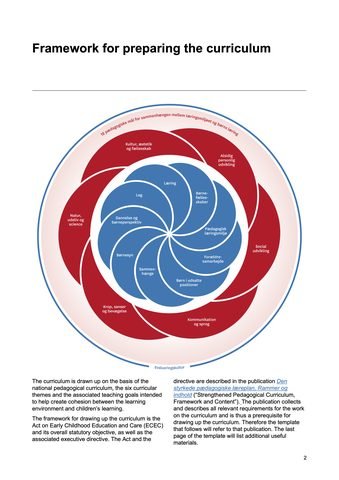
International School of Billund (Denmark)PDF
Not a Montessori school, but they have a very interesting and well-designed 3-6 curriculum, focused on play:
‘In Denmark, there is a strong cultural belief that Kindergarten should be a time for learning through play. At ISB we combine the belief in play with the transdisciplinary framework of the IB’s Primary Years Programme.’
Montessori Tube Academy
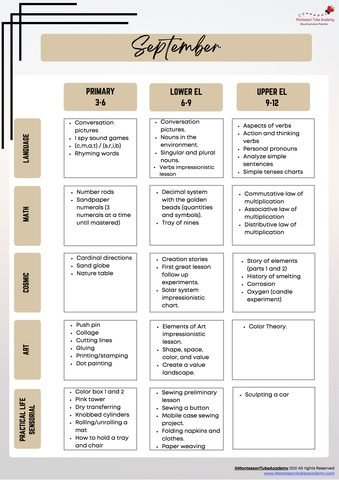
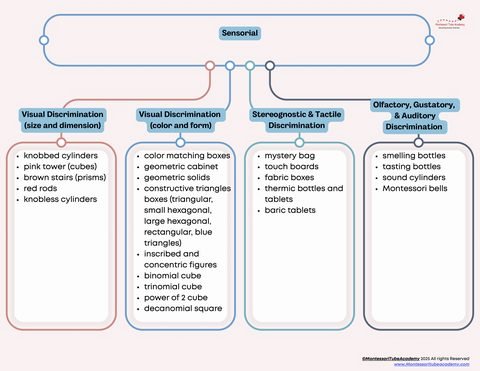
Have free printables that can be accessed by subscribing to their newsletter. Resources include a Scope and Sequence for each year (first month shown below) and beautifully designed and organised Curriculum Maps for 6 to 12 and 3 to 6, the first two pages of which look like this:

The Spiral Curriculum
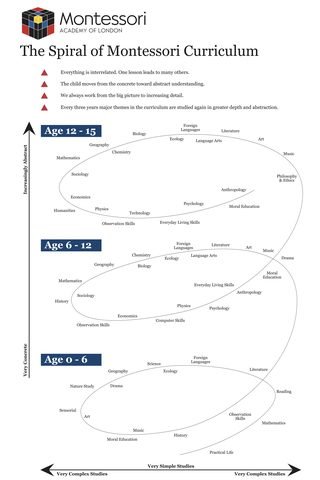
The Montessori spiral curriculum is an educational approach where fundamental concepts are introduced early through concrete, hands-on materials and progressively revisited with greater depth, complexity, and abstraction as the child matures. Rather than teaching subjects in isolated, one-time blocks, this framework allows a child to continuously cycle back to foundational ideas, building directly on prior knowledge, ensuring that learning remains interconnected across disciplines and allowing foundational sensory experiences in early childhood to naturally evolve into advanced reasoning and academic mastery in later years. For example, a child of 4 who handles cubes and prisms using the Geometric Solids or 1000-bead cubes in Mathematics will return to the same concepts at 7 or 8 to calculate area, eventually reaching total abstraction and algebraic proofs by 10 or 11.
This continuous progression is powered by multi-age classrooms, where students cycle through roles as beginners, practitioners, and mentors of the same material, and by anchoring every complex, abstract idea in a tangible, sensorial memory from years prior, the Montessori spiral eliminates the need for artificial review cycles or rote memorization, weaving History, Science, Math, and Language into an interconnected, lifelong architecture of learning, ensuring that knowledge is deeply constructed rather than temporarily memorized for a test.
The Montessori Foundation
Jerome Bruner
American Montessori Society
Details the historical connection between Maria Montessori's work and Jerome Bruner's theory, explaining how Montessori materials are naturally designed to be revisited with increasing complexity.
Elizabeth Lapon
This qualitative study (2020) explicitly identifies the spiral curriculum as a core structural element of multi-age Montessori environments, detailing how the spiral framework allows concepts introduced in early childhood to be revisited with increasing academic and socio-emotional complexity during the adolescent years, serving as a buffer that builds resilience for traditional educational transitions.
Irish National Council for Curriculum and Assessment
This research report evaluates how alternative models -including the Montessori Method- utilize constructivist pathways, highlighting how a child-led spiral curriculum aligns with contemporary neurocognitive science and bioecological models of development by revisiting foundational concepts across progressive physical domains.
Research
By the University Of Plymouth and Montessori Global Education
By Siti Jamaiyah, Noorazwa Binti, Ahmad Muhid, Ros Izzati, Binti Rosli, Romarzila Binti Omar, Izwan Mohamad.
By Deo Corrinne Payongayong.
From Alagappa University.