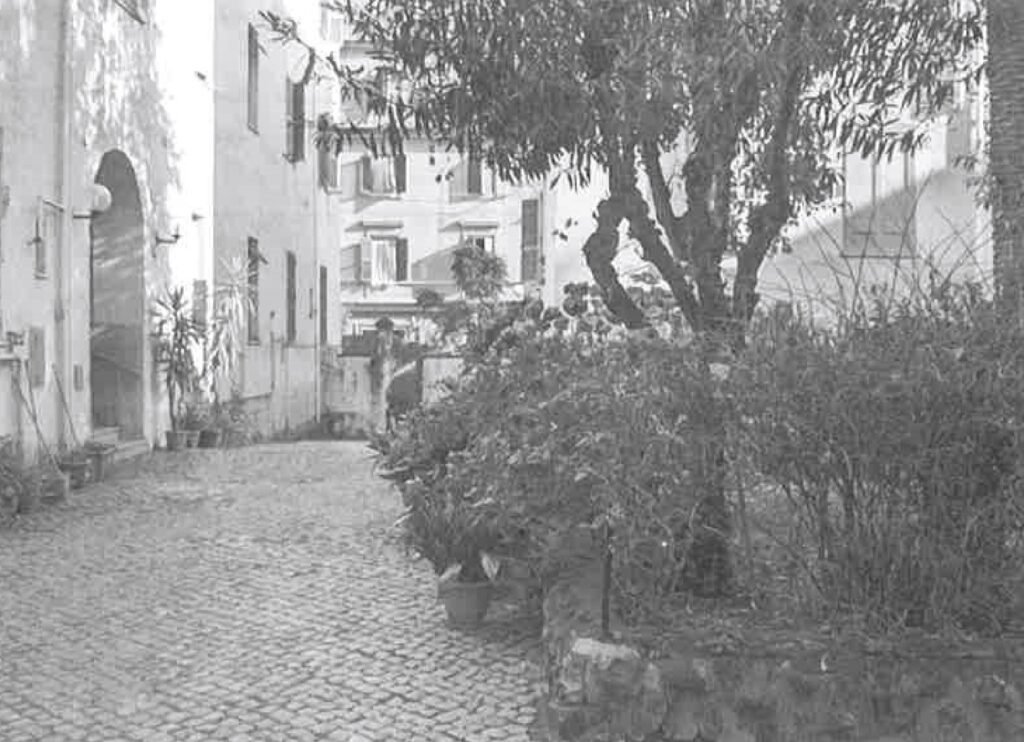
The Story of San Lorenzo
Introduction
Had it not been for Maria Montessori and Edoardo Talamo, Director General of the Istituto Romano dei Beni Stabili, we might never have celebrated one hundred years of the first Casa dei Bambini a few months ago in the San Lorenzo district of Rome.
Both had a vision; both were passionate and determined to realize their goals. Edoardo Talamo wanted affordable, decent housing for a forgotten part of Rome’s population. Maria Montessori wanted decent, and because of that, revolutionary education for the forgotten citizens: the children.
The story of San Lorenzo has been told many a time by Maria Montessori herself: it was included in the original edition of her book The Montessori Method. A search through the Maria Montessori archives produced an abbreviated version of “The Origin of San Lorenzo”, sketching how this district was exploited and rescued, paving the way for the establishment of the first Casa dei Bambini.
In the archives we also came across a letter by Edoardo Talamo who acknowledges the great success of the Case (a second Casa was opened as early as April 7, 1907) but shows his concern about the procedure concerning the numerous visitors that the Case are attracting. He argued that the Case were part of a larger body, and should therefore fall in line with the general regulations stipulated by the Istituto. A summary of his letter is featured.
And, to give you an idea of how the Istituto operated, a selection from the Rules and Regulations are reproduced here.
We thank Carolina Hussein for her translations of these historical documents.
The Quarter of San Lorenzo
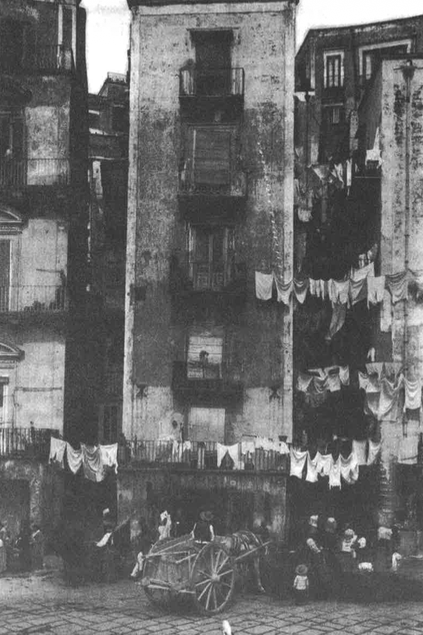
When the district of San Lorenzo was developed between 1884 and 1888, the intention was not to build a working-class quarter. During the building fever of that period, new constructions were not subject to social or hygienic guidelines. The only aim was to cover as many square metres of land as possible. The more space covered, the higher the subsidies obtained from banks and building societies, which were completely unaware of the imminent disasters. As a natural consequence, there was a total disregard for the houses under construction.
When the inevitable building crisis broke out around 1888–1890, the poorly constructed houses remained uninhabited for a long time. Then, as a shortage of housing arose, these apartments were gradually filled by tenants. And because those who had remained in possession of these buildings neither wanted to nor could add fresh capital to that already lost, the apartments—unhygienic and, even worse, reduced to temporary tenements—served as a shelter for the poorest class in Rome. The five, six or seven-roomed apartments were let at a very low rent to individuals who, because of the abundant space, took to the easy and profitable practice of subletting. Because of the deplorable condition of the buildings, this became a major source of immorality, usury and every kind of disgrace that no civilized country, out of self-preservation, should have tolerated.
However, as was to be expected, the quarter of San Lorenzo very soon aroused interest. The sad accounts of the inhabitants who had found shelter in this quarter—considered almost a ghetto, separated from the rest of the city—were repeated daily in the newspapers and drew the attention of philanthropists. So charities went to work with, as usual, few beneficial results, either because of a lack of means and orientation or because the aid was restricted to a limited number of people instead of providing for the entire community.
Three years ago [1904] the Istituto Romano dei Beni Stabili [Roman Real Estate Institute] was established. Its programme consisted of buying up city buildings, improving them, and increasing their value and administering them as a good father would.
The first buildings acquired included a large part of the quarter of San Lorenzo, where the Istituto today owns 58 houses covering a surface of about 30,000 square metres, containing, apart from the ground floor, 1600 apartments.
According to its programme, the Istituto, exactly as a good father would, felt it could not consider as a real and lucrative property this clutter of old, humble houses, which—because of the unhygienic and derelict state they were in—represented something that inevitably would decrease in value daily.
So it was decided that the buildings should be renovated according to modern standards, both from the point of view of construction and of hygiene and morals—because renovation would ensure a true, lasting property, while the hygienic and moral transformation would consolidate and guarantee income from these apartments, through the improved condition of the tenants.
A complete programme was developed which would allow the gradual attainment of this ideal, based on:
- the demolition of all those parts in every building that originally had been created not to make apartments but to write bills and absorb money. In other words, to tear down a large part of the central body of the buildings with the respective air and light shafts in order to create wide courtyards, thus giving air and light to all the rooms of the remaining part of the building which, blocked up by these useless constructions, had no value whatsoever;
- the addition of more staircases in order to divide the apartments, today uselessly and harmfully occupying five, six or seven rooms, into smaller ones with one, two or at the most three rooms with a kitchen and a toilet.
This means:
- reducing the crowds of people on the same stairway, thus decreasing the damage to the building brought about by so many people;
- abolishing the subletting, thus lessening the burden of the individual tenant on the one hand and increasing the income of the owner on the other.
It may seem strange but this is the truth. One can rent a six-roomed apartment in San Lorenzo for 40 lire a month. The tenant who sublets an entire room to the most fortunate people and a corner of a room to the less fortunate for 8 or 10 lire a month earns quite often 70 to 80 lire a month. Dividing six-roomed apartments into three one-roomed apartments with a kitchen obviously means that the income of the owner increases while avoiding the subletting which is so burdensome in all aspects to the neediest tenant.
(…) We have here today renovated buildings next to the original ones: the latter remind us of what once was, what unfortunately still is; the former show what skill and loving and intelligent interest can bring to what once was the most derelict quarter of Rome.
Once the environment had been improved, it was necessary according to the Istituto to educate and civilize their clients for the reasons already mentioned.
First the idea was suggested to give a reward to those tenants who kept their apartment in the best condition. This was a first important step, never before undertaken on a large scale by a building society in other Italian cities. This made the tenant feel responsible for the maintenance of his apartment and the entire building, with a moral advantage for him and a material one for the owner. The results were exceptional, as everyone can judge from a building nearby in Via dei Campani, made habitable about two years ago, which until now has not needed any special or ordinary maintenance, because the first, the true caretakers, were the tenants who put much care into the building in order to obtain the promised reward.
Encouraged by this successful experiment, the Istituto decided to take a second, much more important step: the opening of the first Casa dei Bambini.
Editorial note: l’Istituto Romano dei Beni Stabili has been translated in most of Dr Montessori’s books as The Roman Association of Good Works. This mistranslation may have occurred because of the word beni; however, beni stabili means real estate.
REPRODUCED HISTORICAL DOCUMENT · 1907
Rules & Regulations of the Case dei Bambini of the Istituto Romano dei Beni Stabili
Strict rules and regulations were drawn up to help enforce correct and proper conduct on the part of the tenants, children and staff—in a bid to ensure that the ideals for Social Reform and the “moral transformation” of the tenants could be attained. To give you a taste of some of the details upon which these rules touched, a selection has been made from the full set of Rules and Regulations.
From the General Regulations
The Case dei Bambini are an initiative of and have been established by the Istituto for the exclusive use of the tenants who live in the buildings; only the tenants can send their children between the ages of three and seven to the Casa.
A signed permission from the Director General is needed for a child to attend the school; this permission can only be given if both parents apply, handing in a birth certificate and a medical certificate issued on the day of application.
Once the child is admitted, the parents must observe all the rules of a hygienic, moral and disciplinary nature as stipulated in the General Regulations of the Case dei Bambini, put up in the hallway of the school.
If these rules fail to be observed, the child will be expelled from school: the Directress of the school can expel a child for the duration of two days. For a longer expulsion up to ten days the order will be given by the Inspectress General of the Case dei Bambini of the Istituto, who must always inform the Director General in writing, stating the duration of and the reasons for the expulsion.
Final expulsion is at the sole discretion of the Director General of the Istituto at the specific request of the teacher and the approval of the Inspectress General. Final expulsion applies to:
- children who prove to be incorrigible;
- children whose parents show no respect to the people in charge of the Case dei Bambini;
- children whose parents have in some respect neglected their duties towards the Istituto;
- and finally those children who stay away from school for longer than two weeks without a plausible reason.
- during the summer holidays from 1 August until 3 September;
- on Sundays;
- and on public holidays, which will be shown on a special notice board every year.
School hours are from 9 to 4 o’clock from September to 30 April and from 9 to 5 o’clock from 1 May until 31 July.
From Article II
The teachers must:
- when working with the children follow the regulations and the pedagogical and educational rules issued to them by the Inspectress General;
- always behave in the same way towards all the children put in their care, because they all are equally entitled to their care—equality and justice towards all being the foundation of every educational system;
- keep in touch as much as possible with the parents of their young students in order to help improve the environment by giving an example and advice; the school being the most important factor in this process of improvement;
- keep meticulously to the timetable; they are not allowed to leave the school without having obtained explicit permission, which must be requested of the Directors of the Istituto through the Inspectress General;
- register daily the presence or absence of the pupils;
- keep a diary in which every evening at closing time everything that is important to the progress and development of the organization, as well as the characteristics and capabilities of the young students, will briefly be recorded;
- report in writing to the Directors of the Istituto in case of a breach of the regulations by the students or their parents;
- present at the end of every two months a report on the progress of the school.
The teachers must always keep in mind the high civil duties entrusted to them; they will take care to behave with the utmost politeness, kindness and dignity both towards their own pupils and in their contact with the parents.
Twice a month, on every second and fourth Sunday at 10 o’clock, the Inspectress General and the teachers will gather for a meeting with the Directors of the Istituto. The aim of these meetings, chaired by the Director General and in his absence by the Inspectress General, is to:
- attend to the proper development of the various Case dei Bambini;
- imprint on them [the teachers] the unity of guidelines essential to the proper development of the organization;
- allow the teachers to express all the ideas and suggestions they find useful for the continuous improvement of the Case dei Bambini.
The caretakers’ duties are:
- to clean the school every day in such a way that it is in perfect order when school opens;
- to give the children, under the supervision of the teacher, all the care they may need during school hours;
- to keep meticulously to the timetable; they are not allowed to leave without the permission of the teacher in charge.
The teachers must supervise the exact execution of the duties entrusted to the caretakers. Any neglect of those duties must be reported to the Directors of the Istituto.
Summary of Signor Talamo’s Letter to Maria Montessori
The year and date are not entirely clear. The letter is dated 11/IX. This is probably November, 1909 as in 1910 the collaboration between Montessori and Talamo was to end. This letter may well have had some bearing on the “parting of the ways.”
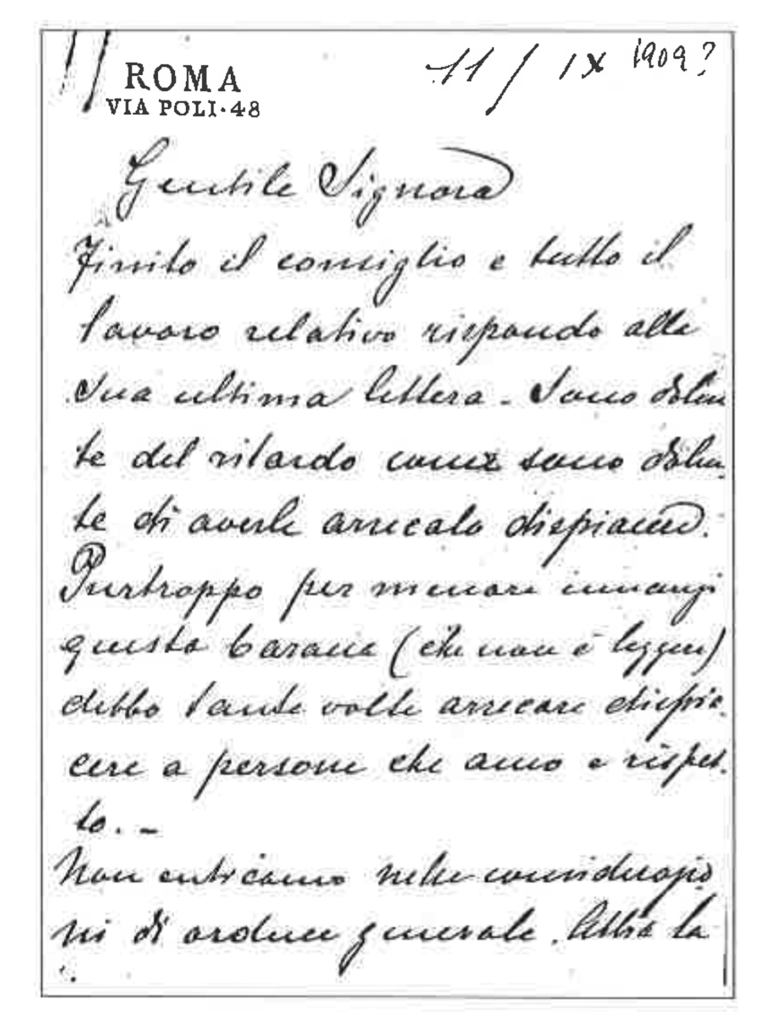
Dear Madam
Now the council is over and all the work connected with it is done, I can reply to your last letter. I regret being so late and regret having caused you displeasure. Unfortunately, to keep this organization going (which is not easy), I often must displease people I love and respect. Let us not enter into considerations of a general nature. Have the…
This ten-page letter of Edoardo Talamo, Director General of the Roman Real Estate Institute, to Dr Montessori reveals their disagreement about the status of the Case dei Bambini. Talamo complains, very politely, about an official visit of Barone and Baronessa Franchetti to the Case dei Bambini. He only found out about it afterwards, by accident. He asks Dr Montessori to put herself in his shoes. The Case dei Bambini, admirably led by Dr Montessori, are part of the Institute and have to remain so. However, there are other organizations forming part of the Institute which are in every respect exemplary, led by people who run a model organization.
Talamo does not want to compare the various organizations, as they are all different, but does not Dr Montessori think that it would be total anarchy if all these people would bring along every Tom, Dick and Harry to show off their particular organization without informing Talamo as head of the Institute? Again, the various organizations cannot be compared, but this inequality shows the “irregular” status of the Case dei Bambini, which needs to be repaired. The Case dei Bambini have had the opportunity to become known; now is the time to expand and give them solidity. The Institute, having invented them, can do this best. Let us not waste time on publicity, which the results will bring about naturally.
A person wanting to visit a Casa dei Bambini goes to the Institute and will get an invitation. Dr Montessori is then free to show him around and do what she wants. If a person in authority wants to pay a visit, Talamo must be informed, so that he can receive him and show him that the Institute does not merely provide the premises, but that the Casa dei Bambini is a complex, coordinated institution, the essence of modernity, which Talamo also wishes to impress on the Institute itself. It would seem strange if the Institute does not show an interest in important visitors, as the incident with the Franchettis would seem to indicate. There is no need for displeasure; he is certain that Dr Montessori will see it his way if she gives it some thought. He ends the letter by writing that he feels friendship, respect and admiration for her and that is why he had to speak so frankly.