The Montessori Materials
Montessori materials are meticulously crafted educational tools, designed to facilitate hands-on, experiential and self-directed learning, encouraging children to engage in exploration and discovery at their own pace, the aim being to nurture intrinsic motivation, independence, and a deep engagement with learning. As such, the materials -along with a trained adult, mixed-age groups and uninterrupted blocks of time- are one of the corner-stones of the Montessori approach to child development.

A display of materials in the house where Maria Montessori was born, now The Casa Montessori Chiaravalle museum, in Ancona, Italy.
- Montessori, Maria Montessori Speaks to Parents, p. 20.
Montessori materials have their roots in constructivism, the theory that learning is an active process whereby children construct their understanding and knowledge of the world through prior knowledge, contextual and active-learning, social interactions and reflection. This results in knowledge that is not a copy of what the child experiences, but a reconstruction of it. The ideas at the heart of constructivism can be traced back to ancient history –“I hear and I forget. I see and I remember. I do and I understand,” is attributed to Confucius, who lived 2500 years ago- but their practical application really began to take hold in the mid 18th century
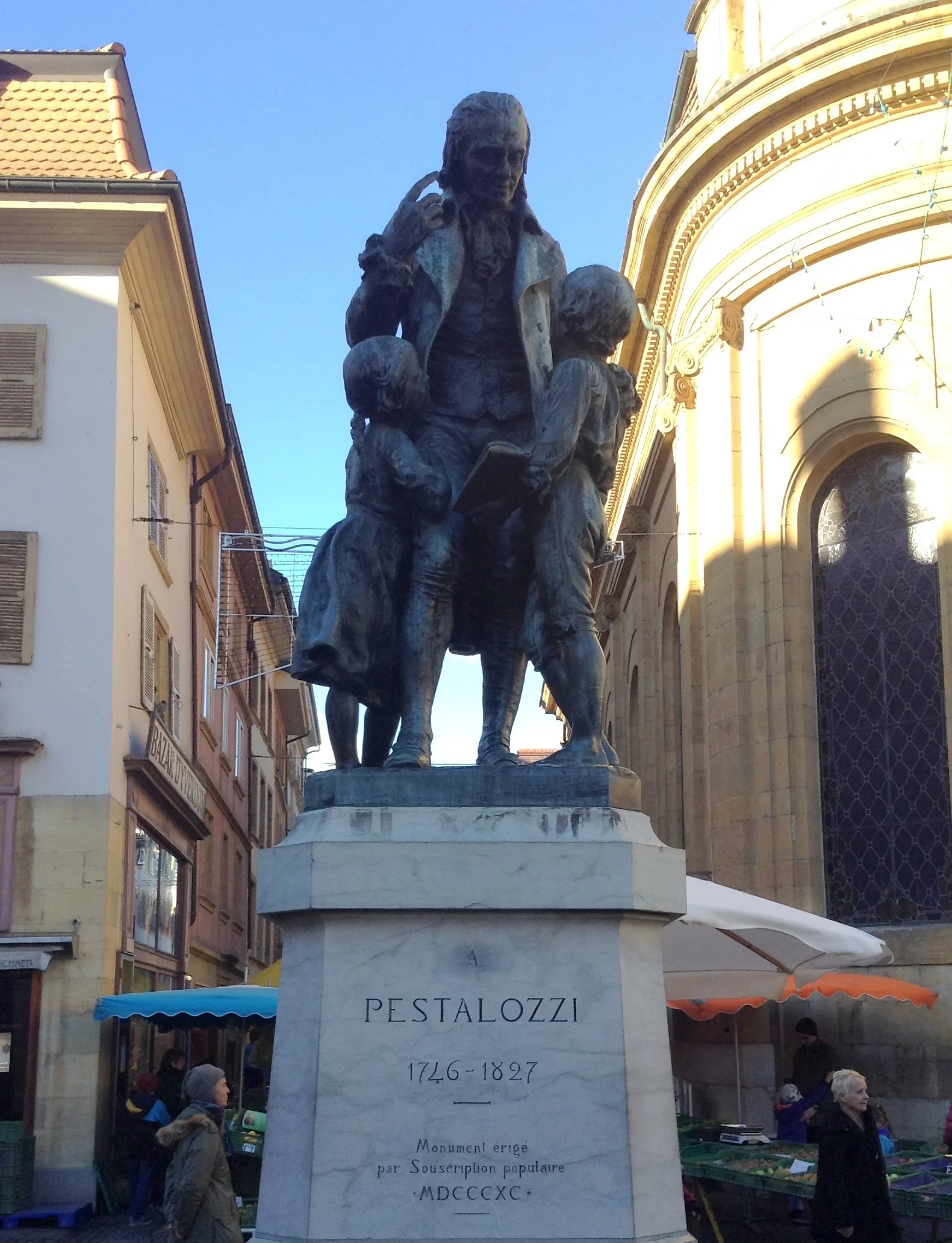
Johann Heinrich Pestalozzi (1746–1827), a Swiss educator known as the ‘Father of Pedagogy’, was one of the first proto-constructivists. He believed that that children learn through their senses, by being active and handling objects (“head, heart, and hand”) and that they should be taught in a way that mimics how they experience the world, constructing new information upon familiar. From 1805 until 1825 he was director of a school at Yverdon (now Yverdon-les-Bains) where I took this photo in 2014.
Friedrich Froebel (1782–1852) was a German pedagogue who visited Pestalozzi’s school in Yverdon, Switzerland, where he spent two years studying and teaching. Originator of the concept of the kindergarten, Froebel believed in the efficacy of using materials (or ‘gifts’ as he referred to them) as a means for children to self-educate.
The physicians and educators Jean Itard (1775-1835), and his student Édouard Séguin (1812-1880) developed a pedagogy that focused on engaging the whole child -physically, emotionally, socially and intellectually- and grounded in the idea that education should be tailored to the individual needs of the child.
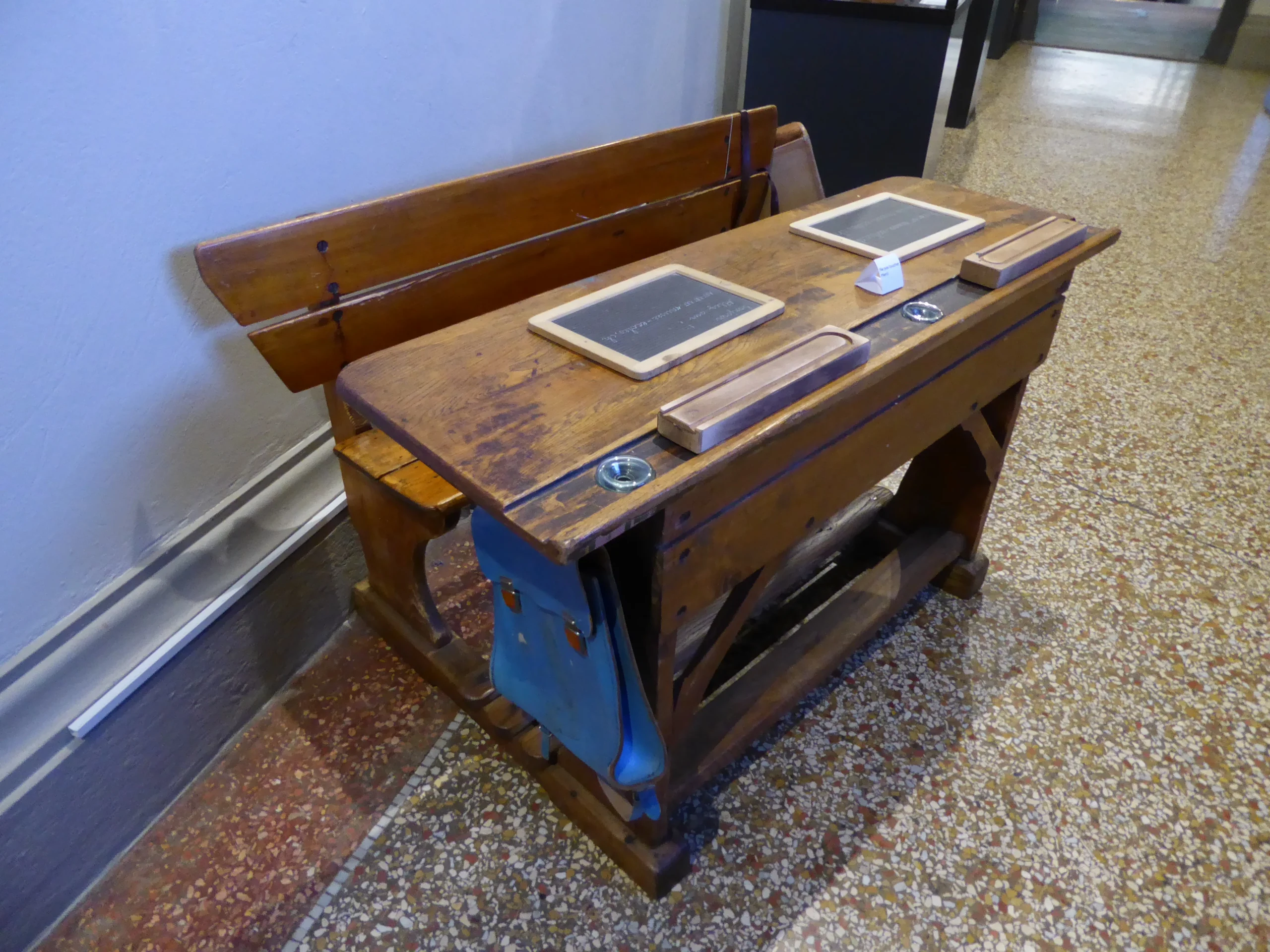

Where traditional methods of education forced children to sit immobile at rows of desks, memorizing endless streams of meaningless facts and figures, Itard and Séguin emphasized the use of hands-on materials that fully engage a child’s senses, thereby freeing them to self-educate. The didactic materials that Itard first designed for this purpose are a collection of tools and exercises intended to stimulate the senses, improve motor coordination, and foster independence:
- Rita Kramer, ‘Maria Montessori: A Biography’, p. 88. (1976)
This was the intellectual tradition, and these were the thinkers who helped to clarify Montessori’s thoughts about childhood education. After graduating from the University of Rome with a medical diploma, Dr. Montessori visited the hospital where Séguin had worked and read the books that Itard and Seguin had written on how to treat special children, later translating some of them into Italian. During the same period, she was working in psychiatric clinics in Rome, studying children with learning difficulties. In 1900 she was appointed co-director of the Scuola Magistrale Ortofrenica, an institute for training teachers to work with children with learning difficulties.
- Rita Kramer, ‘Maria Montessori: A Biography’, p.116. (1976)
After the results achieved by the children in the attached classroom received widespread acclaim, she referenced the help that Itard and Seguin had provided:
- Maria Montessori, The Montessori Method, p. 79.
This was the genesis of the Montessori materials:
- Rita Kramer, ‘Maria Montessori: A Biography’, p.122. (1976) [ *3. ‘The Montessori Method’, p. 261 ]
In 1902 she again enrolled at her alma mater, studying philosophy and psychology, and spent the next five years lecturing and writing on pedagogy. In 1904 she graduated and was appointed to lecture in the Pedagogic School at the university, one of the two teacher-training colleges for women in Italy, and two years later she received the offer that was to change her life:
- Maria Montessori, The Montessori Method, p. 85. (1912)
Maria Montessori was 37 years of age, she’d spent a decade educating herself in pedagogy, was familiar with the educational approach of Itard and Séguin, as well as the materials they’d developed from their theoretical underpinnings, and she had amassed two years of experience in using those materials with special-needs children.
- E.M. Standing, Maria Montessori - Her Life and Work, p.11. (1957)
Writing a decade later, Montessori again acknowledged her debt to Itard and Séguin and placed her approach firmly in the constructivist tradition:
Maria Montessori, The Montessori Method. (1912)
On 6 January 1907 the first Montessori school opened at Via dei Marsi, 58, in San Lorenzo, a slum neighbourhood close by Roma Termini, the main train station in the city. Montessori appointed Candida Nuccitelli -the building porter’s daughter- as the teacher (the first Montessori guide) and entrusted her with a simple responsibility:
For 10 hours a day, while Ms. Nuccitelli took care of the children, Montessori sat and observed:
- Maria Montessori, Maria Montessori Speaks to Parents, p. 18. [2017]
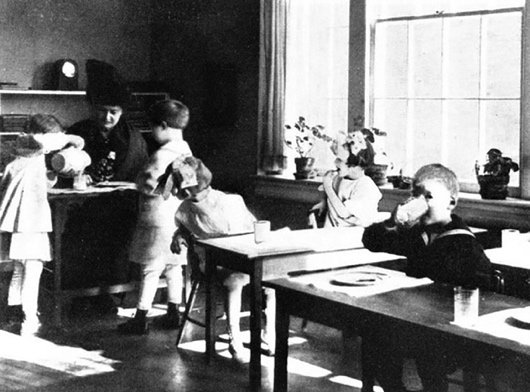
She sits at her desk, watching the children, recording their actions and reactions, then acts upon her observations, adapting some materials, discarding others, endlessly refining and experimenting:
- Maria Montessori, The Discovery of the Child, p. 101.
Purpose of the Materials
The principal aim of the Montessori materials is to attract the child and stimulate them into activity, because the child has the means to self-educate through deep and repeated engagement with the materials. Designed to be used after a short introduction, the materials thereby support the child in their striving for independence and act as a springboard to investigation and discovery.
- Maria Montessori, The Secret of Childhood, p. 121.
Characteristics of the Materials
Children, especially from ages 3 to 6, are concrete learners, their minds not yet ready to grasp purely abstract ideas through words or symbols alone, so the materials are concrete objects that represent an abstract rule or principle, making a complex, intangible concept visible, touchable, and understandable for a child.
- Maria Montessori, The 1946 London lectures, p. 70. [2013]
Characteristics of the Materials 2 – Appealing, child-sized and accessible.
- Maria Montessori, Some Words of Advice to Teachers, AMI Communications, p. 4, 14 (1995).
In the majority of the Montessori schools I’ve visited, the lids are on the boxes so the beautiful materials are hidden from the child’s view. This has always puzzled me, because it doesn’t matter how appealing the materials are if the children can’t see them.
When I’ve asked why they aren’t opened, the standard response is “to keep the dust out”, an odd justification in a room full of children who take great pleasure in dusting and cleaning.
In the majority of the Montessori schools I’ve visited, the lids are on the boxes so the beautiful materials are hidden from the child’s view. This has always puzzled me, because it doesn’t matter how appealing the materials are if the children can’t see them.
When I’ve asked why they aren’t opened, the standard response is “to keep the dust out”, an odd justification in a room full of children who take great pleasure in dusting and cleaning.
The materials must serve a purpose, but they also must be real to the child i.e., natural to their environment and culturally appropriate, e.g., transferring objects with chopsticks is commonly seen on the Practical Life shelves in many Asian countries, but might look out of place in European schools. The materials also must be whole, so that all of the individual parts are available and functional (i.e., each Cylinder Block must contain 10 cylinders), and complete so that if part of a set, the entire set must be available (i.e., all four Cylinder Blocks must be on the shelf).
- Aristotle (384 - 322 BCE)
Inviting kinesthetic engagement and encouraging active, hands-on learning is an essential aspect of the materials. A child chooses a piece of material and in the course of carrying, pouring, stacking, tying, opening and closing it they refine their sense and self-educate.
- Maria Montessori, The Discovery of the Child, p. 150.
This process could easily lead to disorder, but the Cycle of Activity brings structure to the child’s activities, whilst simultaneously facilitating their independence. There are three stages to the cycle:
- Choose a material.
- Manipulate it.
- Return it to the shelf.
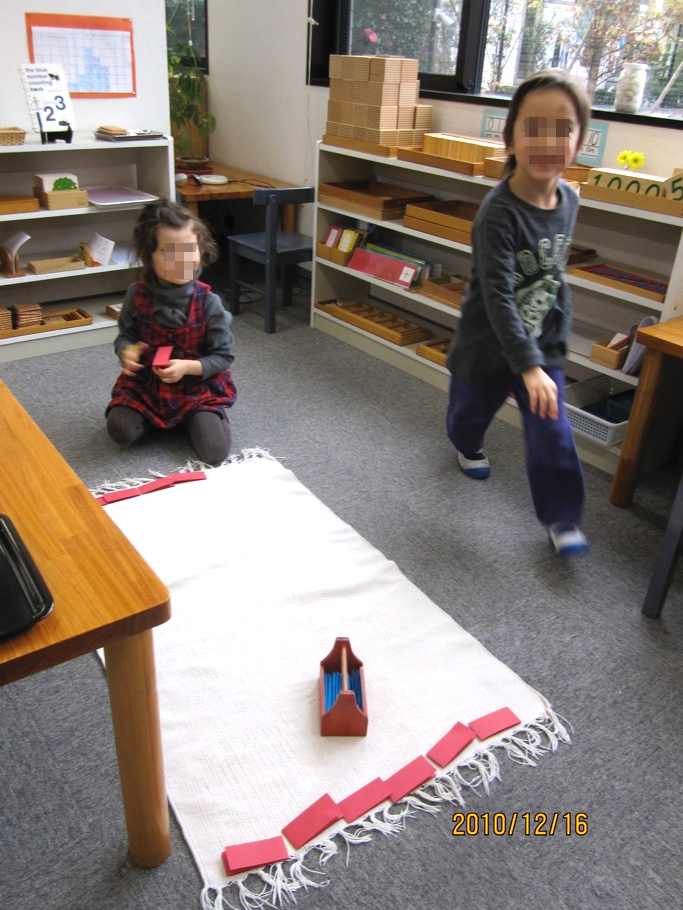
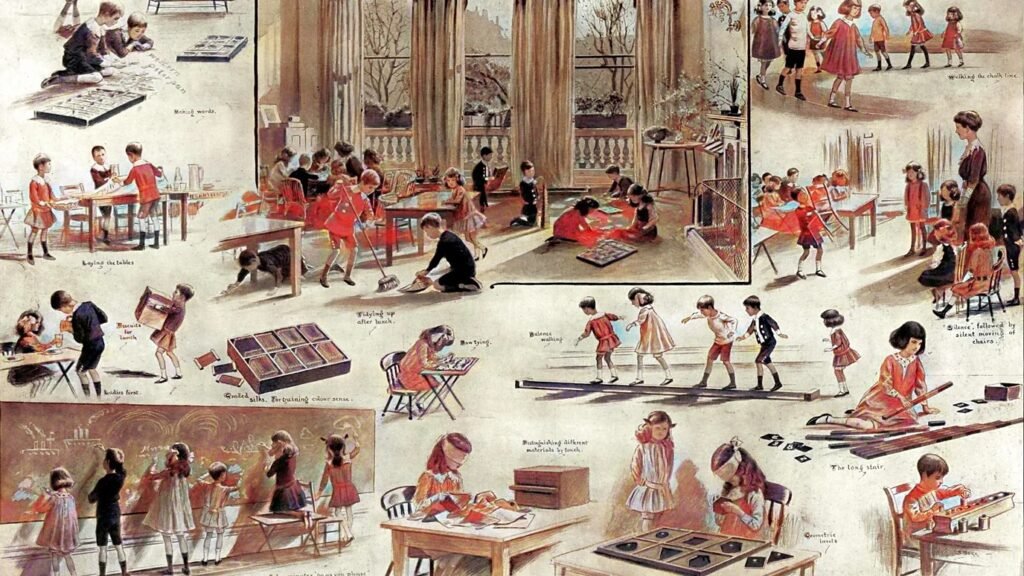
In a Montessori environment there is often a low hum of activity, with a constant flow of children moving about the room. Some children will be deciding which material to choose (sometimes with help from the guide), others might be engaging with a material (either on a table or a mat), and some will be returning a material to the place on the shelf from whence they took it.
- Maria Montessori, Maria Montessori Speaks to Parents, p. 34. [2017]
In this photo the children are using Action Cards, a reading activity that requires them to act out various verbs: hop, sit, hum, or -in this instance- run. —————->
Sensory-based education has a long history is the western philosophical tradition.
‘Nihil est in intellectu quod non sit prius in sensu’ is a Latin phrase that translates to,
‘There is nothing in the intellect that didn´t first pass through the senses’.
This is the Peripatetic axiom and is a guiding principle of empiricism. Thomas Aquinas, an Italian theologian, adopted this principle from the Peripatetic school of Greek philosophy, and other philosophers who accepted the principle in some form include Locke, Berkeley, and Hume. Itard and Séguin belong in this tradition, as does Maria Montessori. The axiom suggests that sensory input is the foundation of human experience and is why Montessori materials utilise a range of senses, a multi-sensory approach which helps to make abstract properties concrete.

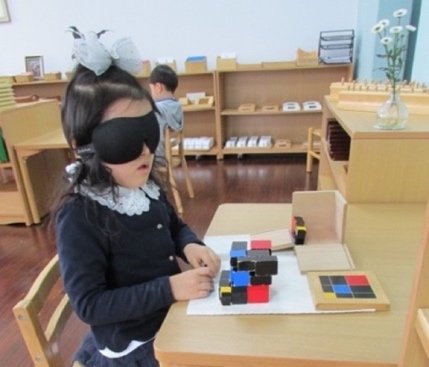
When a child carries the Red Rods to a mat, they feel the weight and see the length of the rod. When they pour beans, they engage their senses of touch and sight but also hearing, for the sound when spilled beans hit a tabletop provides an extra clue that further assists them. By seeing, touching, hearing, smelling and tasting, the children refine their senses, while learning about colour, texture, shape, size, dimension and volume, and when they’ve mastered a piece of material and want to increase the degree of difficulty, they can reduce the senses available to them, perhaps by wearing a blindfold.
Order is very important to children, and the layout and use of the materials support this need. To begin with, they are grouped in separate and distinct areas of the curriculum -Sensorial, Language, etc.- so the child knows where to find each material when they need it, and where to return it when they’re finished.
- Maria Montessori, The Discovery of the Child, p. 84.
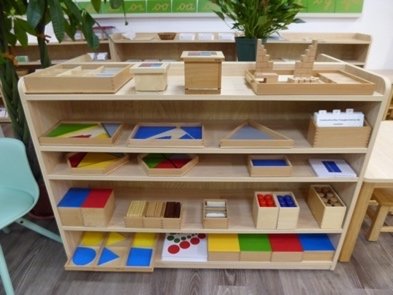
The materials are arranged on the shelves in a predictable and logical sequence, and this also supports the child’s need for order: in Group 2 of Mathematics, for example, Decimal Beads (concrete quantities) come before Decimal Cards (abstract symbols), and Decimal Operations (using concrete quantities) precede the Stamp Game (using abstract symbols), for the same reason. To the right are the shelves I prepared in my class in Taipei, demonstrating this order.
Order and sequence are also inherent in the way the children use the materials, whether cubes (Pink Tower), prisms (Brown Stairs), batons (Red Rods), or anything else: with the cubes they construct a tower, with the prisms they build a stair, and the rods have to be laid out from longest to shortest. Because of this logical and consistent order, the children develop an understanding of the sequence and hierarchy of the materials, and it is common to observe pairs of them at a shelf or cabinet, comparing where they have reached in the curriculum.
Finally, this awareness of the order and organization of the materials on the shelves inevitably leads to a more abstract order in the way children process information: order in the environment helps to inculcate order in the mind.
The Montessori materials are designed to isolate one specific skill or concept. The Colour Tablets, for example, are all the same size and shape, differing only in their colour. By isolating this concept, we support the child in their focus and engagement with it, facilitating deeper understanding.
- Maria Montessori, The Discovery of the Child, p. 103.
A key characteristic of the materials is that many of them exhibit an inbuilt control of error, which allows children to identify and correct their own mistakes.
- Maria Montessori, The Discovery of the Child, p. 257.
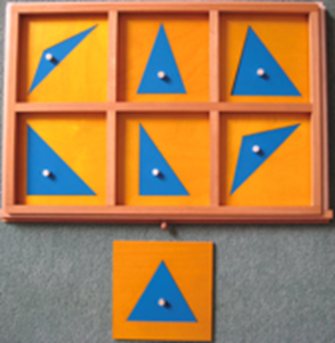
When using Tray 1 of The Geometry Cabinet, if a child places a triangle in the wrong inset, the materials provide immediate feedback. This control of error allows the child to identify and learn from their mistakes, without adult intervention, fostering a sense of autonomy and facilitating the development of confidence and problem-solving skills.
- Maria Montessori, The Secret of Childhood, P. 61.
Of course, if the child had the right guide, they’d be less likely to make an error…
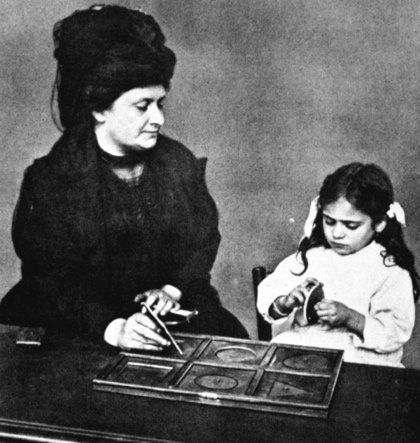
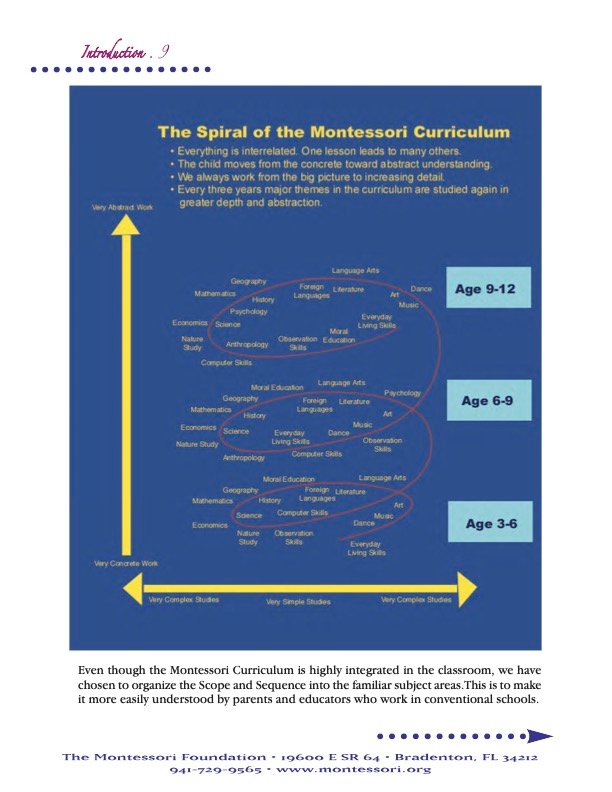
The ‘Spiral Curriculum’ is a term coined by the educational psychologist Jerome Bruner in 1960, but with its roots in a tradition stretching back to Piaget and Vygotsky. By revisiting and exploring the same materials over time, building upon prior experience, and with each encounter increasing in complexity and depth, the child deepens and solidifies their knowledge and understanding. Bruner suggested that his was a “bold hypothesis”, to which Mario Montessori responded,
“the hypothesis was bold when my mother started experimenting with it sixty years before”.
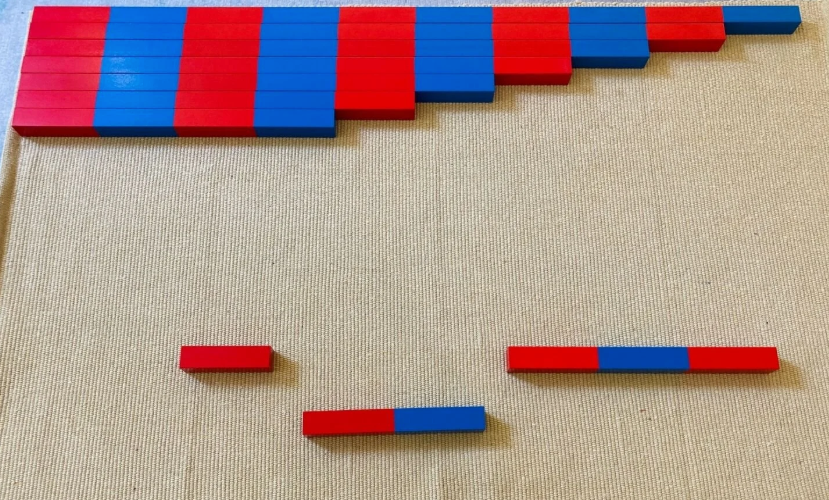
The Montessori materials become progressively more complex, moving from concrete to abstract. The first presentation in the mathematics curriculum is the Number Rods, 10 wooden rods identical to the Red Rods in dimension, the difference being that successive rods are red and blue in alternate decimetres, the number of sections representing the number of rods. This is a very concrete representation of the tactile difference between different numbers.
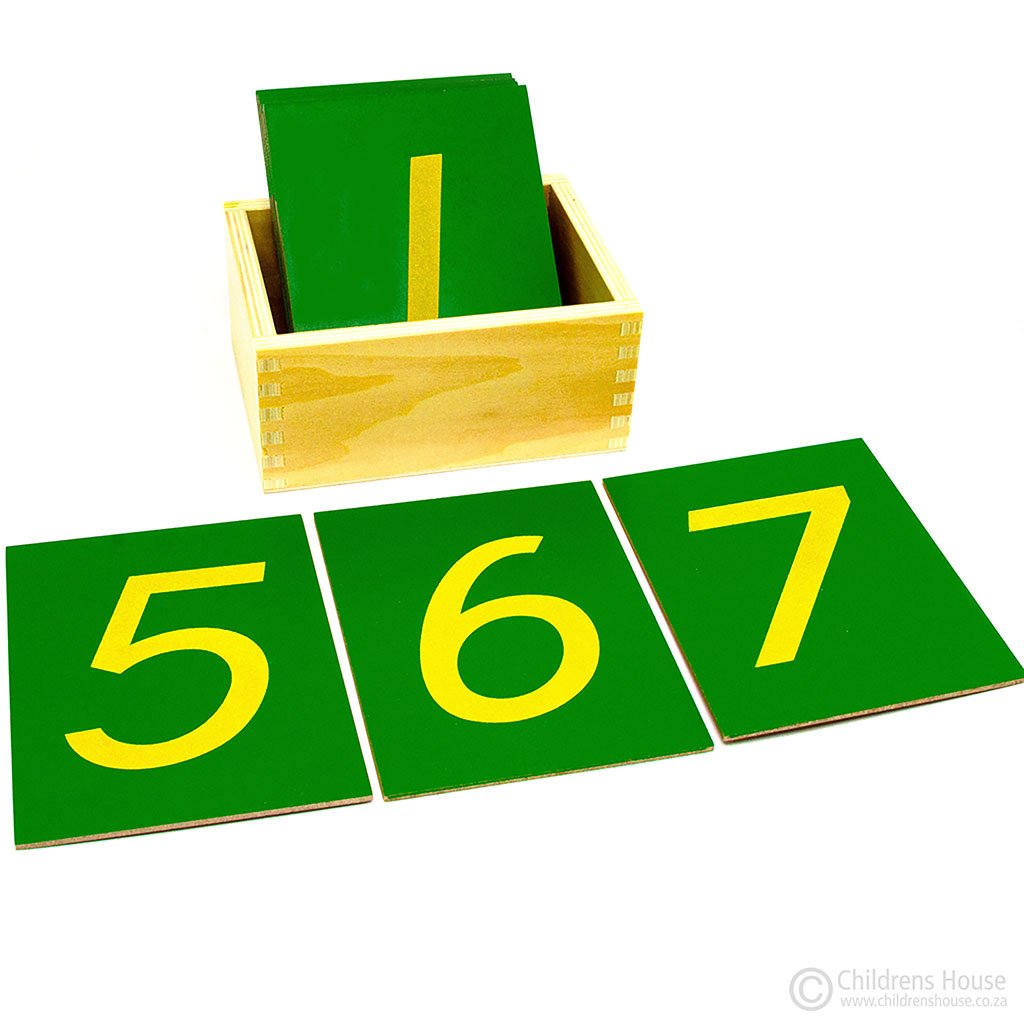
The second presentation is Sandpaper Numerals, introduced once the child has become aware of the difference in size between the rods. They are a set of 10 boards, identical in shape and size, with each of the roman numerals from 0 to 9 outlined in sandpaper and are an abstract representation of numbers.
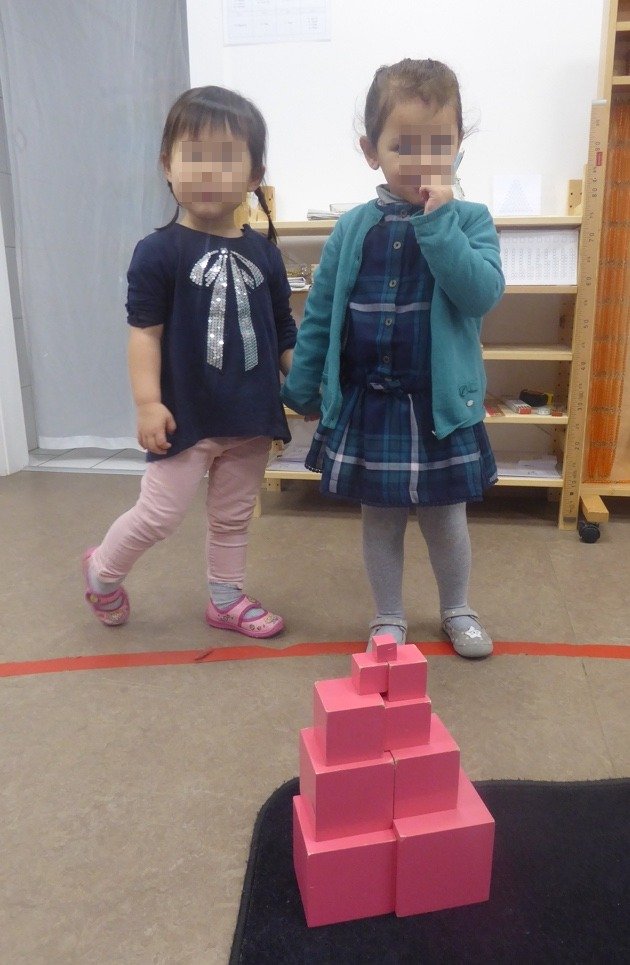
1. Pink Tower – aged 3
- Child builds cubes from largest to smallest.
- Develops visual discrimination of dimension.
- Experiences the cube physically.
2. Binomial Cube – aged 4
- Introduces algebraic relationships visually.
- Represents the formula (a + b)³
3. Trinomial Cube – aged 4 1/2
- Represents the formula (a + b + c)³
4. Elementary Montessori algebra work – aged – 6 to 7
- Children later solve algebraic expressions.
5. Cube roots and polynomial expansions – aged 9 to 10
- The physical cube experience supports abstract reasoning.
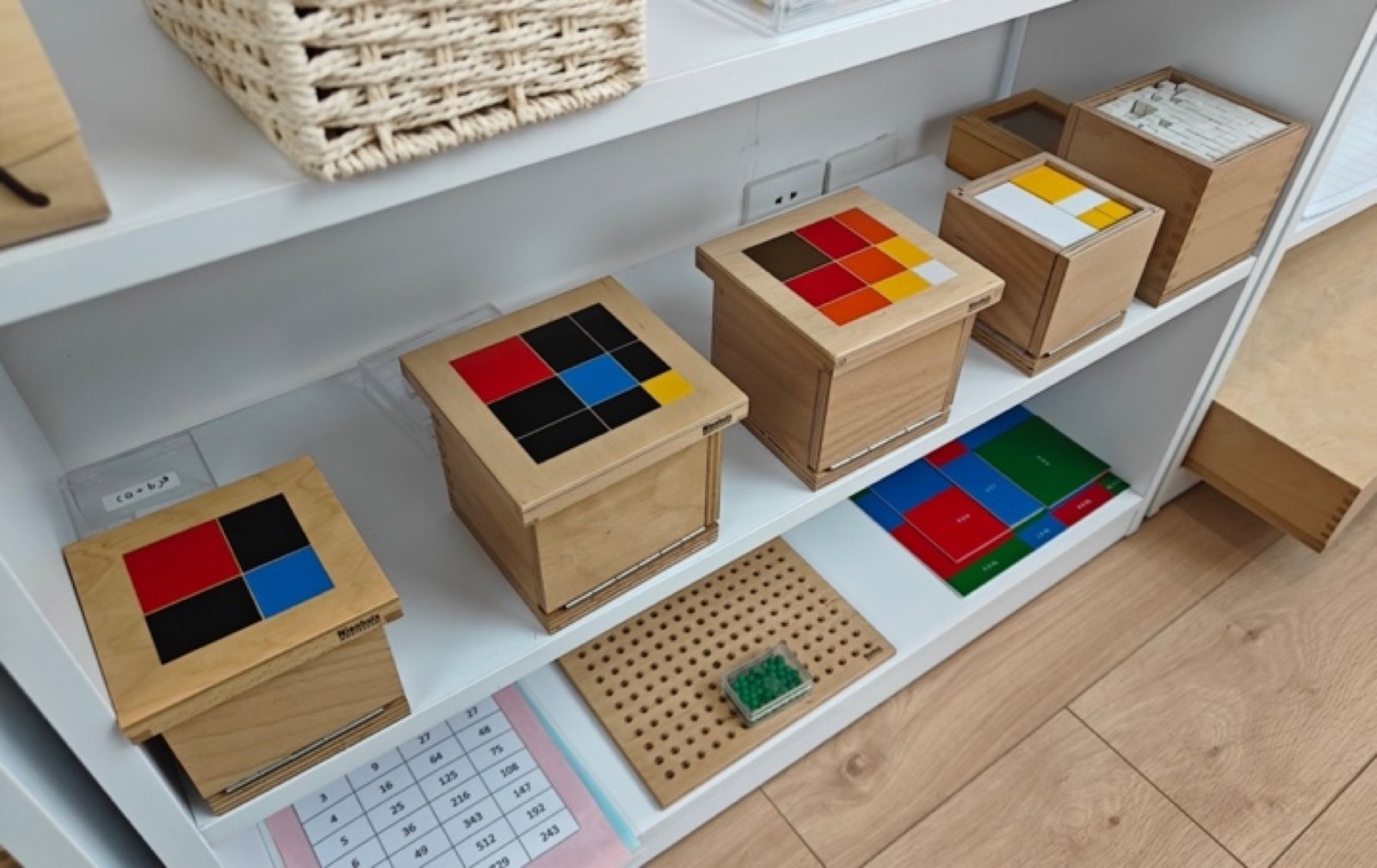
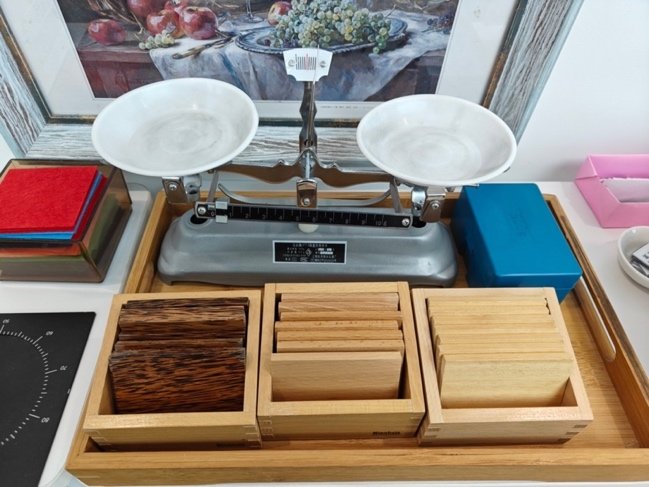
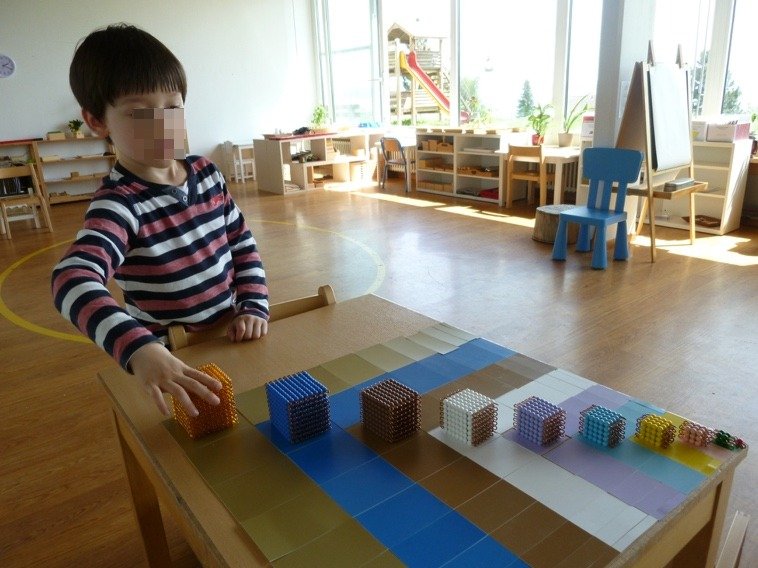
Another example of this is the Baric Tablets: in the 3-6 level the child uses them to refine their discrimination of weight, and when they move to the 6-12 environments, they can weigh the tablets and use them for Mathematics, etc, and a third is the way the Decanomial Square prepares the child for later work with the Decimal Beads.
Categories / Types of Materials
Montessori materials are categorized into five areas of the curriculum, each focusing on the academic skills they support, and based on the developmental needs of the child:
Click on the links for more information on each of these categories.
Extra Materials
Along with the standard AMI-approved materials, there are a whole range of supplementary materials available, and deciding whether these should have a place on the shelves of an authentic Montessori environment has become something of a hot topic.
Dr. Angeline Lillard has published a number of papers that address the issue of supplemental materials, and in an essay on the Montessori Society AMI (UK) website she discussed some of her findings:
‘As Montessori has evolved, we might say two courses have been taken. One course has been to keep very much to Dr. Montessori’s sets of materials [at each classroom level], with few changes; for lack of a better word I will call this the Traditional approach. The second approach, which I will call the Modified Montessori approach, has been to adopt modifications in a democratic fashion, with each teacher trainer and teacher making decisions about new materials to add to the set [or in cases what to take out]. Some of the added materials are readily available commercially and are not special to Montessori [puzzles]; others are presented at and sold at Montessori teacher conferences or are in Montessori catalogues. The result after some fifty years of this is a wealth of alternative materials in many Montessori classrooms, materials in whose creation Dr. Montessori did not have a hand or mind.’
While I’m in complete agreement that diluting the materials is widespread and generally unwise (the number of environments I’ve visited with collections of dolls, play-kitchens and a box of Lego in the corner is too depressing to admit), I also feel that there are gaps in the curriculum, a curriculum that, like the bible, hasn’t been updated in a few years.
In the Language area, for example, once a child learns the Sandpaper Letters, the next presentation is the Moveable Alphabet, when they ‘write’ by combining the individual letters to create words. It’s a bit of a leap, which the AMI training fills the gap with the suggestion that the guide ‘familiarise the child with the letters by introducing them, perhaps organising or dusting them’. Indeed. But might it not be more useful to add some materials designed to reinforce the sandpaper letters?
Materials such as Matching Letters and First Sounds are an excellent way to improve vocabulary whilst reinforcing the shapes and sounds of the letters, which can be played using the Sandpaper Letters or the letters from the Moveable Alphabet, or both. Or perhaps writing activities which provide invaluable opportunities for the child to practice copying or tracing the shapes of the letters, either on paper, using the easel, in sand, on another child’s back, or in the air?
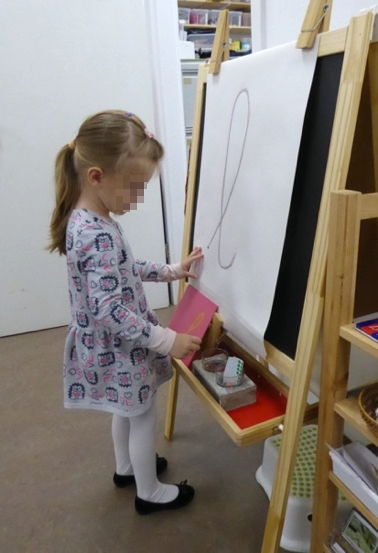
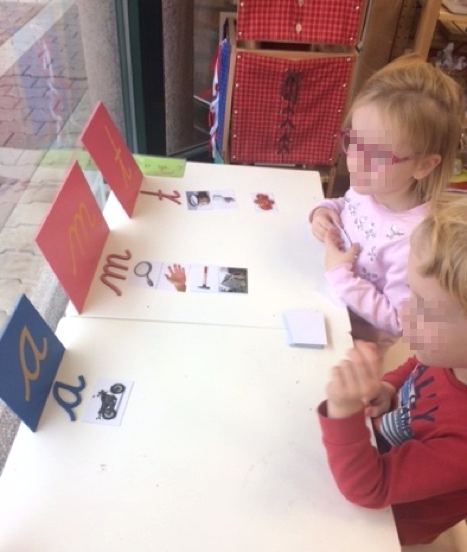
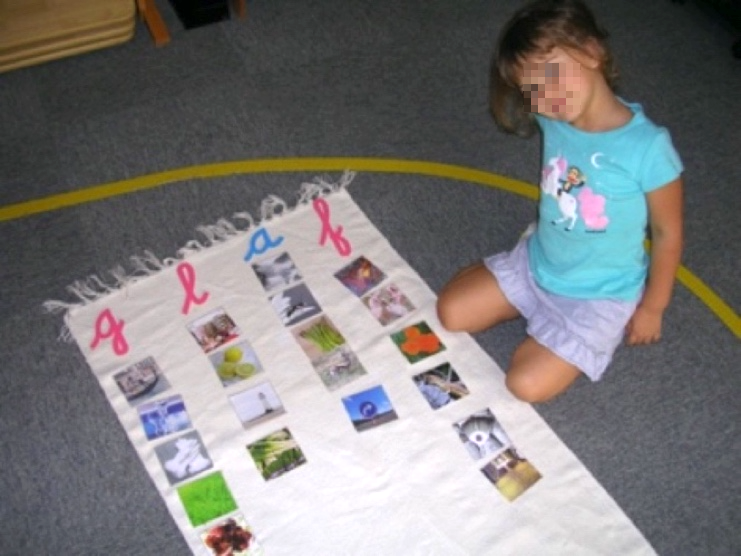
Lynne Lawrence discusses some of these and some other supplementary activities in her book*, ‘Montessori Read & Write: A Parents’ Guide To Literacy For Children’, an excellent resource for parents looking for a detailed introduction to the theory and practice of how to teach reading and writing in a Montessori way.
*Trigger warning: not all of the materials she uses are AMI-approved.
The ‘Pink, Blue, and Green’ series might be considered one of those supplementary materials, despite Maria Montessori herself playing a key role in their development: learning to read wasn’t particularly challenging for Italian children because Italian is a phonetic language, with each letter in a word pronounced, and with consistency of pronunciation across the alphabet (i.e., no phonemes). English is not as simple, so Montessori asked Margaret Homfray (who studied under her in London in 1929) to develop a reading scheme for English. The ‘Pink, Blue, and Green’ is the result.
Nevertheless, the PBG series aren’t on the shelves in AMI-accredited schools, which is a little puzzling considering the 22-year collaboration that Ms. Homfray had with Montessori, particularly in light of the fact that Montessori had so much faith in her mastery of the Montessori pedagogy that she permitted Ms. Homfray to issue Montessori Diplomas. I mean, if we can’t trust her, who can we trust?
With regards to the materials, the adult has a number of responsibilities.
- Maria Montessori, The Absorbent Mind, p.397. (2014)
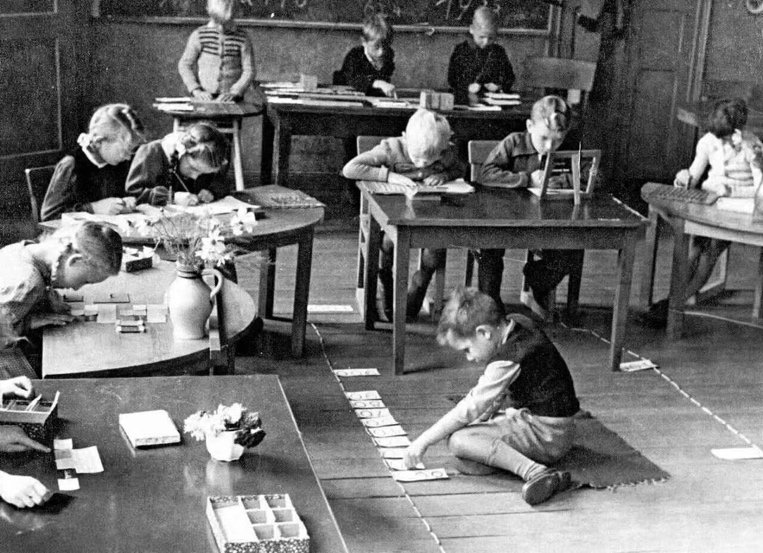
Our next role is to present the material to the child in the right place, in the right way, and at the right time so as to stoke the fire of the child’s interest. Following on from this, the guide must create both motive and opportunity for the child to use the materials; he does this by ensuring that the child has freedom to choose his activity, and that the environment is calm, so that he can practice without interruption. Next, the guide must ensure that the materials are treated with reverence while they are being used, and when the child is finished that they are returned to the correct place on the shelf. And all the time, the guide must practice with the materials: