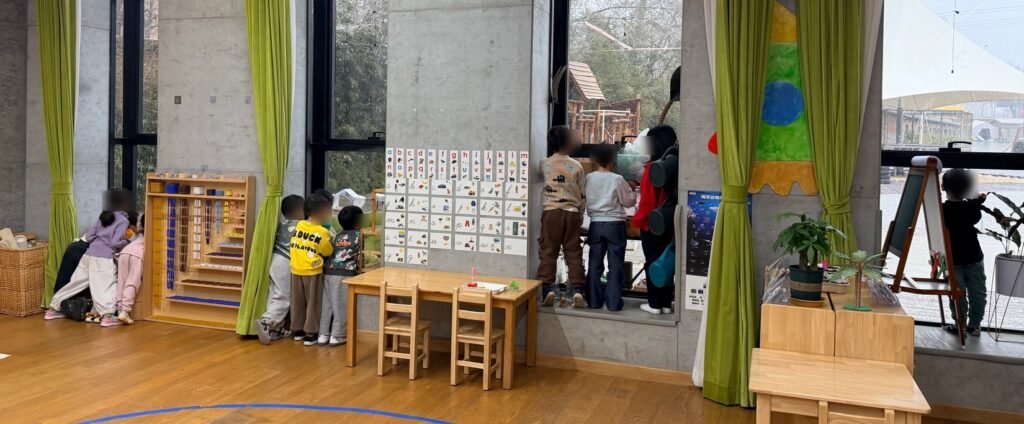
The Prepared Enviroment
Maria Montessori opened her first school in the San Lorenzo district of Rome, on 6 January 1907, and she called it a ‘Casa dei Bambini’, which translates from the Italian as either a ‘House of Children’ or ‘Home of Children’:
- Maria Montessori, Creative Development of the Child Vol. 1, pg. 52-53.
- Maria Montessori, The Discovery of the Child, pg. 37.
Despite its location in a slum neighbourhood (not far from Termini, the main train station in Rome), the casa was spotlessly clean, as befits a room prepared by someone with medical training. More than a century later, it remains a Montessori school, which I visited a few years ago:
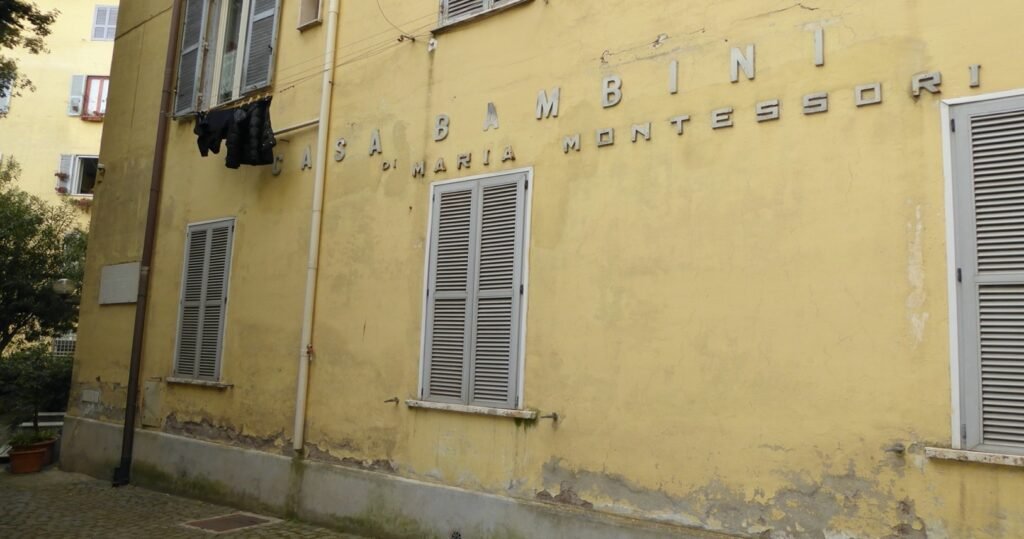
Here it was that Maria Montessori created an environment that could meet the physical, psychological, social, emotional, and cognitive needs at children each stage of their development. She called it ‘the prepared environment’ and it is of paramount importance in the Montessori system of education:
- Maria Montessori, The Child in the Family, p. 64.
In the intervening century her approach has spread throughout the world -there are more than 15,000 Montessori schools, on six continents- but it can be adapted to any culture or setting, so all authentic Montessori environments evince the same key characteristics:
- They are designed to support the developmental characteristics and interests of a mixed age group within a defined age range (0 to 3, 3 to 6, etc),
- They facilitate self-directed, highly personalised learning and growth, and
- They foster the child’s self-motivation, natural curiosity and desire to learn, not merely permitting exploration and discovery but actively encouraging it.
In an environment such as this, the children engage with the activities according to their individual interests and passions, they feel at ease and thereby motivated to explore, discover and learn at their own pace, and exhibit a lively and purposeful engagement with the materials.
- Peller, Lili. “The Children’s House.” On Education and Development of Young Children. New York: Philosophical Library, 1978. Repr. The NAMTA Journal 21.3 (1996, Summer): 8-23, pg. 21
Crucially, they find joy in learning, and as a result they exhibit confidence, self-discipline and concentration, develop a sense of responsibility and self-discipline, assume stewardship of the space, and demonstrate bonds of mutual respect and social connection. The first and most important responsibility of a Montessori guide, then, is to prepare the environment in a way that maximally facilitates learning:
- Maria Montessori, The Absorbent Mind, Chapter 27: ‘The Teacher's Preparation’, p. 277.
My experience preparing environments
I was fortunate in my first job at the Montessori School of Tokyo because the school was well established, the children in my class were mostly normalised, the parents tremendously supportive, and the environment had been prepared over the course of many years by many experienced Montessori guides. As a result, I was able to focus on learning all of the things I needed to learn and not have to worry about the environment. After I left Japan, I helped to prepare new environments in Russia and Thailand, and this was the first time I had to really think deeply about this aspect of the job, my carpentry skills coming in handy in Moscow, where I built and installed the shelves in the class and the storeroom.
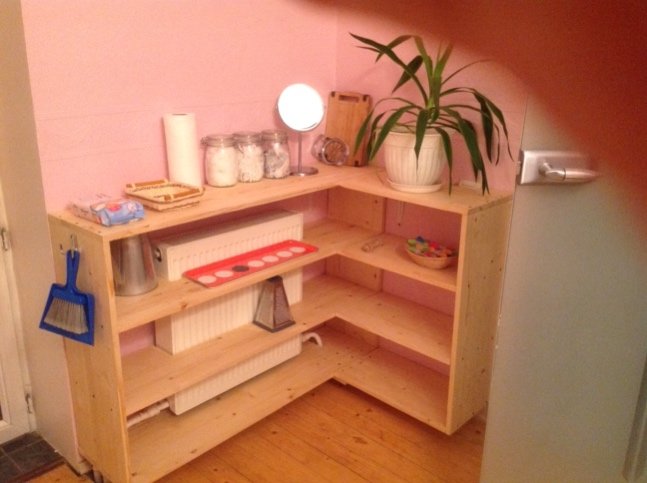
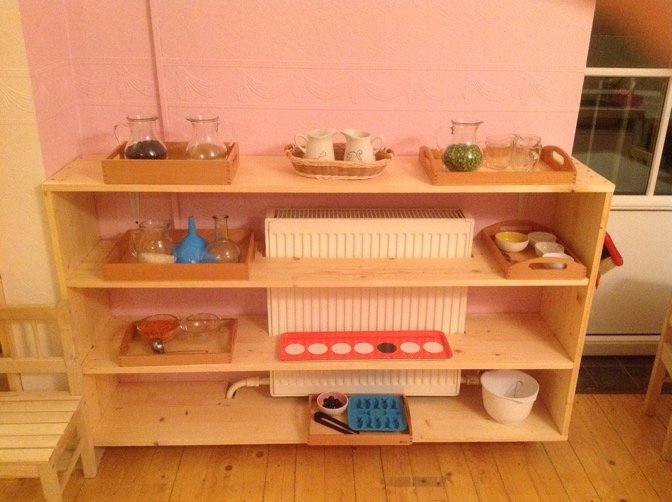
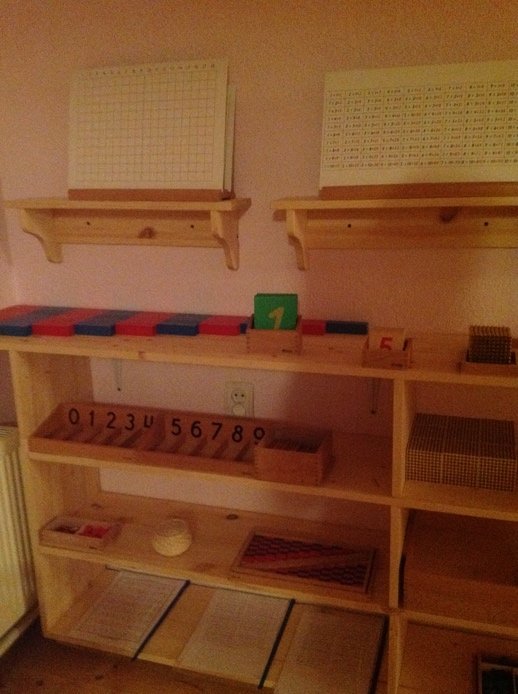
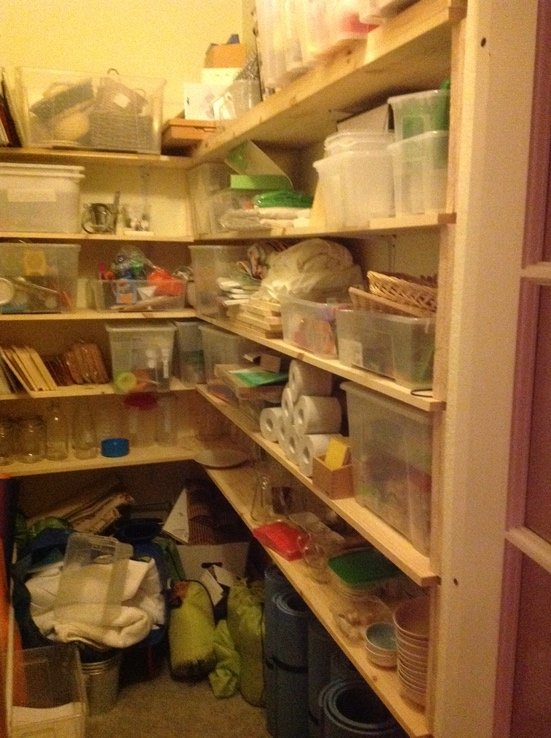
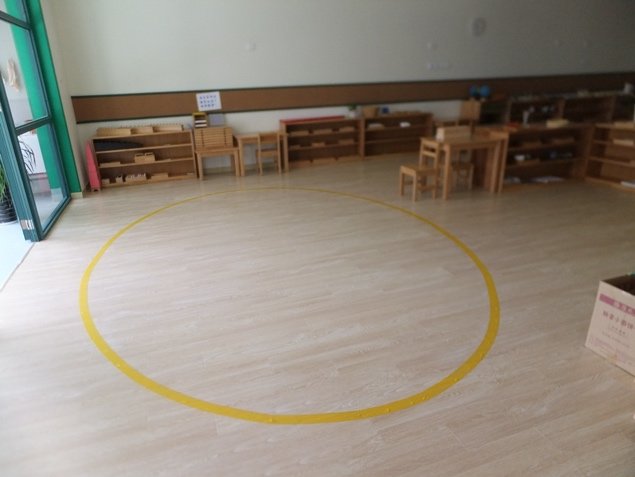
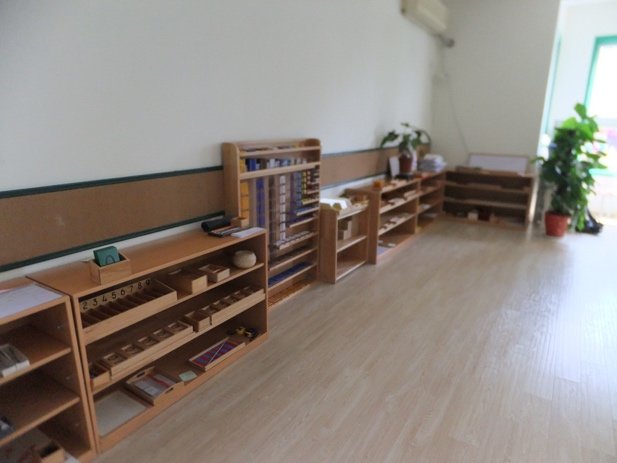
The following years were spent in China, where I worked in an established school in Beijing and set up a new class in Shanghai.
In Switzerland I rearranged a class in Neuchatel. The previous teacher had placed a line of shelves across the room, with a narrow passageway between them. When I asked why, she looked at me like I was simple, the answer was so obvious: “To stop the children from running.” Shortly afterwards she took sick leave -possibly worn out from chasing the children around the room- so I was able to remove the shelves and open the room up. Miraculously, the children didn’t run in the class.
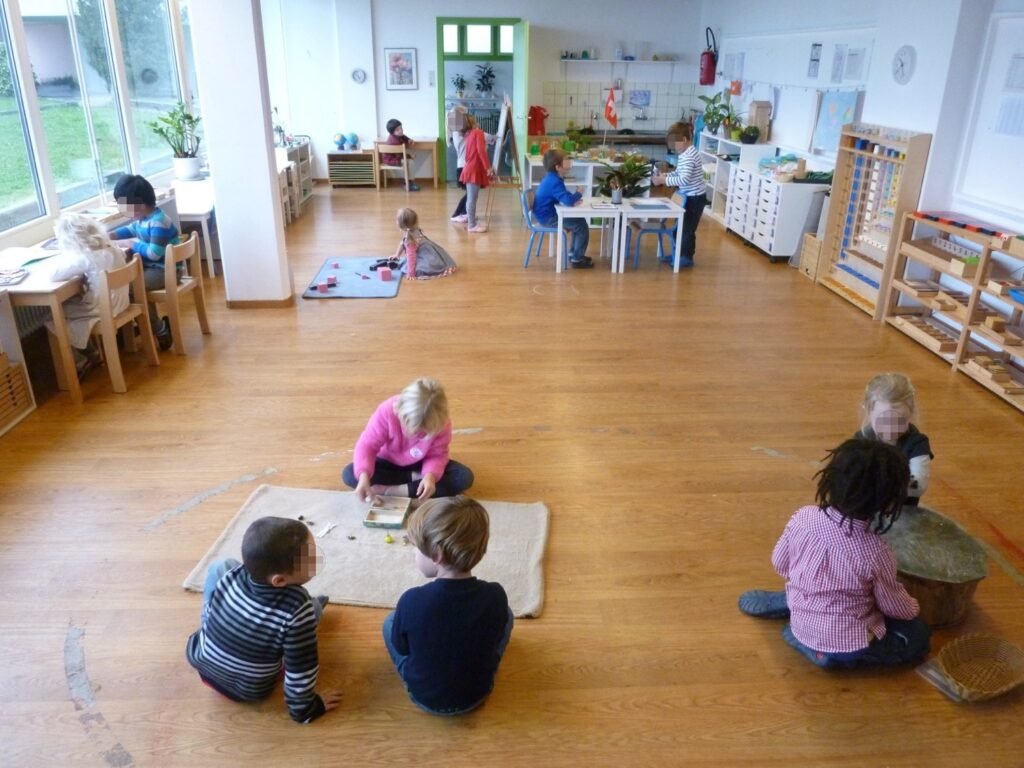
After that, I established a new class in Geneva.
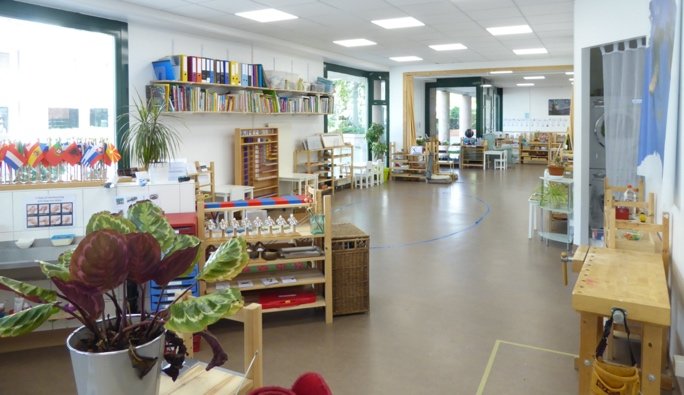
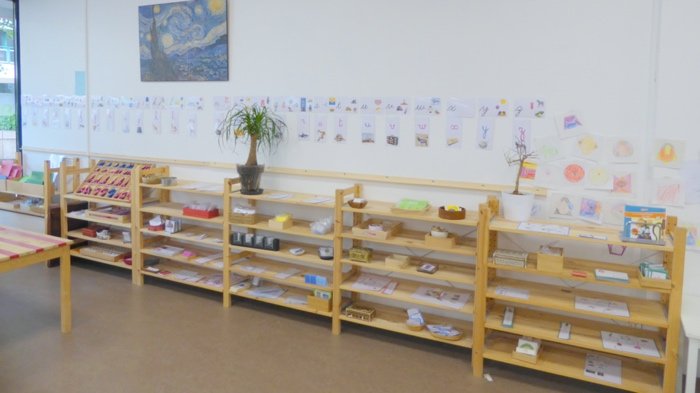
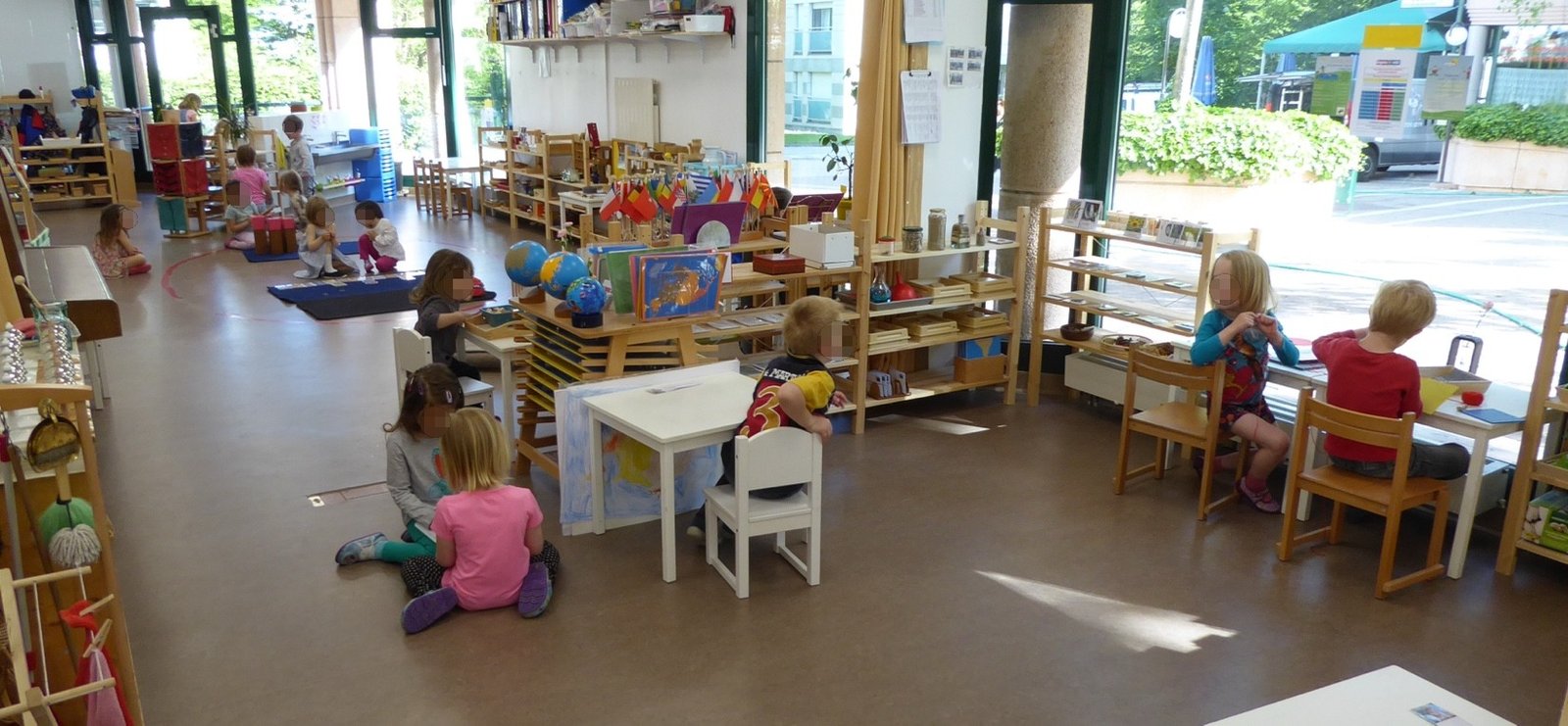
Furniture – purchasing
- Maria Montessori, The Montessori Method, p. 81-84. (1912)
I’ve spent more than half of my career in Asia, where it’s wonderfully simply to find someone who will create furniture to your exact specifications. Which is pretty great, obviously, but if you’re not so fortunate, in the world of Montessori, Nienhuis are the most famous brand, but they don’t come cheap, and I’ve not always been satisfied with either the durability or precision of their materials. Also, they are the first company I’ve seen provide a quotation for a table with a separate quotation for the legs, which I confess raised the eyebrows of this ex-carpenter.
Gonzaga Arredi are based in northern Italy, not far from Parma and Reggio Emilia, and have considerable experience in making furniture for many types of school, not just Montessori. Their catalogues are detailed and they even have a museum containing some of the original materials designed and used by Maria Montessori.
Northern California, as well as having some of the best wine in the world, is also home to Montessori Services, who have a pretty great selection of furniture, mats, trays, etc.
Kave Home began in Spain in 1983, but ship worldwide now, and have a lot of well-designed Montessori furniture, as does Voila Montessori.
In the British Isles, the aptly named Montessori Materials are Irish and have a range of tables, chairs, mat storage stands, etc and in England community playthings aren’t uniquely Montessori, but they have lots of beautiful furniture and when I’m in need of design or layout inspiration, I like to browse their catalogue.
In China there are quite a few companies producing Montessori (or Montessori adjacent) furniture and materials, and although the quality can vary, the prices are a fraction of what you’ll pay in the west. If you’re looking for an endorsement, Montessori Teaching Aids are certified by AMI China.

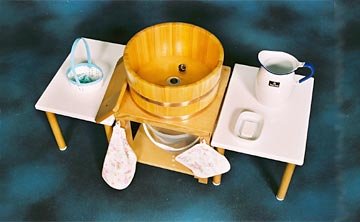
In Japan, Matsumoto Kagaku Kogo supply some beautiful Asian-accented materials:
Furniture dimensions - shelves.
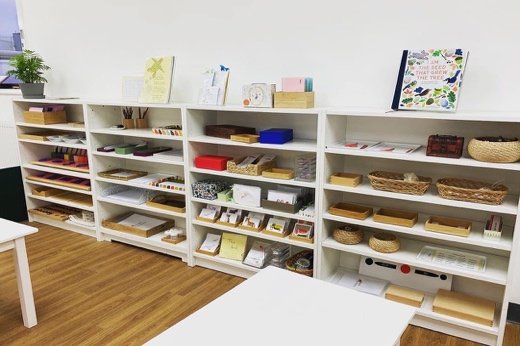
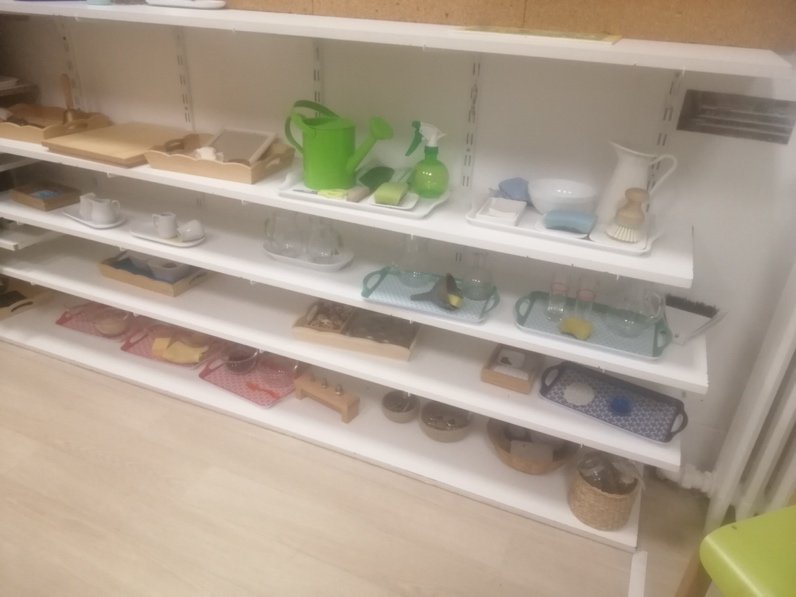
Montessori teachers need to add and remove activities throughout the year, according to the needs of the children, the frequency with which the materials are used, the season, etc, and in that situation it’s useful to be able to adjust the number of rows/shelves in each unit, and to have units that can be at different heights, so adjustable shelving is definitely preferable.
- Maria Montessori, The Advanced Montessori Method: Volume 1, p. 151. (2002)
Rent is a significant expense for most schools, so being able to adjust the shelves means you can pack a lot of materials into a small space,
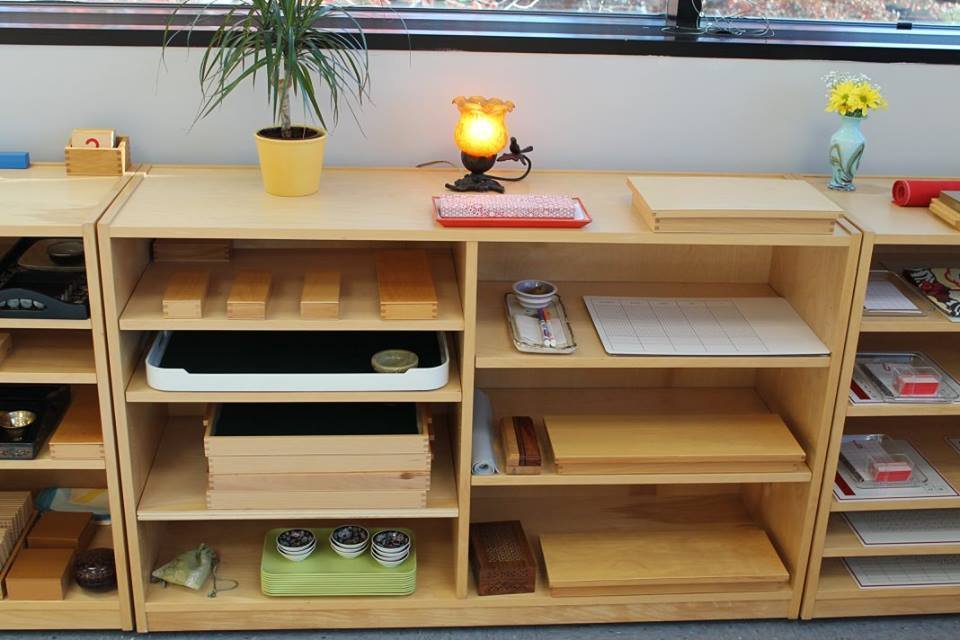
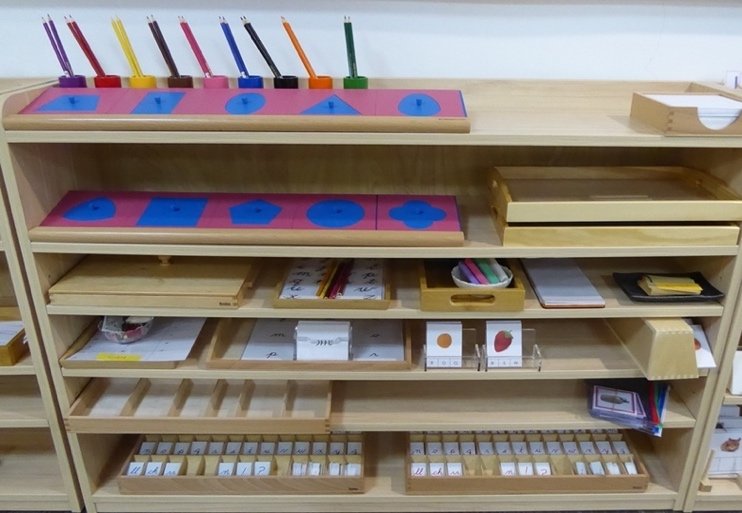
Furniture dimensions - shelf height
Depends on several factors: the first is the location of the school, as Russian children (for example) are distinctly bigger than Japanese children.
Secondly, who will be using the materials on a specific shelf? The first Practical Life and Sensorial shelves will mostly be used by 3-year-olds, while the mathematics shelves containing Groups 4 (The Essential Combinations) and 5 (Passage to Abstraction) will be used by children aged 4 ½ to 5, and they are considerably taller.
So: it’s more important to factor in which piece of material will be on each shelf.
Furniture dimensions - shelf length.
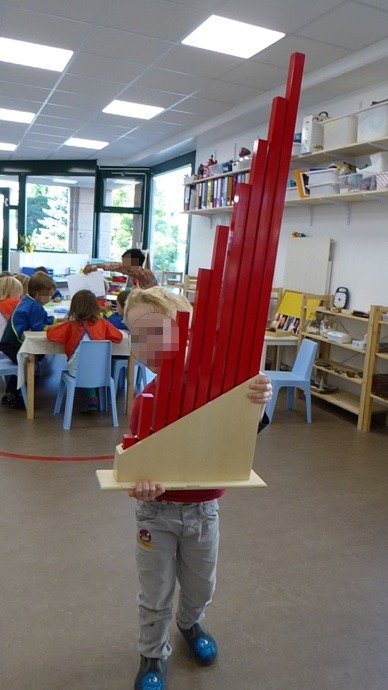
The longest Red Rod and Number Rod are one metre, so the shelf should be at least 1.1 metre long, and for reasons of aesthetics and consistency, it’s better if all the shelves are all the same length.
It’s also possible to use the stand that is designed to hold the Red Rods, which has its advantages, such as portability:
- Maria Montessori, The Secret of Childhood, p.162
Furniture dimensions - tables and chairs.
- Maria Montessori, The Discovery of the Child, p. 65.
Height
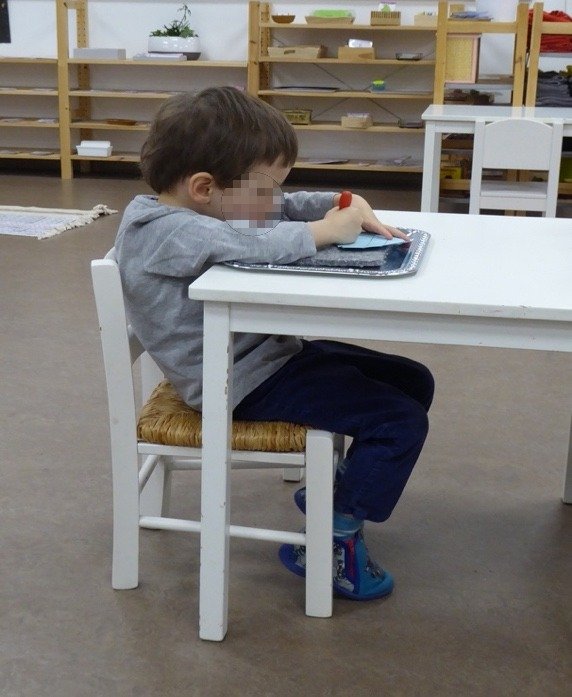
In an environment containing a large group of children, with an age span between 3 and 6, it’s necessary to have at least two sizes of table -and chair- for the simple reason that a 6-year-old is considerably bigger than a 3-year-old. The smaller tables should be about 45cm (18 inches) high, and the bigger ones about 55cm (22 inches) high, and in a perfect world you can have some halfway between those extremes. You don’t want the table to be too high, nor the chair …
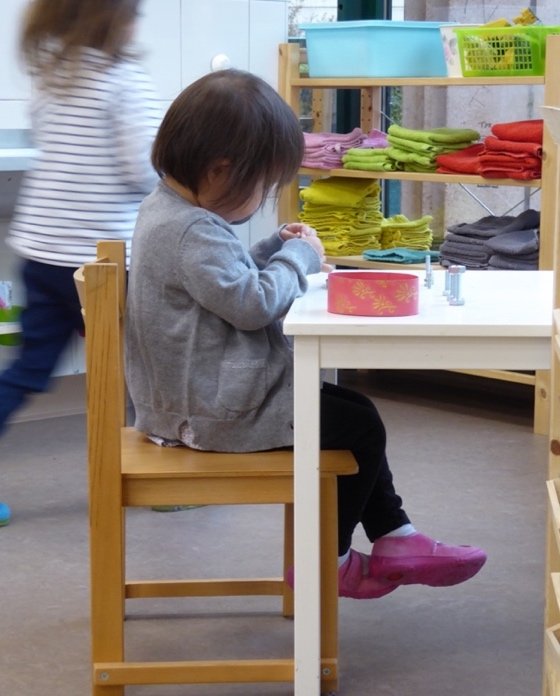
Dimensions of the tabletop.
The small table must be able to hold four Cylinder Blocks placed in the shape of a square, and -as we all know- a Cylinder Block is 470mm long …
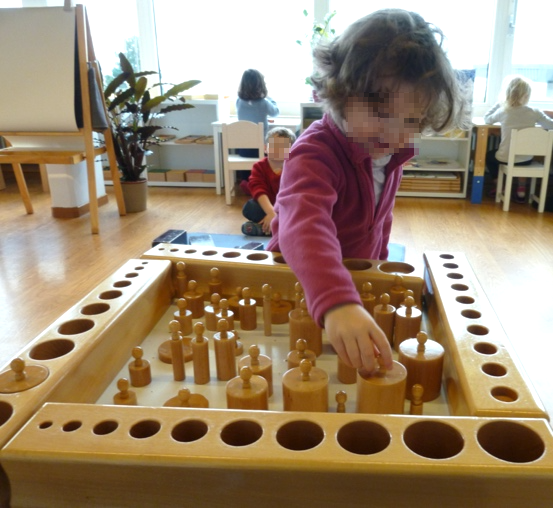
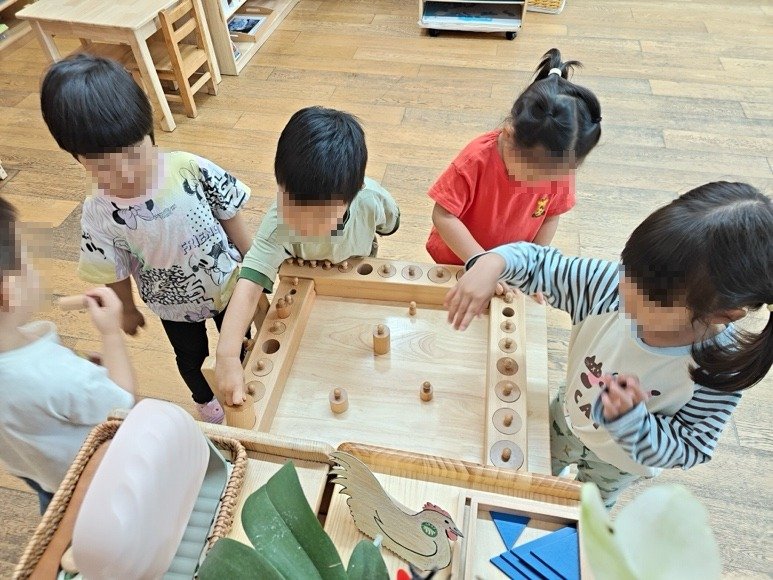
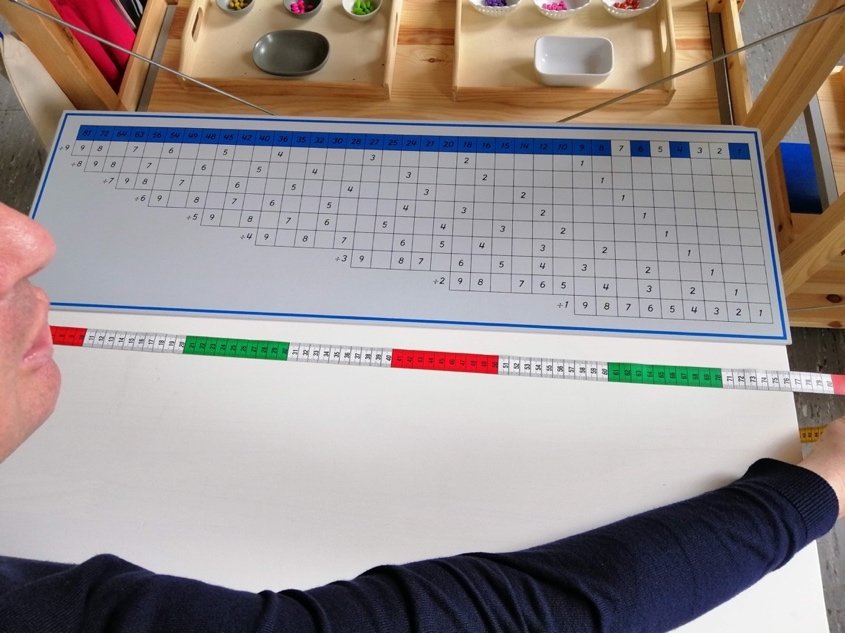
The larger tables must be able to hold the biggest piece of material and in most environments that’s the Division Control Charts, which, depending on the manufacturer, are approximately 80cm (32 inches) long.
For the Fabrics presentation, it’s been my experience that the full set – ‘8 to 10 pairs of fabrics’- are too big to fit on most tables, so I often present them on a mat; this isn’t ideal, because of the tactile distinction between the feel of a table surface and the feel of a mat, but on any table except the most massive it’s not practical.
| Total Height | Height of Legs | Size of Seat | |
|---|---|---|---|
| 2-3 years | 46 cm | 22 cm | 35 x 35 cm |
| 3-4 years | 50 cm | 25 cm | 35 x 30 cm |
| 4-5 years | 53 cm | 29 cm | 33 x 30 cm |
| 5-6 years | 60 cm | 30 cm | 33 x 30 cm |
Source: AMI France 3-6 album.
Mats - Quantity
One of the questions I like to ask teachers is, ‘How many mats are required for a class containing 25 children?’ I’ve had responses varying from 10 to 30 -which probably says more about the training than the teacher- and I have my own answer, which I’ll keep to myself as it’s generally better to provoke debate than end it, but it’s an important issue for teachers to reflect upon.
Mats - Dimensions
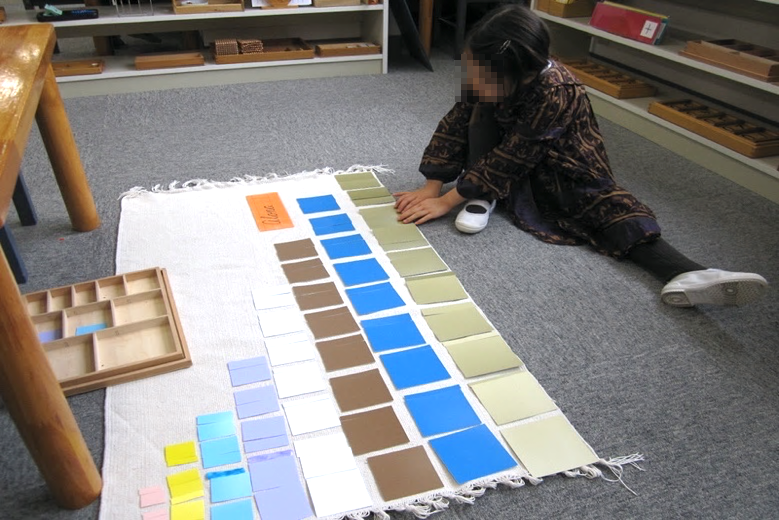
Like the shelves, about 1.1 metre long, so they can comfortably hold the Rods. The height is more difficult to define: your average 3-year-old is pretty small, and I’ve observed them get all twisted up trying to reach the top of the mat without actually stepping on it. Having said that, the mat needs to hold the various Decanomial Square extensions, some of which can take up a fair bit of space …
Mats - Colour
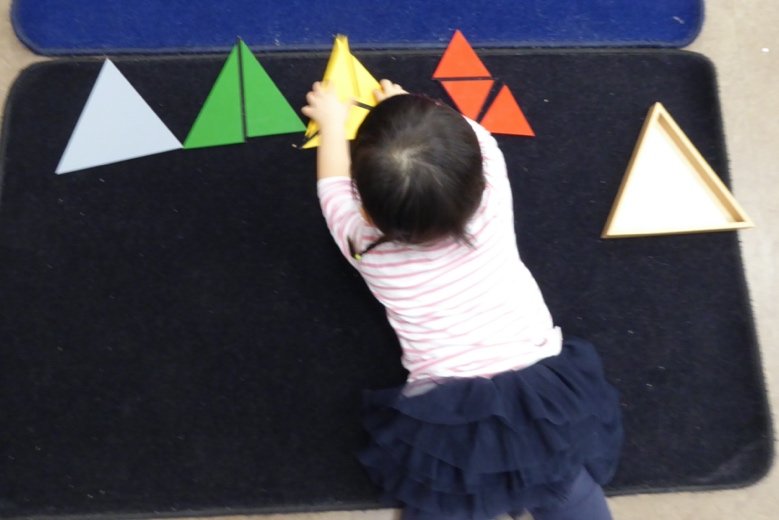
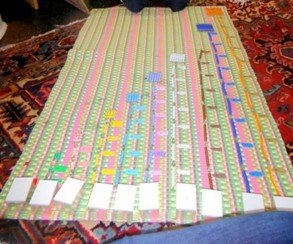
Neutral is better, so the colours of various materials are highlighted, especially Sensorial activities such as Colour Tablets, Decanomial Square and Constructive Triangles, but also Group 3 of Mathematics, with its assorted coloured beads. The children are pretty resilient, but having to use a mat like this does seem to test that a little too much …
Mats - Material and Storage
These are inextricably linked: the more solid mats can stand easily, but they’re not easy to carry -for your average 3-year-old at least- and, unless you’re Jeff Bezos, price is probably going to be an issue: a solitary nienhuis mat will set you back more than €70, and a stand that holds five mats goes for north of €300, so you’re looking at €650 for five mats. Multiply that by however many mats you think you need and then add VAT … well, it’s going to put a hole in your pocket.
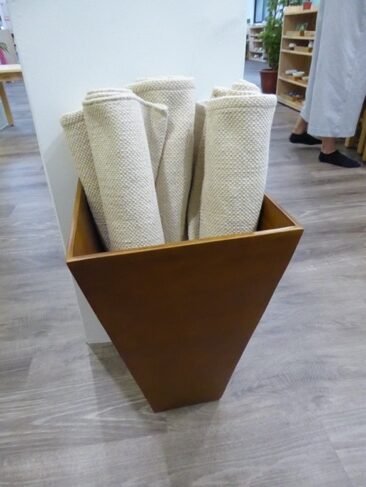
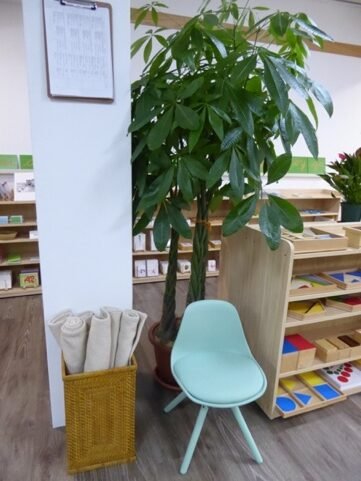
I prefer to have simple cloth mats because they’re easier to carry, unroll/roll, they’re generally beige, and they’re way less expensive.
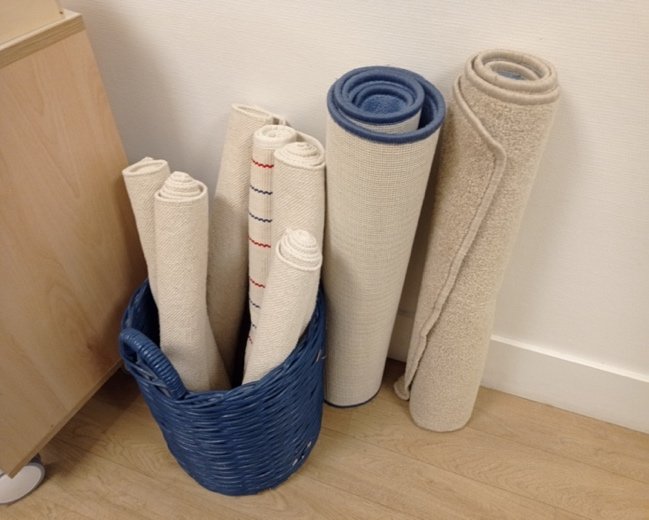
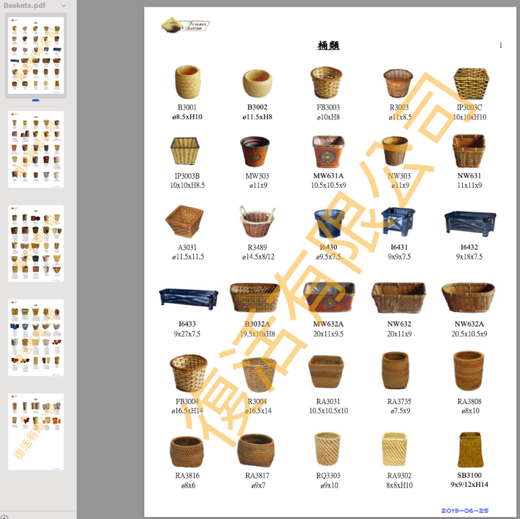
I also like the way they can be stored in beautiful baskets which reflect the local culture. I have fond memories of the workshop I visited in Taiwan, and the seemingly endless array of very beautiful and very reasonably priced baskets they sold.
Mats - Location
Another advantage of the cloth mats is they take up less space, so you can keep them in two or three baskets, placed in different parts of the environment, so they’re close at hand and you avoid having a bottleneck at the mat stand.
Mats - Cleaning
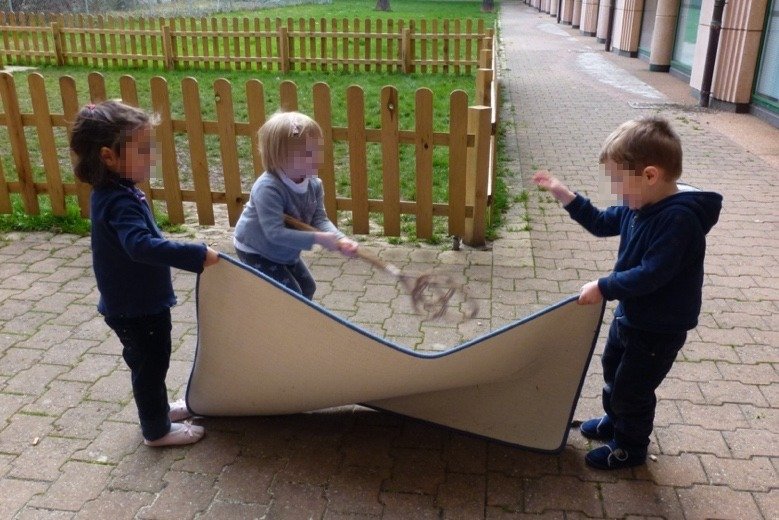
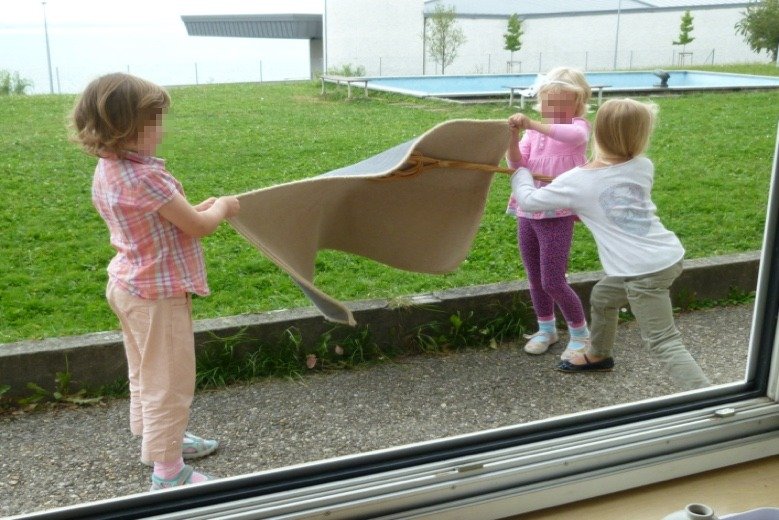
Beating mats is a universally popular activity, especially with those clean-freak Swiss.
Layout of the shelves, tables, and chairs
I’ve spent 15 years working as a Montessori teacher and have observed somewhere in excess of 75 Montessori schools, across five continents, from Bangkok to San Francisco, and from Cape Town to Moscow. Observation is key:
- Maria Montessori, The 1946 London Lectures, p. 96.
I have been fortunate enough to work in well-established schools, with beautifully designed and thoughtfully arranged classrooms, and in others that needed a little adjustment. In Shanghai, the school was well-established, but I spent a week observing the way the children used the materials and interacted with them and each other, reflected upon what worked and what didn’t, then went in on a weekend and moved the shelves and the tables so the class would have a better flow.
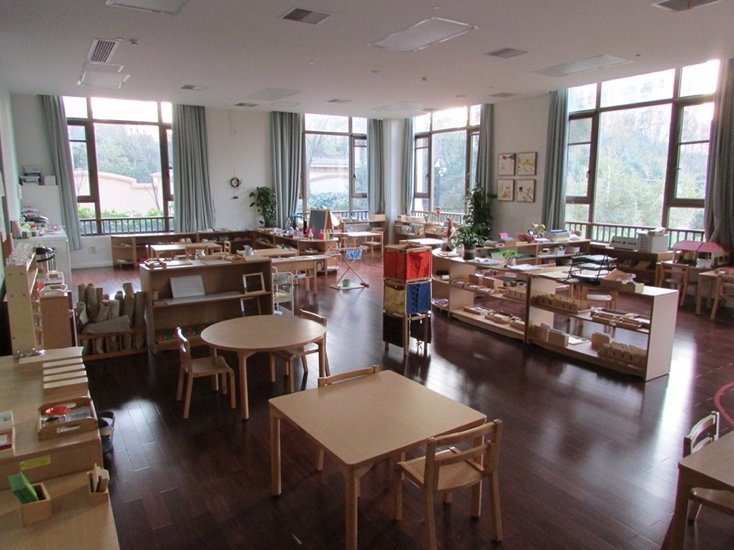
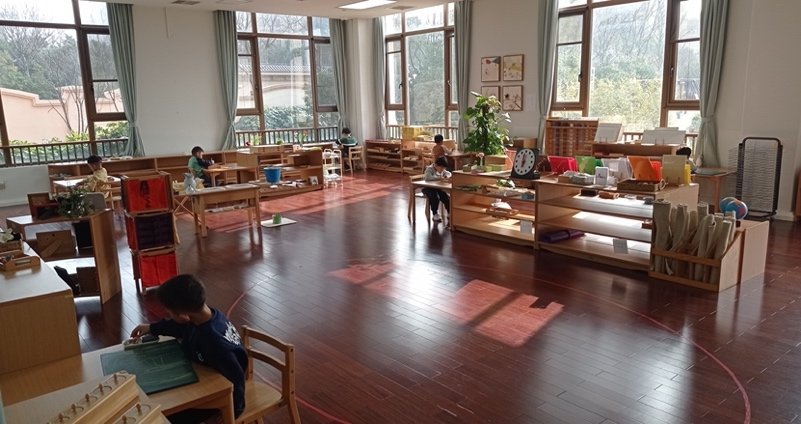
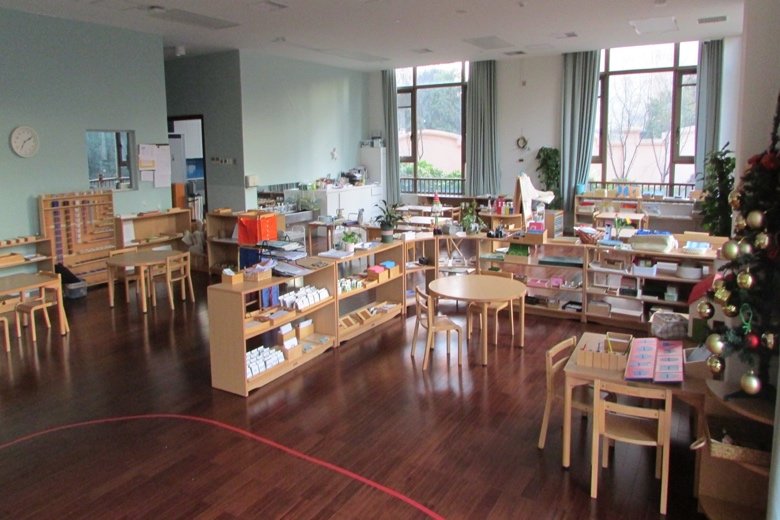
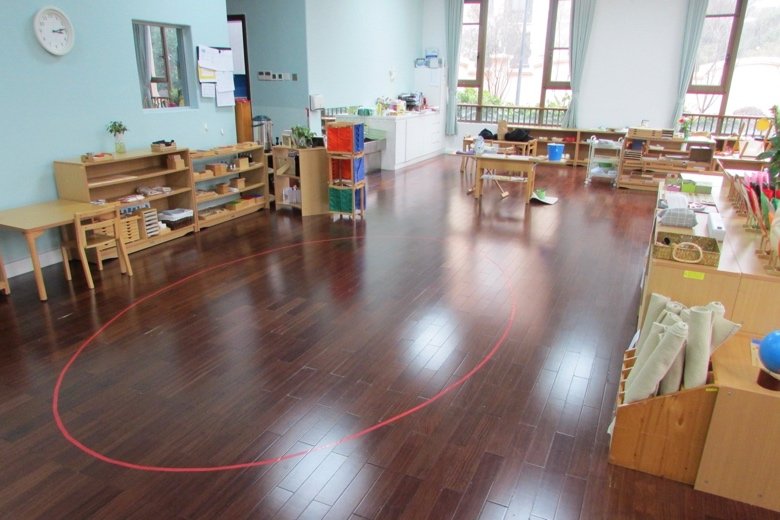
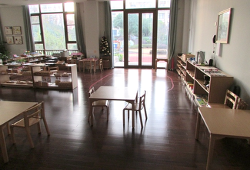
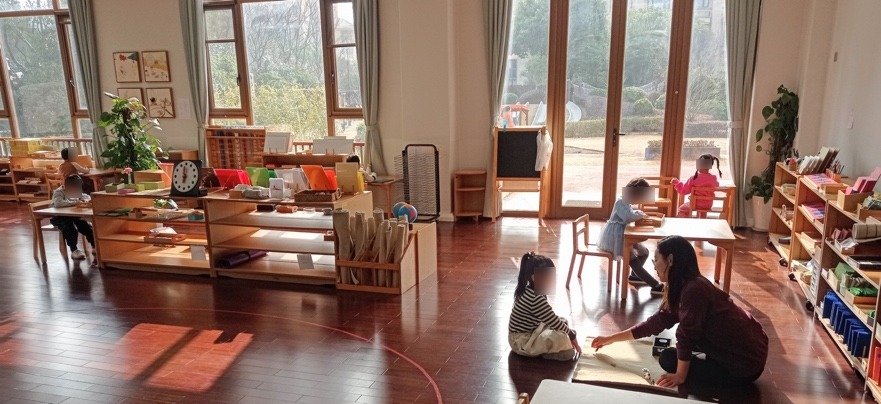
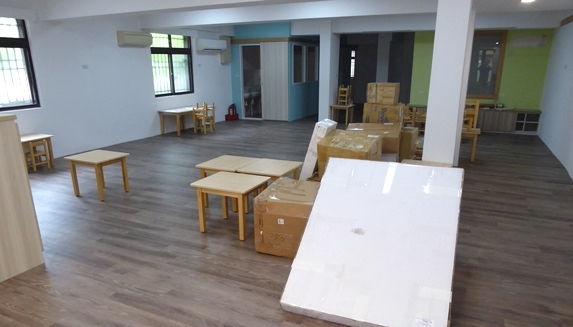
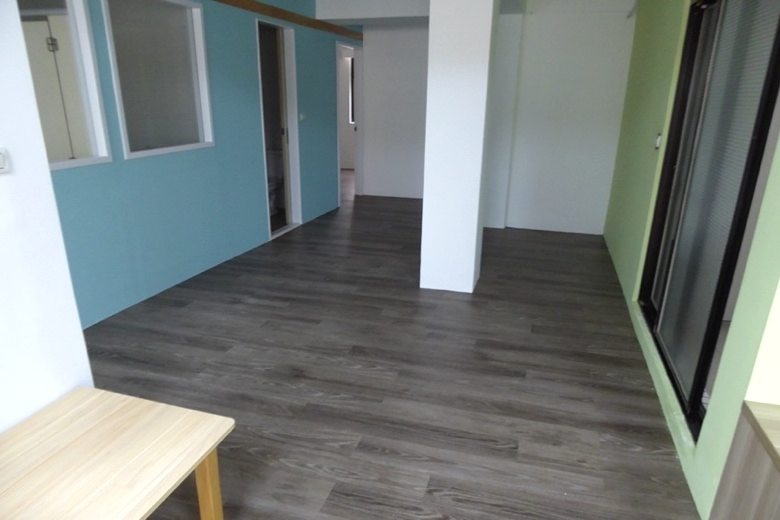
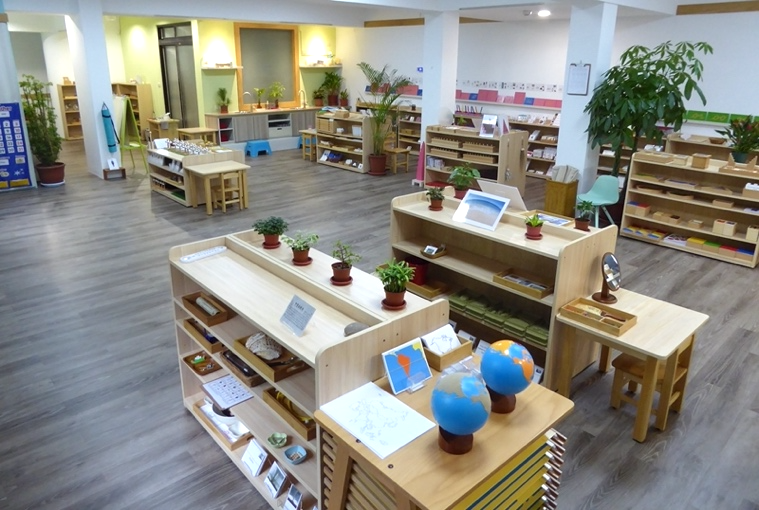
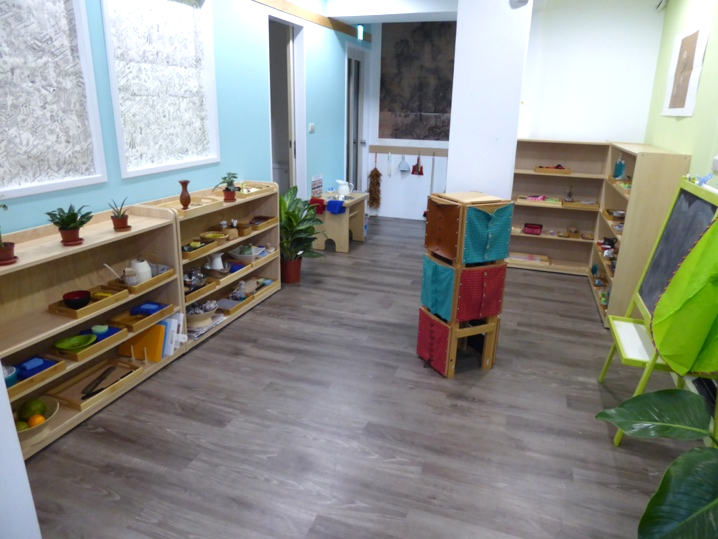
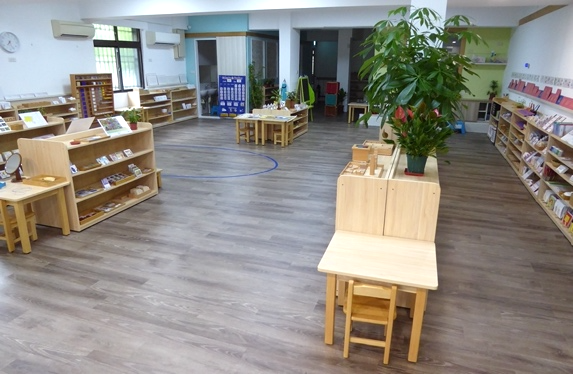
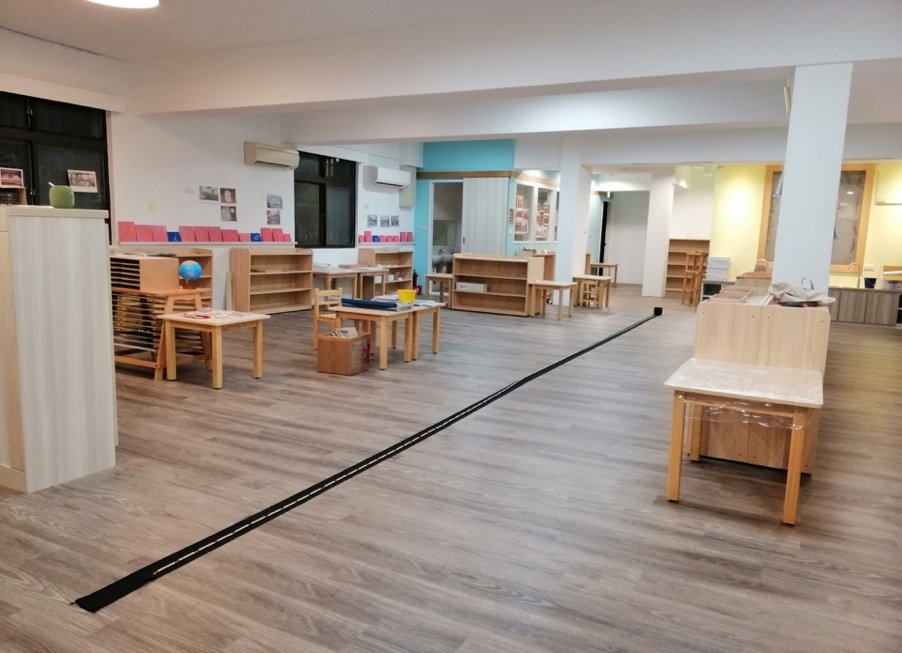
In 2019 I started working at TIMES Montessori, in Taiwan. Although they’d been open a few years, they didn’t have a primary class, so I was responsible for the creation of a new 3-6 environment. The tables and the shelves had been ordered, but when they arrived, they weren’t ideal, so I was able to order new ones.
Some of the materials were bought from Nienhuis, but I provided all of the paper materials and -once they were printed- I laminated, cut, and put them on the shelves. It took me about 8 weeks to prepare this environment:
Before
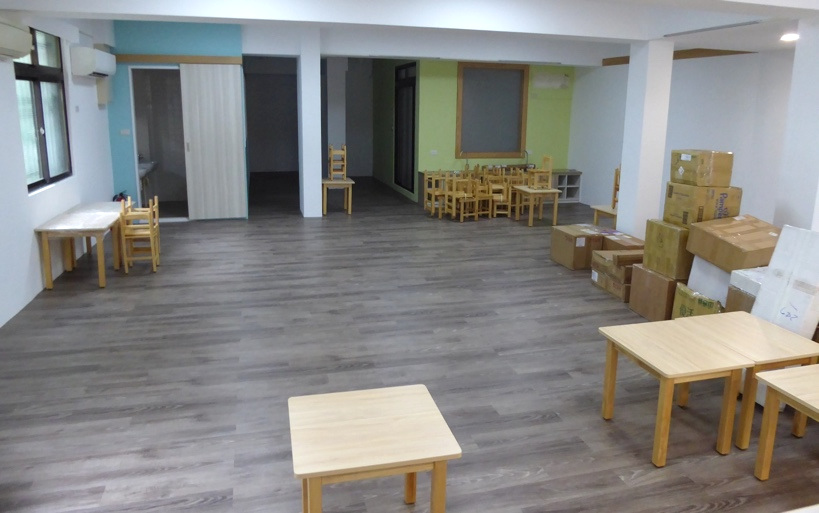
After
- Maria Montessori, The 1946 London Lectures, p. 65.
Layout of the shelves
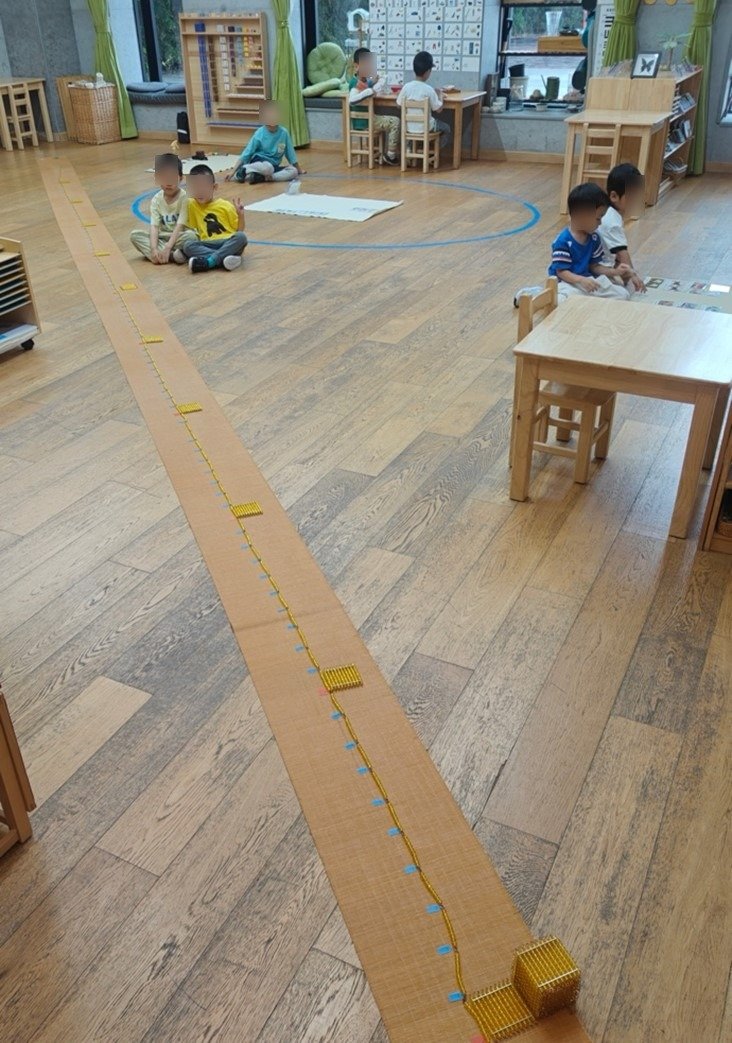
When I set up a new environment, the first thing I do is unroll the 1000-chain mat. At 10 metres it’s by far the longest piece of material in the room, so the space must be prepared so as to allow the children to unroll the mat when necessary.
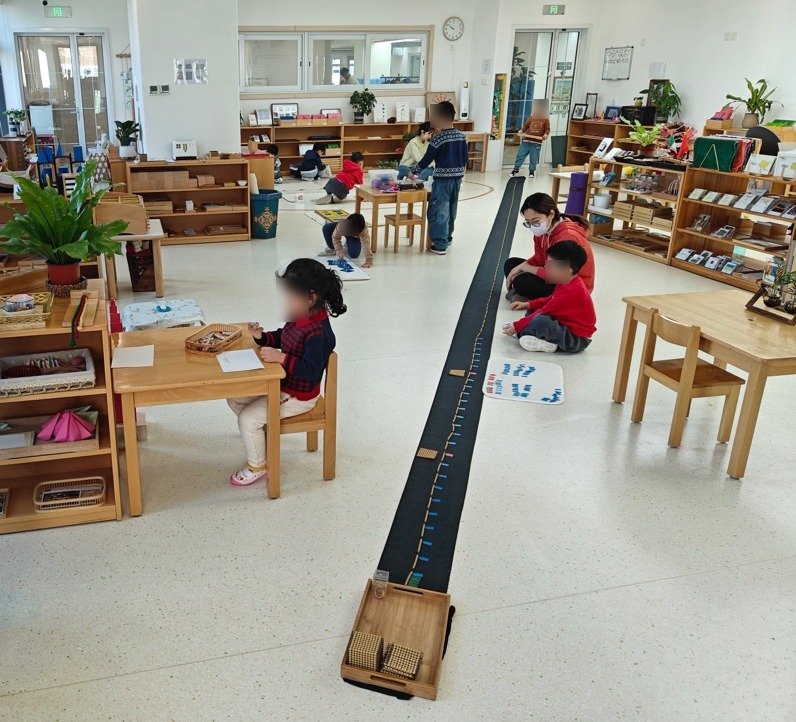
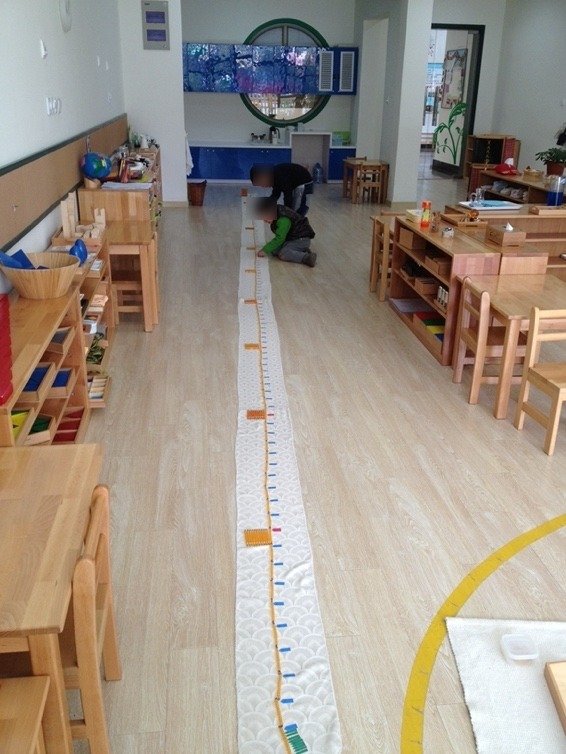
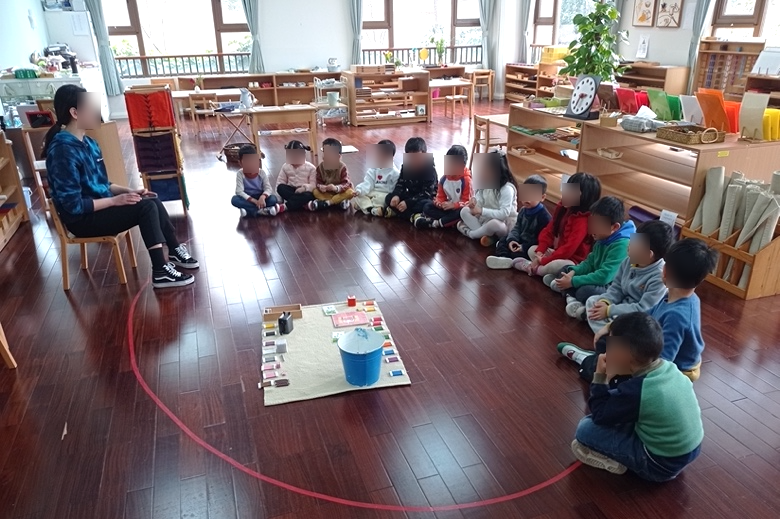
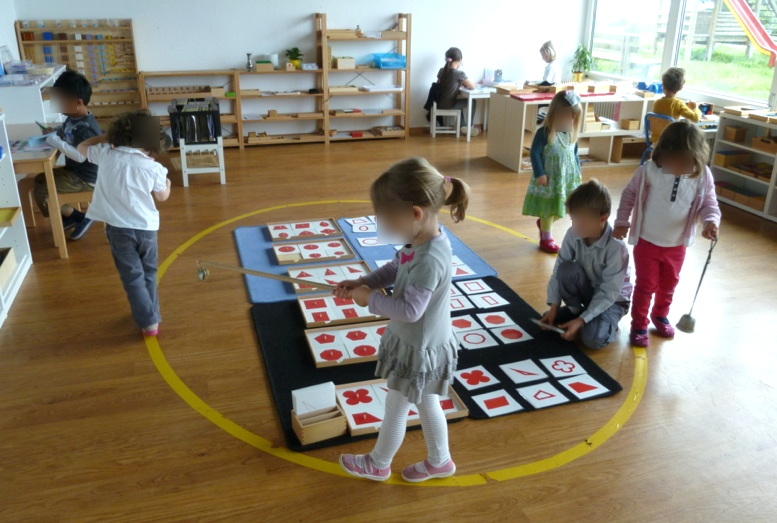
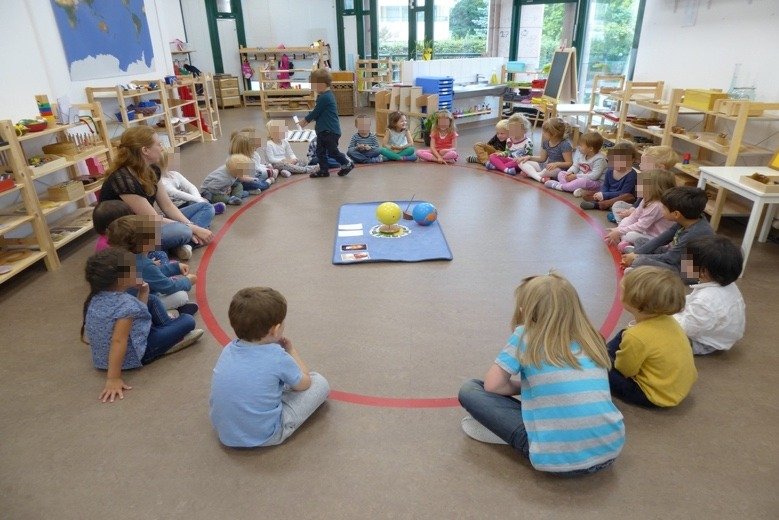
The next activity to plan for is the next in size: Walking on the Line. Ideally the line should in the shape of an ellipse, but often it isn’t, which is a little surprising, as it’s not hugely difficult to create: all you need are three adults (or one adult and a couple of Montessori-trained 4-year-olds), some string and a marker. The main purpose of the line is for walking, but as it’s a large space and without obstacles, the whole group can sit there, so I also like to use it for circle time. For this reason, the dimensions of the ellipse are determined by how many children are in the group: a class of ten 3-year-olds won’t take nearly as much space as one containing thirty children aged 3, 4, 5 and 6. I also ensure that a certain number of mats (4 seems like a good number) can fit inside the ellipse.
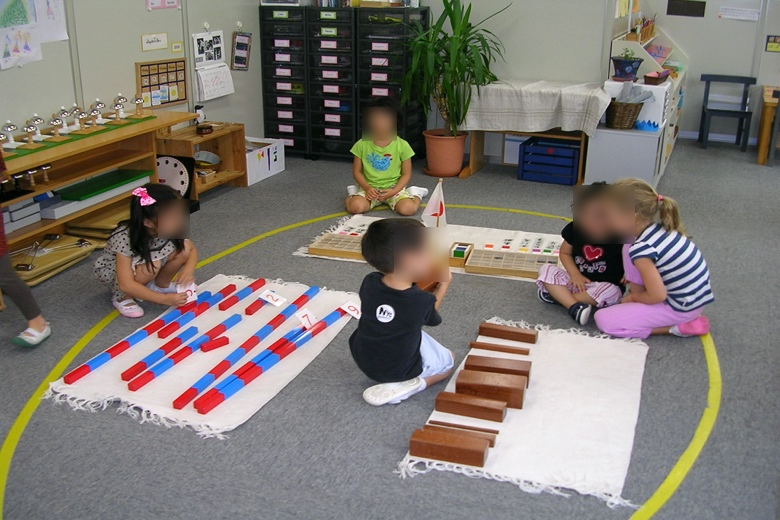
- Maria Montessori, The Absorbent Mind, p. 89.
The next issue to resolve is where to place the shelves (and tables) devoted to each area of the curriculum: Practical Life, Sensorial, Language, Mathematics and Culture.
Mathematics Area
In Montessori, all activities move from simple to complex, but in Mathematics the progression is most clearly defined, so I like to place the Math shelves in a straight line, whilst also factoring in where the 1000-chain mat will be used. This layout allows me to add a continuous rim shelf, running the length of the wall above the shelves, where I can display materials such as the Control Charts used in Group 4.
Decimal Beads
During my training we were told the Decimal Beads should be brought to a mat, where the children can then select the quantities they need for the operations (addition, subtraction, etc).
However, I’ve worked in and observed environments where this system is in place, and it rarely goes as smoothly as during the training: the materials are too big and too extensive, and the children are too small.
It makes more sense to leave the Decimal Beads on the shelf, where the children can access them easily, so when I lay out the Math shelves, I lay out the Thousands, Hundreds, Tens and Units so they’re on the same shelf, from left to right, clearly separated and readily accessible, ideally on a lower shelf …
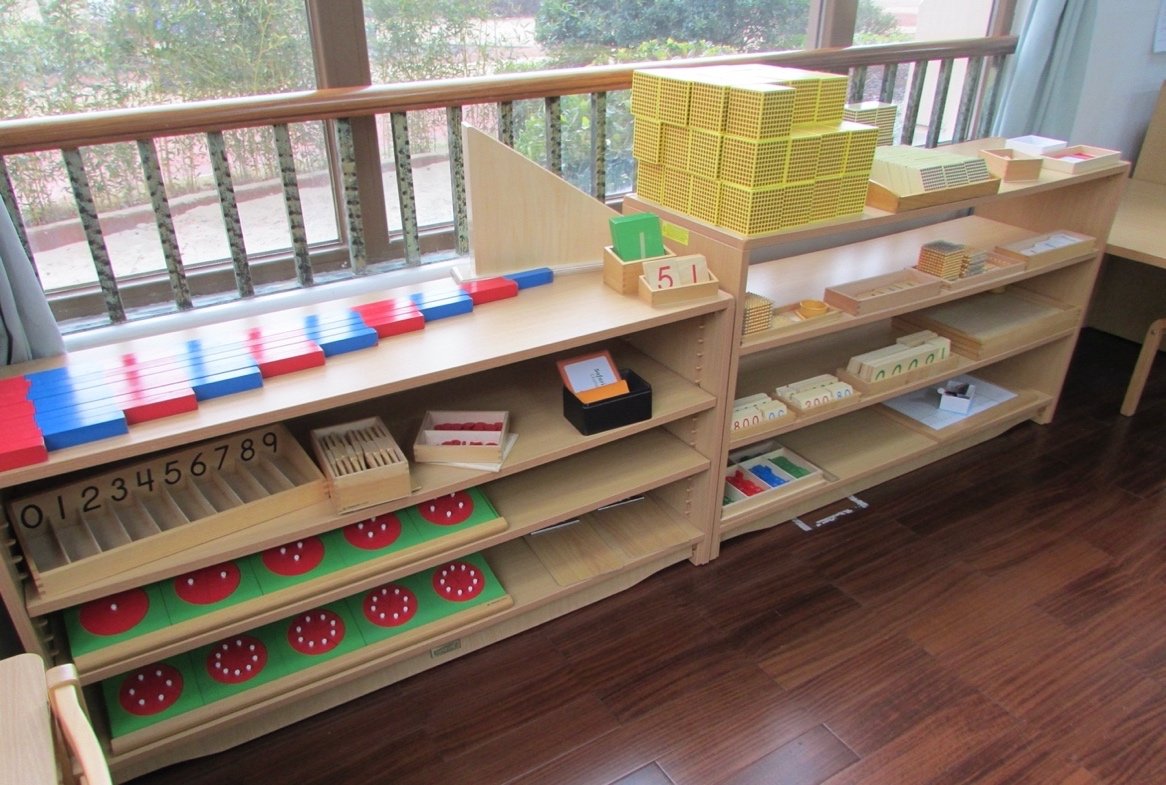
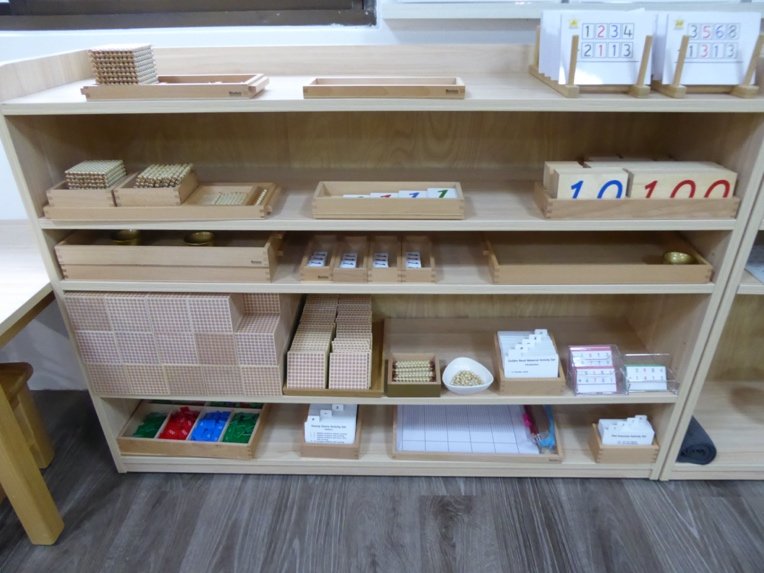
Language Area
I also like the Sandpaper Letters to be placed horizontally and in line, on a narrow rim, rather than in a box or on a vertical display shelf. In this orientation they don’t take up as much space and I notice that the children use them Letters more when they’re clearly displayed. An indirect benefit is that that it reinforces the sequence of the letters.
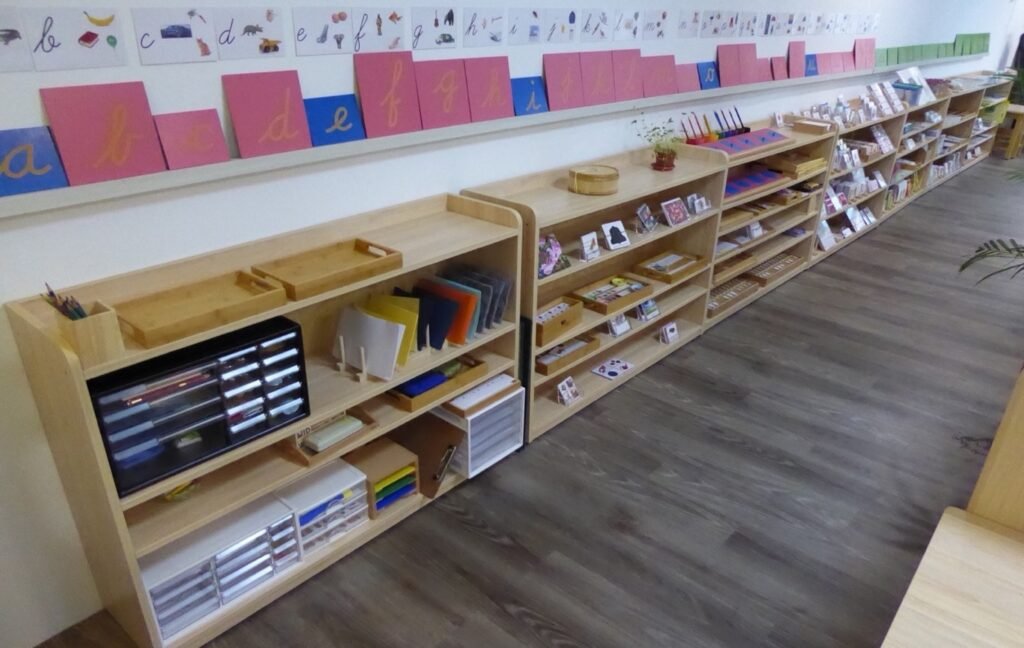
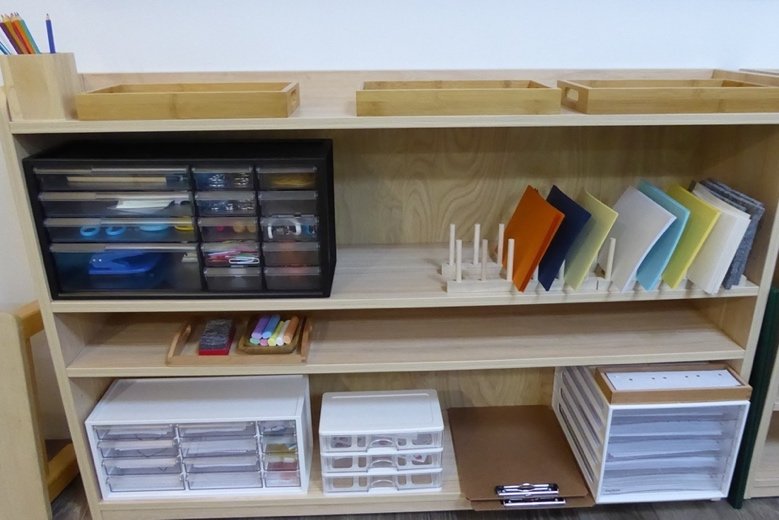
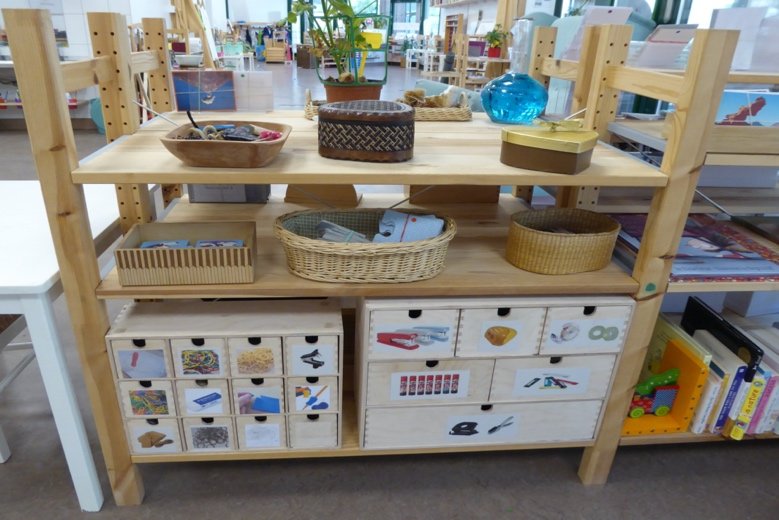
A stationery section is very useful, and the children will maintain it as long as its clear which supplies go where, so if the boxes/drawers aren’t clear (see-through) I attach a photo of the contents to each container.
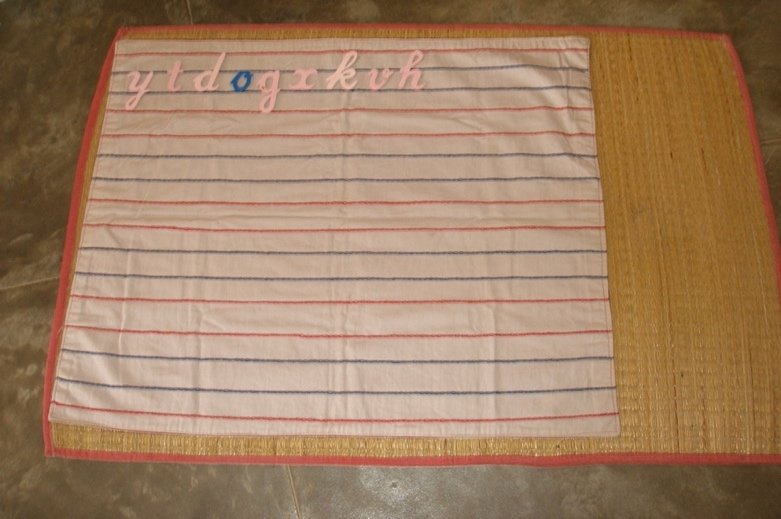
I like to prepare a table with lines (created using tape of different colours to be used with the Large Moveable Alphabet. In my experience such a table gets used far more often than the mats, perhaps because it reduces the aggravation of setting up all the mats that are necessary for the box(es) with the letters and the writing:
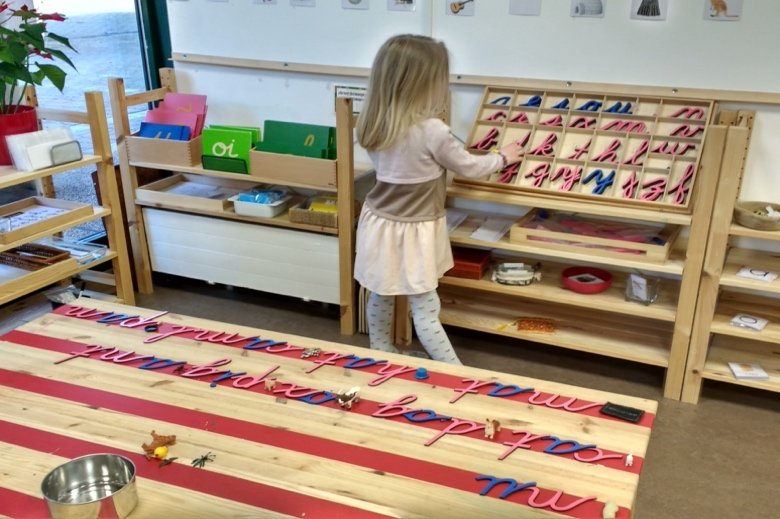
As with many aspects of the Montessori approach, it’s not difficult to gauge if you’re doing the right thing: just observe the children, how often they use the materials and how they use them, then adapt and update accordingly. More on this topic in the Materials – Language section.
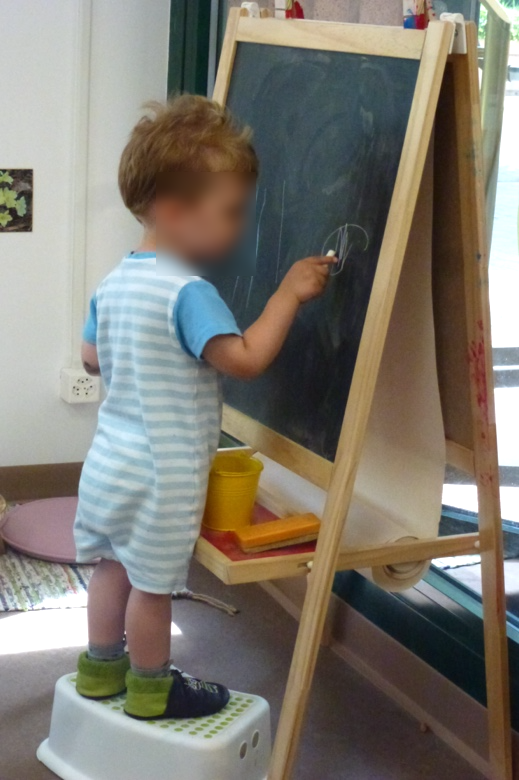
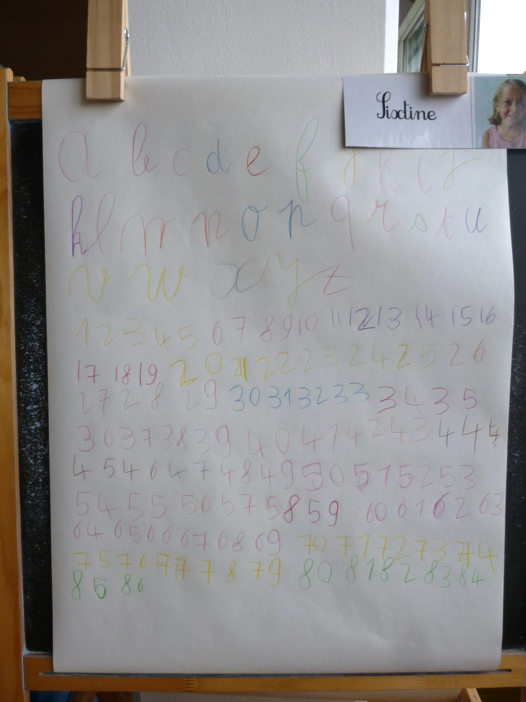
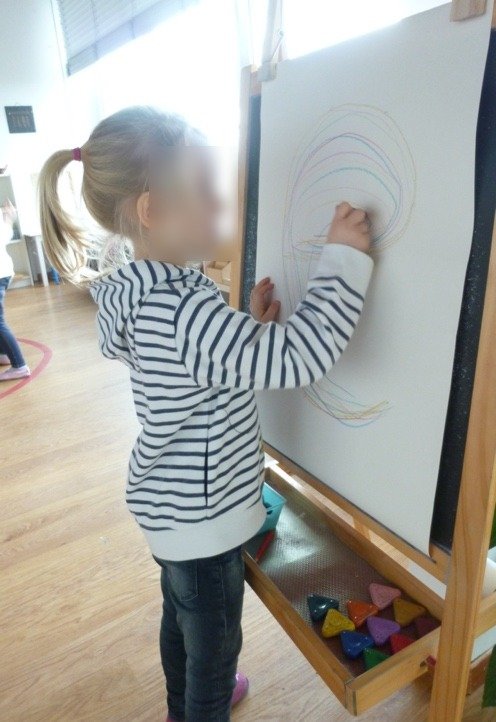
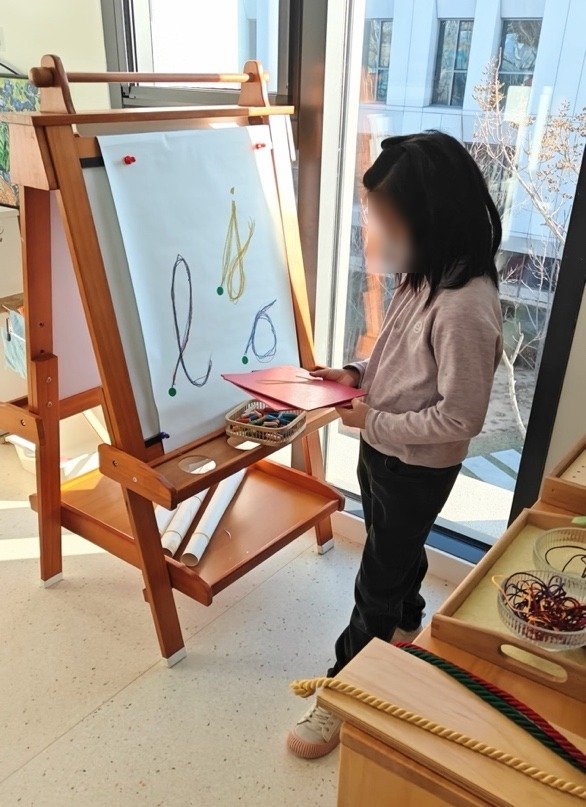
Easel
There are many writing activities when the easel comes in handy, so I place it between the Language and Art areas.
It attracts all of the children, from the youngest/smallest to the oldest / biggest…
Sensorial Area
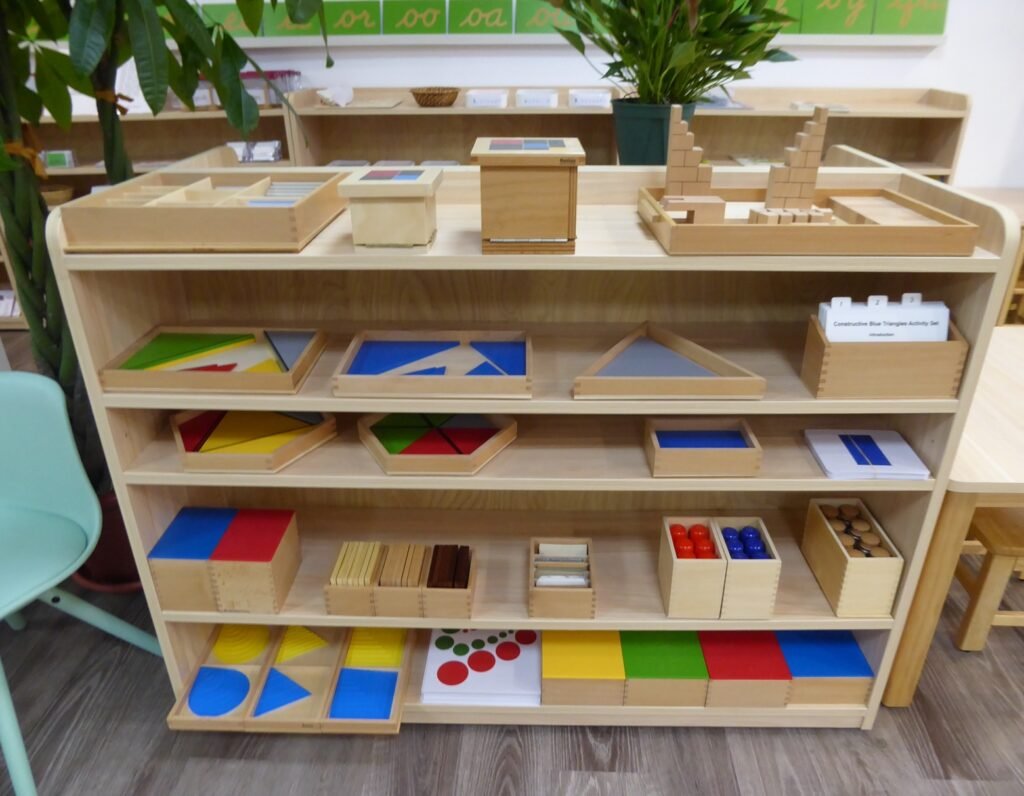
The Geometry Cabinet is one of the first activities a 3-year-old will be introduced to, and for this reason it’s often placed on the top shelf, and -as a consequence- the smaller children have very great difficulty in opening the drawers and choosing the shapes. For this reason, I prefer to place the Cabinet on one of the lower shelves so the child can look down on the open tray of shapes. Another point in favour of adjustable shelves.
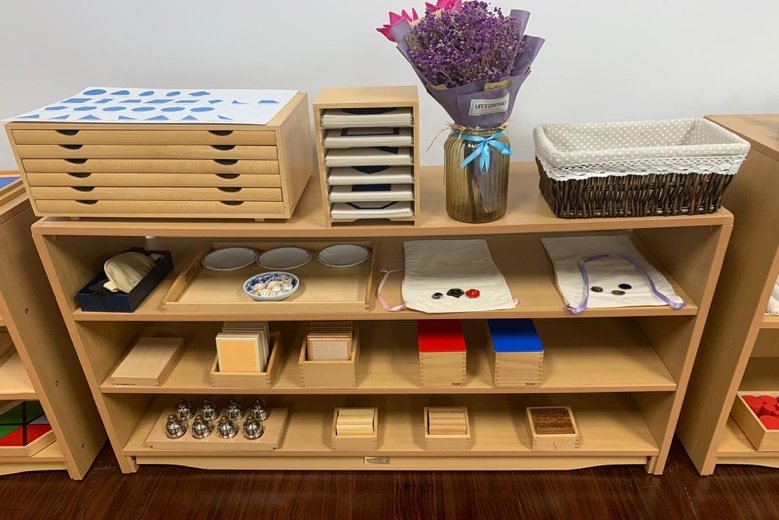
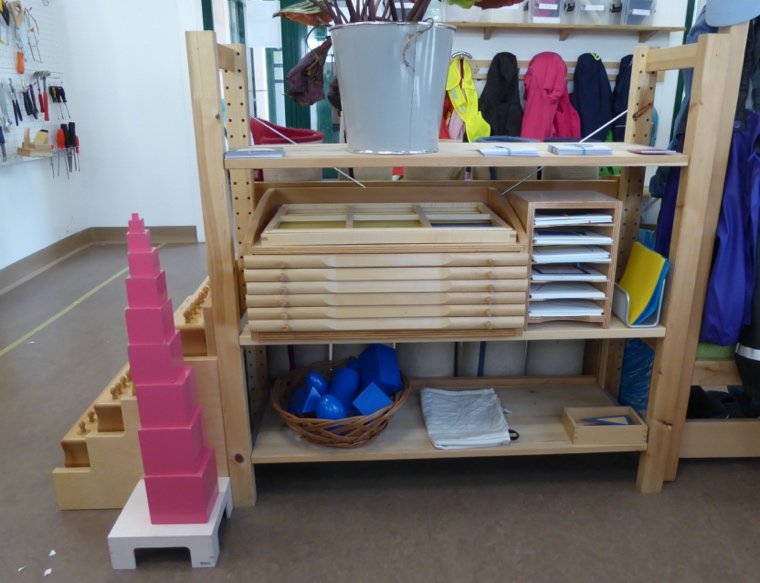
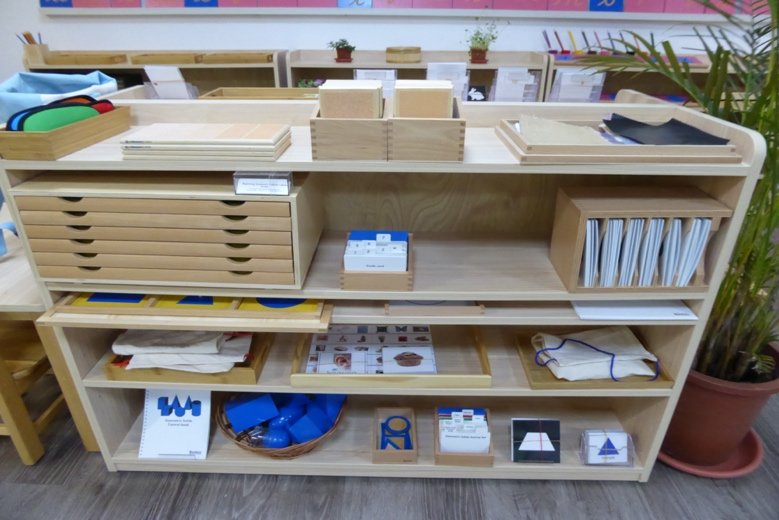
Bells
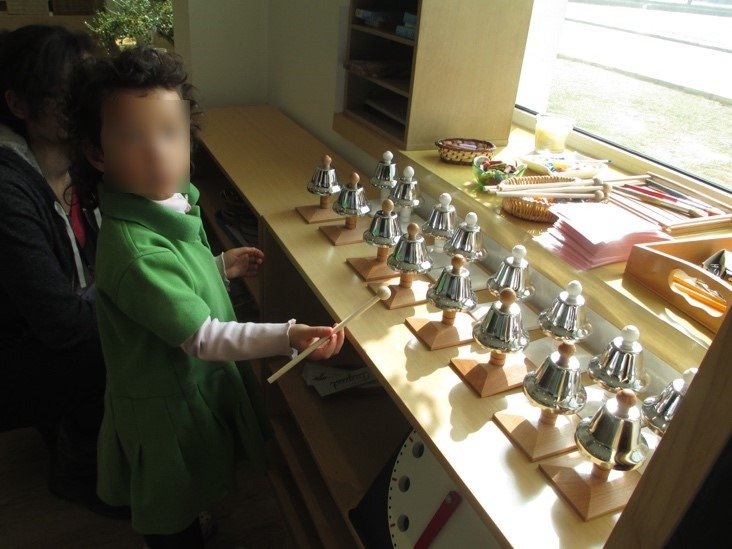
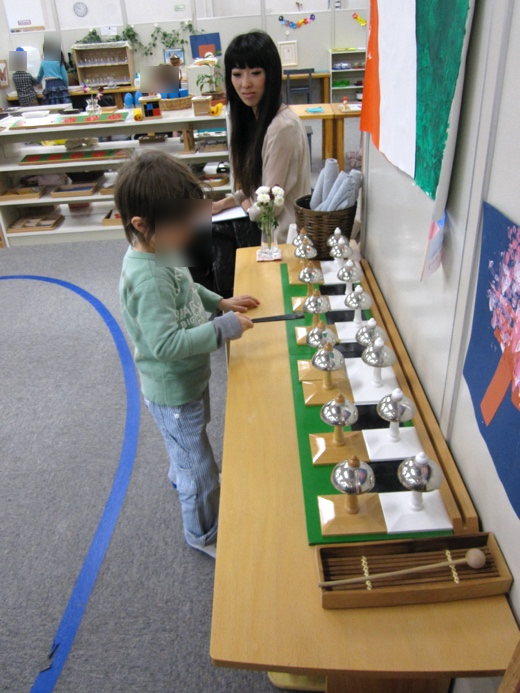
Apart from the size of the table – one of the biggest things in the room- you have to think about how the bells are used and locate them appropriately: next to Book Corner isn’t ideal, and neither is close by Snack Table or the Peace Table. Having said that, I enjoy it when the sound of the bells fills the class, so I also don’t like environments where it’s stuck in some far corner.
Boxes: open or closed?
When I ask teachers why they keep the lids on the boxes, the most common justification is ‘dust’ and I think to myself, ‘If only there were 25+ plus children available, children who not only enjoy dusting but have been shown how to do so …’
For me: boxes must be open. Always. The materials are beautiful and -as was incessantly drilled into our heads during the training- they should ‘call’ to the child.
Practical Life Area
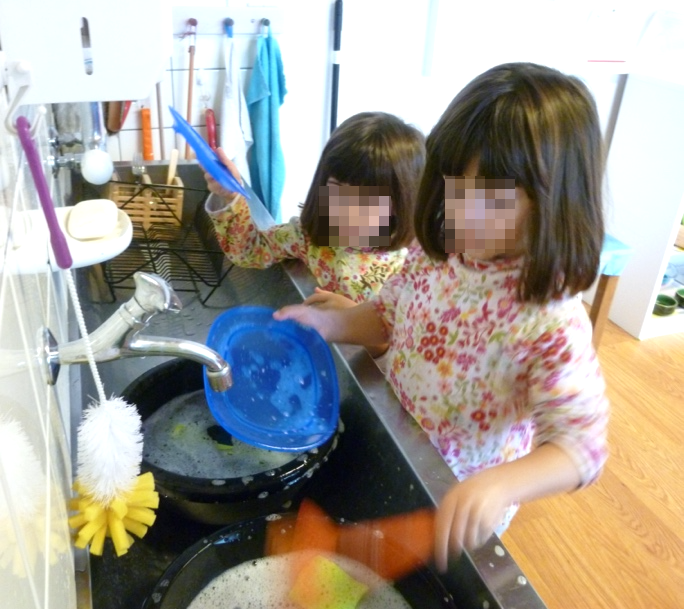
Many PL exercises require access to water and/or a sink – Washing Hands, Washing A Table, Care of Plants, Pouring Liquids, etc, as does the Snack Table – so it makes practical sense to place these shelves near a sink and a faucet.
Obviously, if you have twins in your class, it’s twice as important.
More on this topic in the materials section.
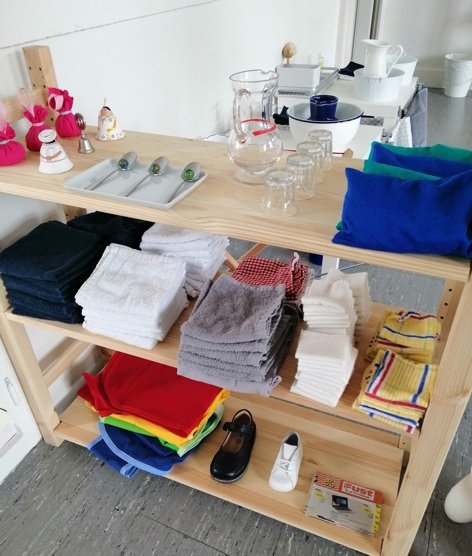
As well as shelves for the materials on the trays, it’s also necessary to factor in a shelf for towels and other supplies such as sponges, tissues, etc.
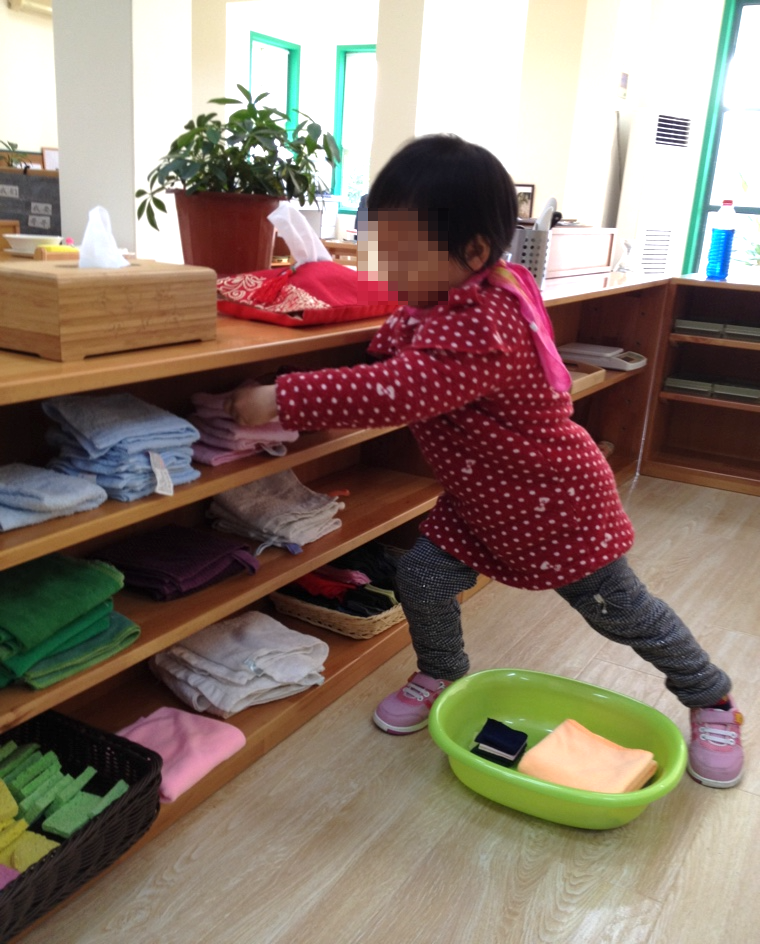
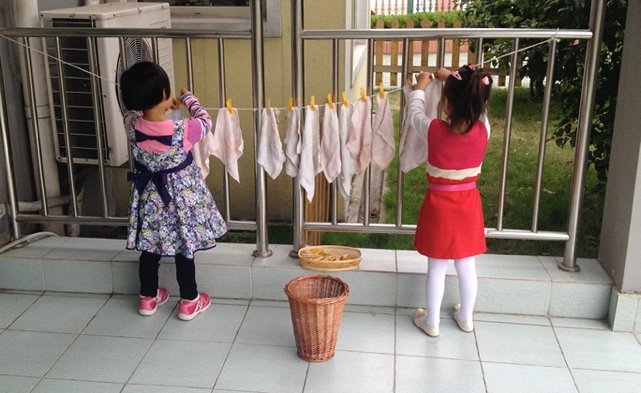
… and what to do with wet towels, cloths, etc. Nienhuis sell what they describe as a ‘Doll clothes airer’ and that’s pretty accurate as you can’t fit much on there, apart from a couple of sets of doll clothes. If you have access to an outdoor space it’s ideal, because it’s been my experience that your typical Montessori class will wet quite a few towels over the course of a day.
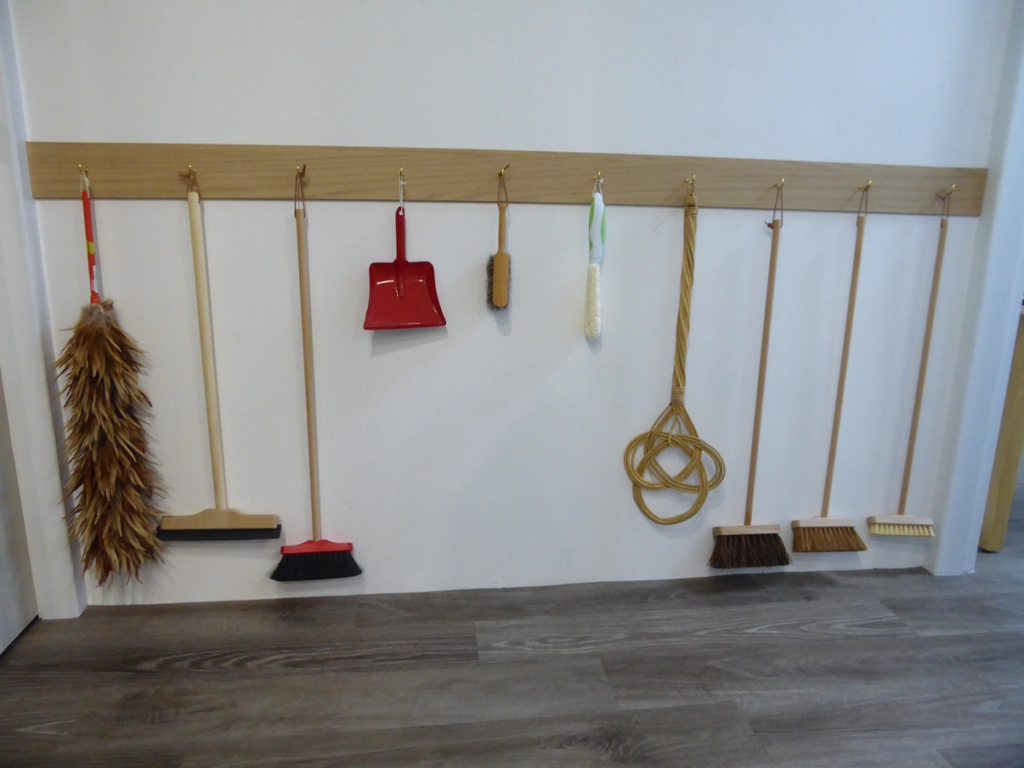
Brushes, etc.
It can be a challenge, figuring out where to keep the assorted brushes: I’ve found that the more types you have, the more the children are inclined to use them, so I try and have a variety of shapes and size available. In my class in Taipei there was the perfect space, a wall between two rooms that weren’t part of the environment.
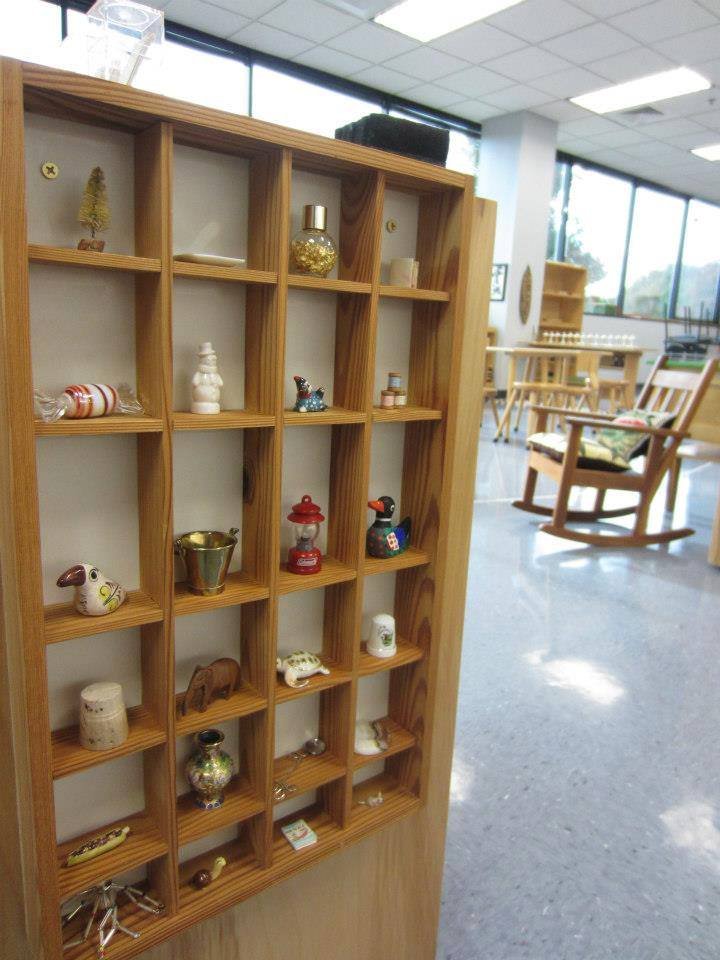
Polishing - Objects
These days it’s possible to buy some beautiful objects to be polished, so having them on display is both practical and aesthetically pleasing.
Woodwork
In Geneva I came across a child-sized carpenters’ bench for sale in a second-hand shop, so I was able to set up a woodwork corner.
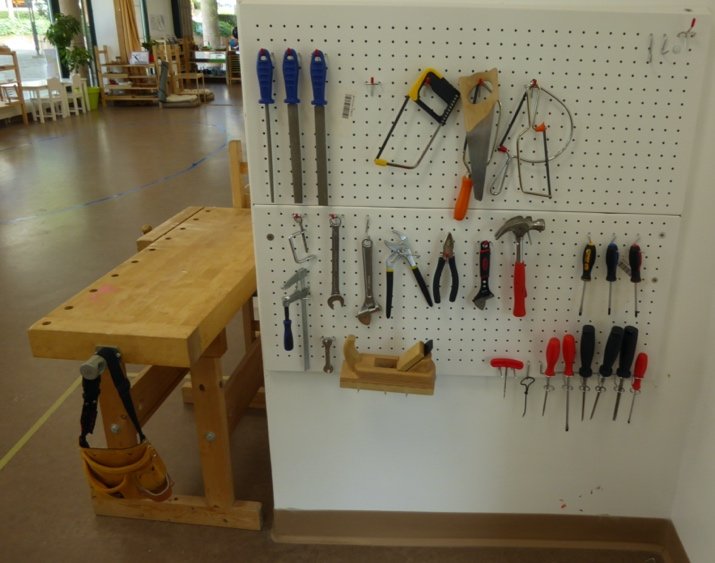
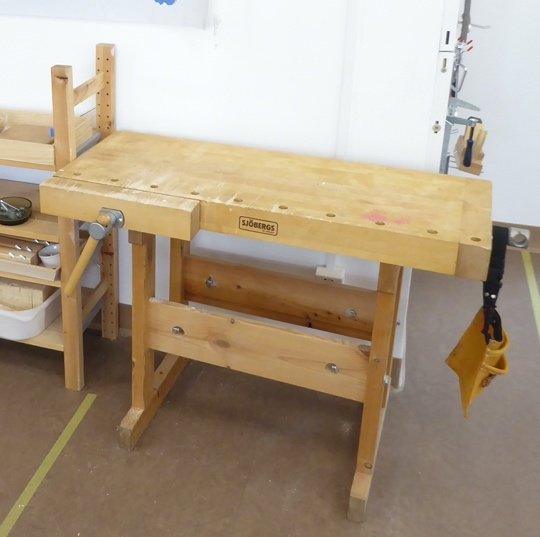
Layout of the tables
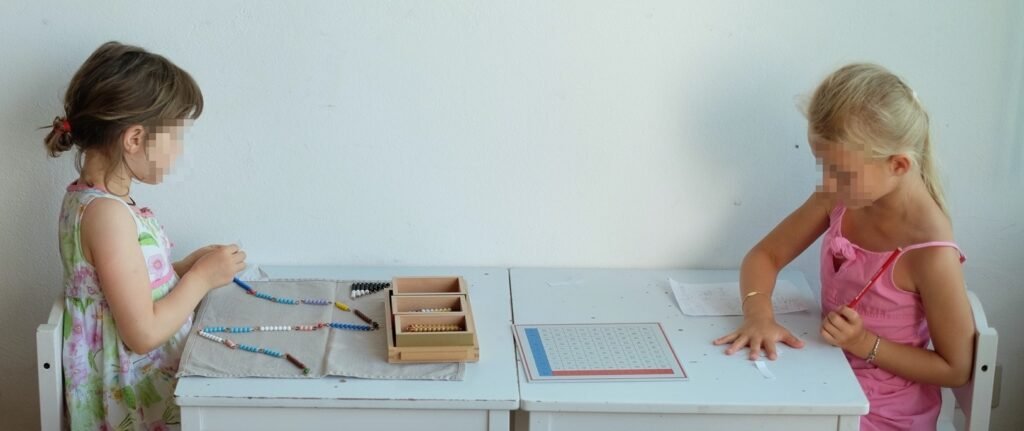
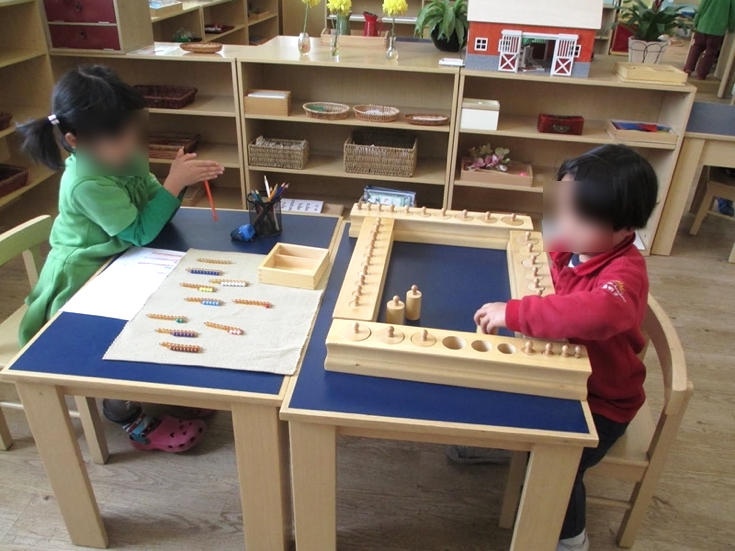
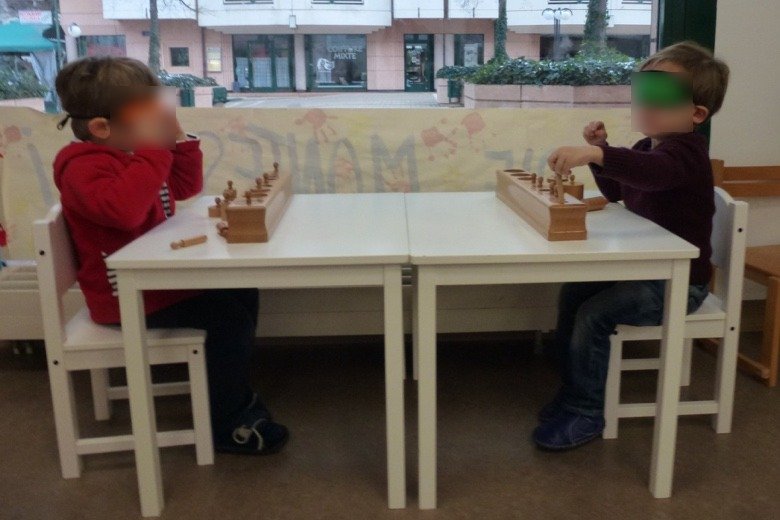
Unlike in traditional classrooms, there aren’t rows of desks in a Montessori class, but tables placed individually or in pairs throughout the room, so a child has the option to sit by themself or alongside a friend.
I’ve visited schools where the tables are placed individually, in isolation from each other, out of concern that a child couldn’t concentrate with another child alongside them, but it’s been my experience that children are often more resilient that they’re given credit for, and this arrangement feels antiseptic, sterile even, so I avoid it. I prefer to have individual tables, we well as others in pairs, beside or facing each other:
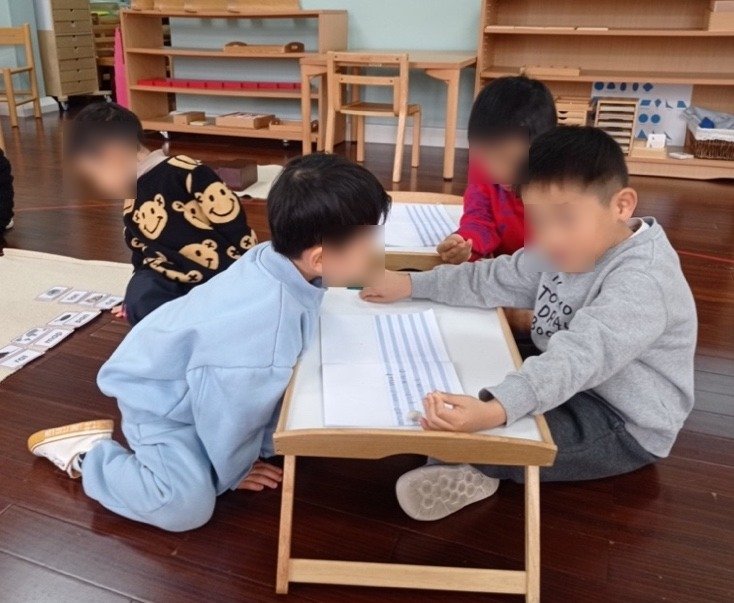
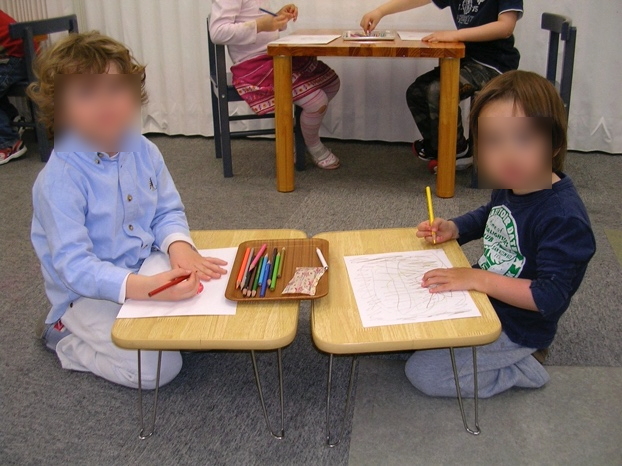
Portable tables with fold-away legs are also useful for a variety of activities, particularly writing …
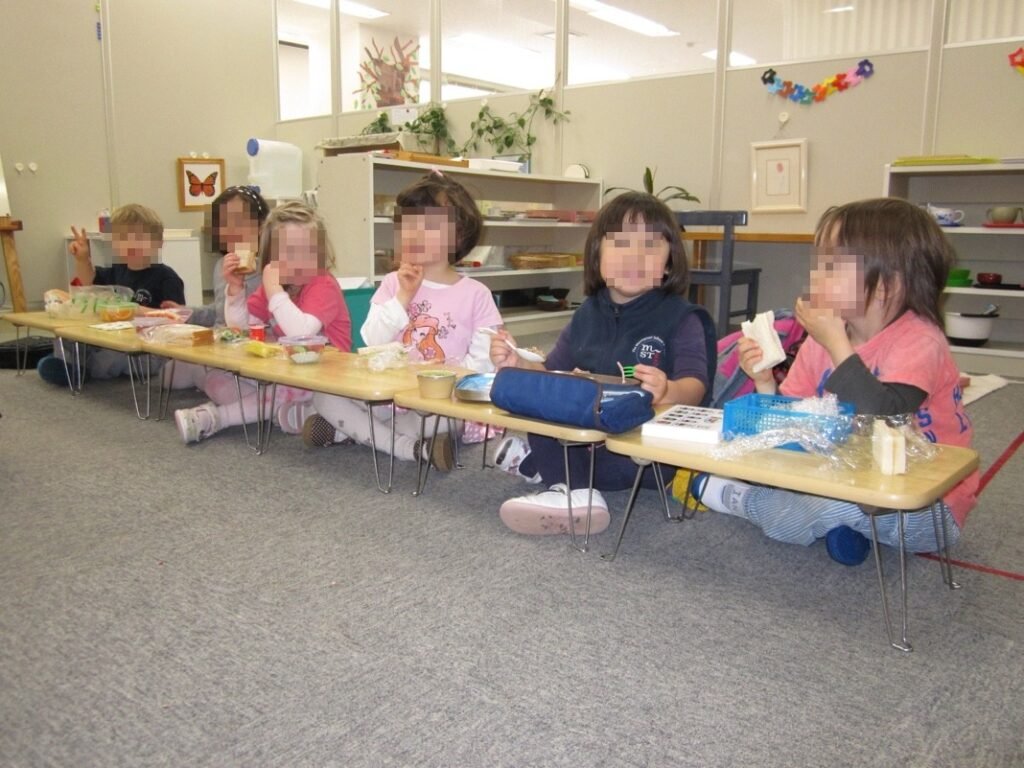
… or having lunch.
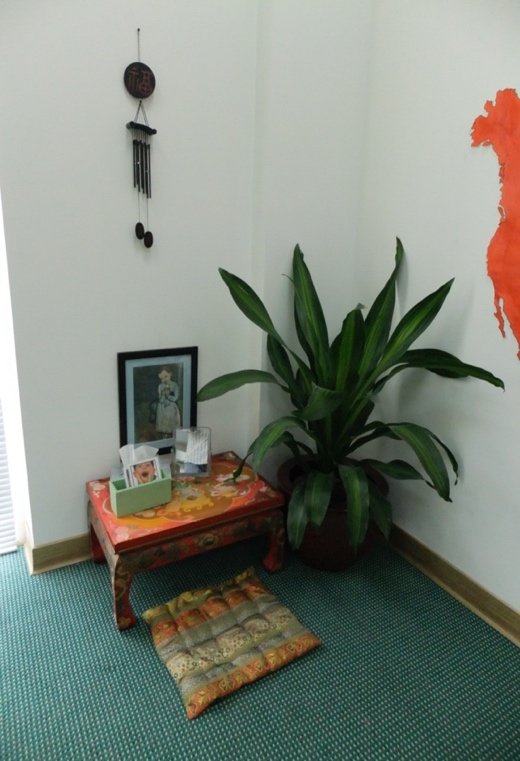
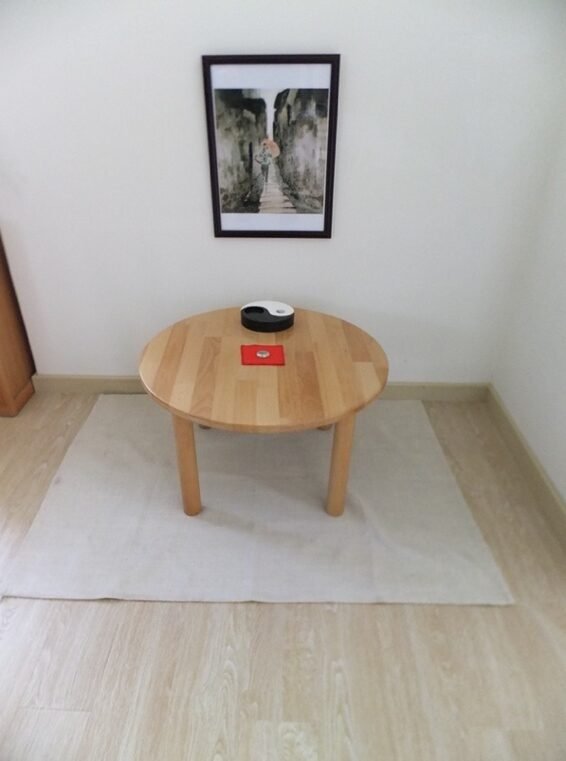
The Peace Table
I’ve seen two kinds of peace corner: the first is an area devoted to calmness and reflection, in which the child relaxes and is led to meditative thought, the second a place where the children can go to resolve their issues by speaking with and listening to their classmates. Whichever you prefer, it’s better if the Peace Table is located in a quiet, mellow corner of the class, away from the entrance/exit, the bathroom or the shelf with the bells, etc.
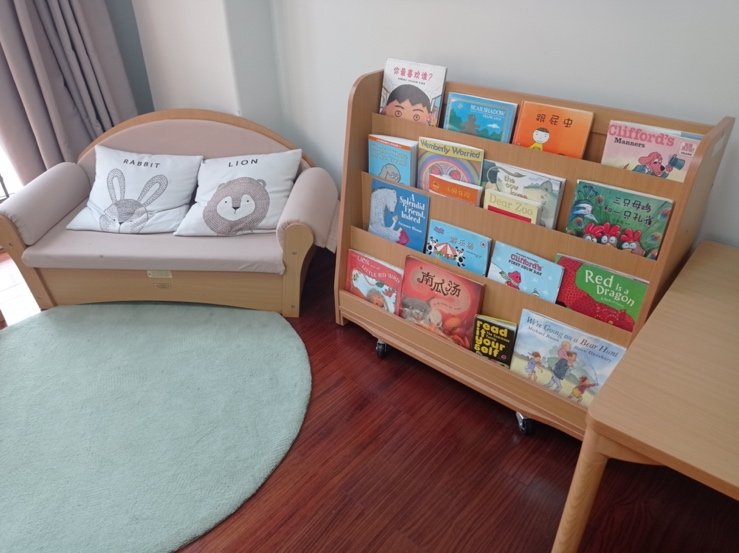
Book Corner
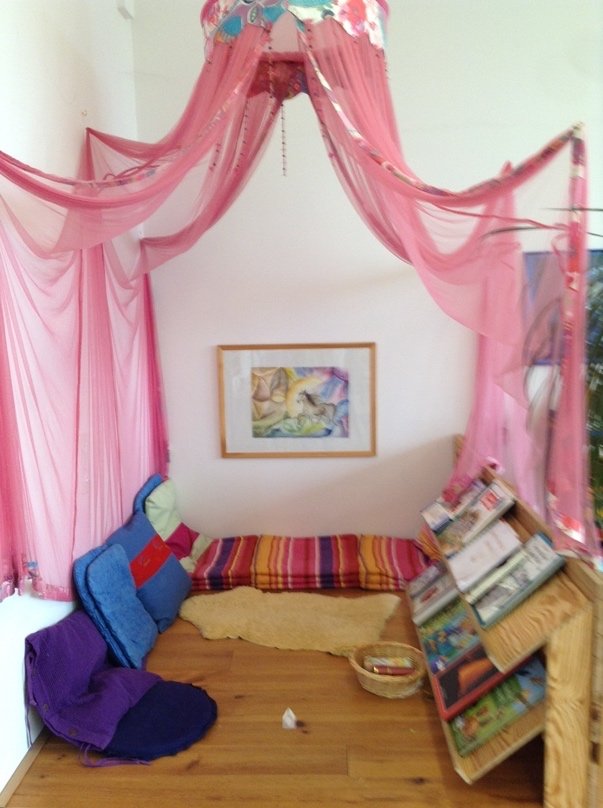
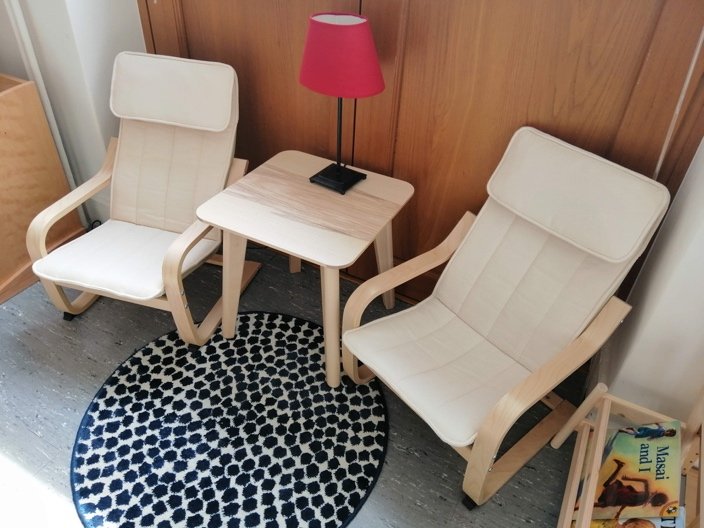
Every class needs a place where children can sit and read, whether that’s reading words or looking at the pictures and creating their own story with their imagination. It can be as ostentatious as the one I came across at a Montessori school in Lucerne (Switzerland) …
Or as simple and neat as these examples.
Plants
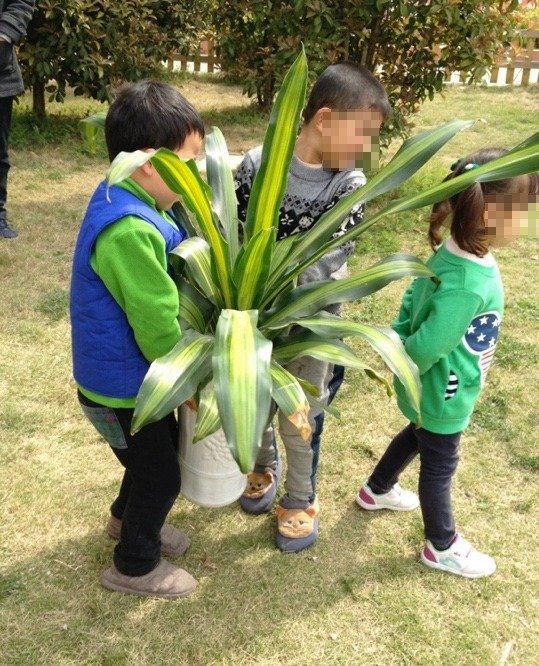
It’s important to have an array of different plants, large and small, with leaves in a variety of shapes and sizes so the children can get a lot of experience cleaning them. Watering plants is one of the most popular activities in the class, so it’s nice to have some bigger plants sitting in pots on the floor, and others on shelves.
As for which plants to buy … here’s an article from the good folk at Missouri Botanical Garden, another from a homeschooling blog, from Edutopia, from the English Gardens website, and this one from Horticulture magazine.
This is a useful article from the University of Florida on Houseplants That Clean the Air, this article is from HowWeMontessori blog and this is an interesting article on the best classroom plants for multi-sensory learning.
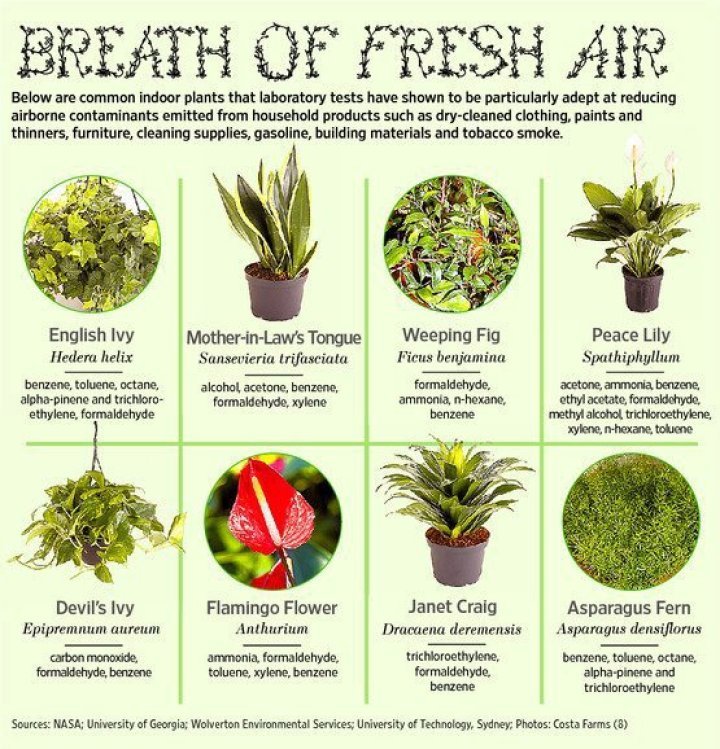
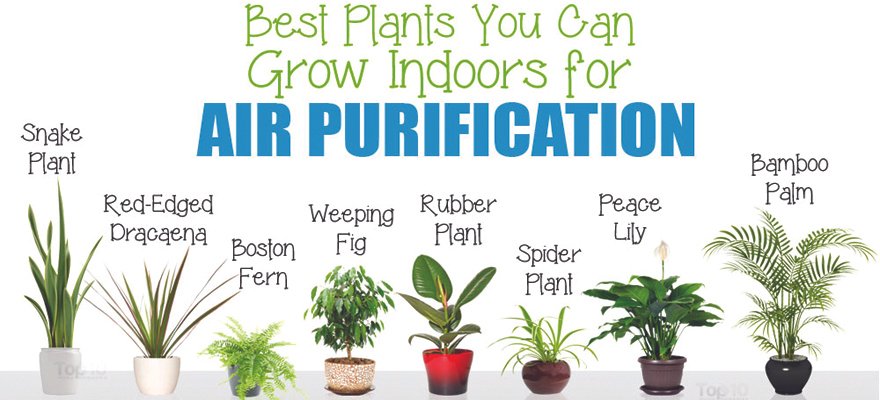
Source – https://www.miltons.law.za/air-purifying-plants-for-office-and-home/
Nevertheless, no matter how much care they get, sometimes a plant, like a child, just needs a little time in the sun.
Bathroom
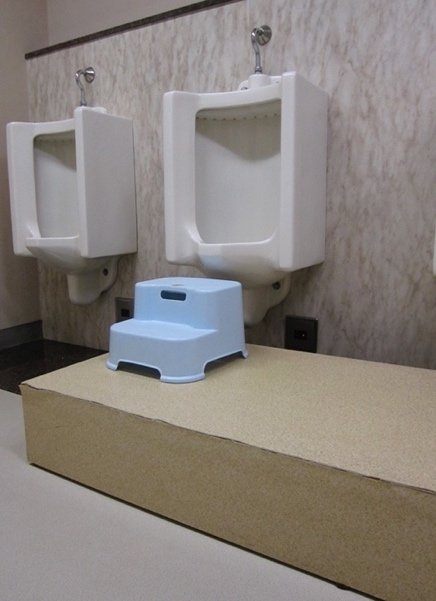
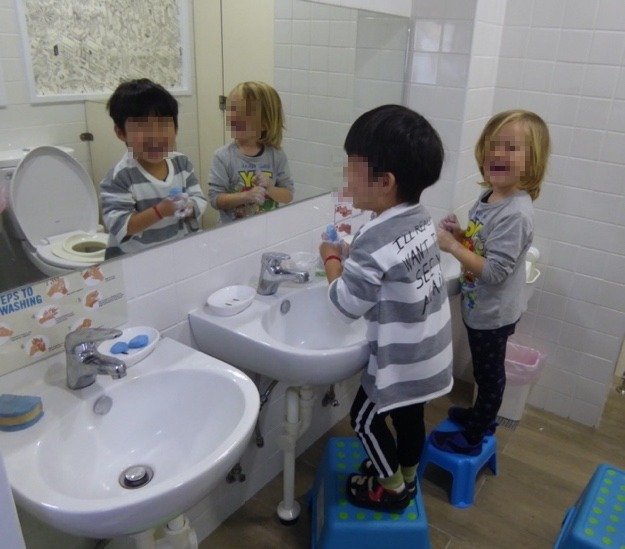
It’s better if there is access to washroom facilities within the environment, and better still if they’re child-sized, but if they aren’t, I’ve found the children can be quite ingenious …
Mirrors
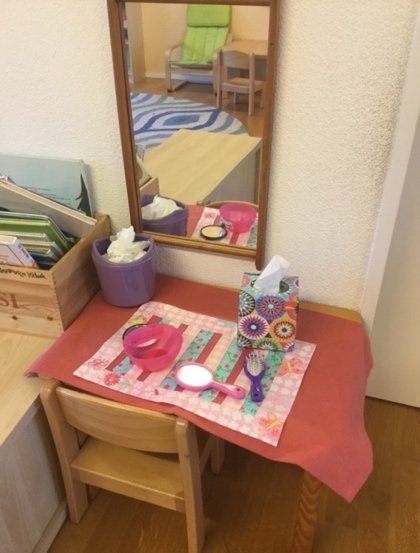
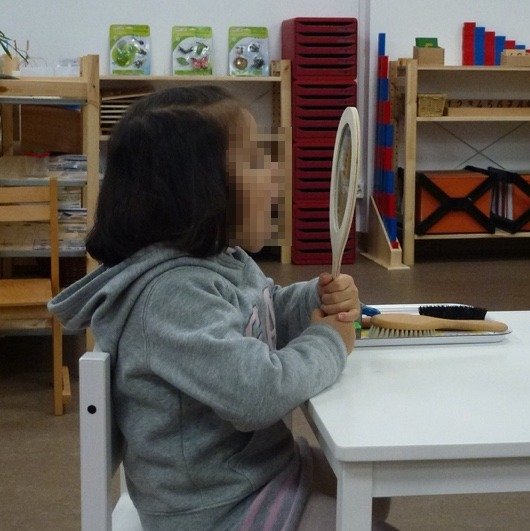
I prefer to have two mirrors in the class: one of them wall-mounted -hung at a height suitable for children- and another that is portable so it can be carried to a table, where the children can brush their own or their classmate’s hair. Or examine their teeth.
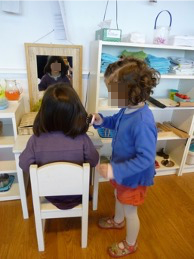
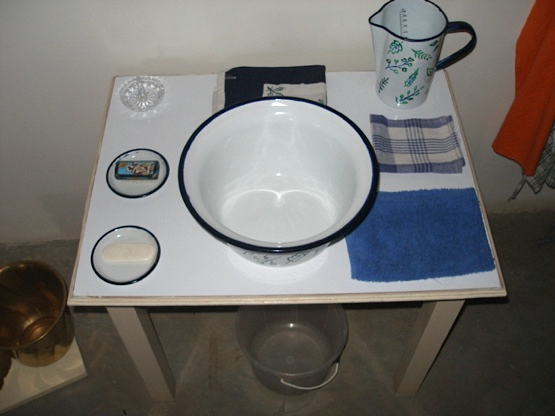
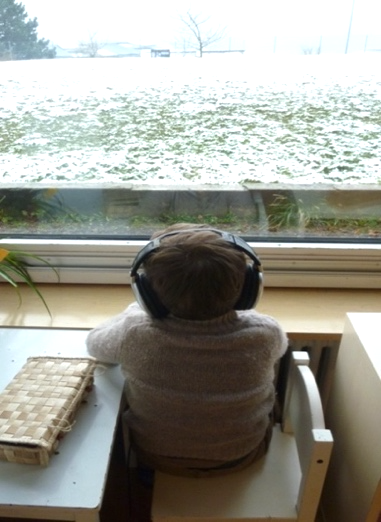
If the environment is spacious enough, it’s useful to have tables that are uniquely intended for: Washing Hands, Headphones, and … … Snack Table.
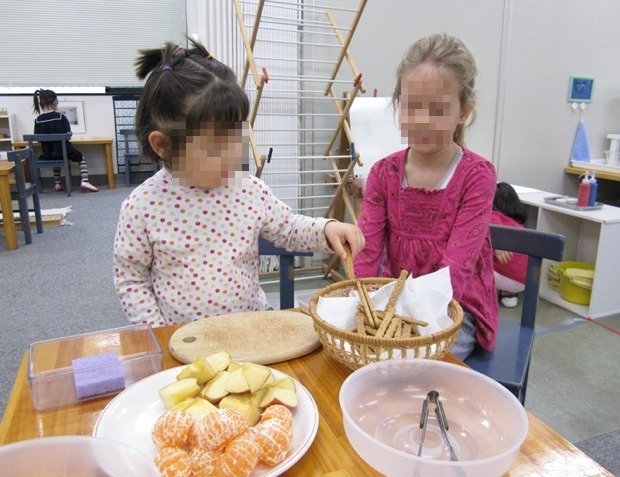
“The teacher’s task is not to talk, but to prepare and arrange a series of motives for cultural activity in a special environment made for the child.”
- Maria Montessori, The Absorbent Mind, p. 7.
Class Decoration
There’s some evidence that Heavily Decorated Classrooms Disrupt Attention and Learning In Young Children, so it’s important not to let decoration get out of control, but what ppictures there are should also be hung at the child’s eye level. Of course, there are all kinds of educational ways in which to decorate the walls:
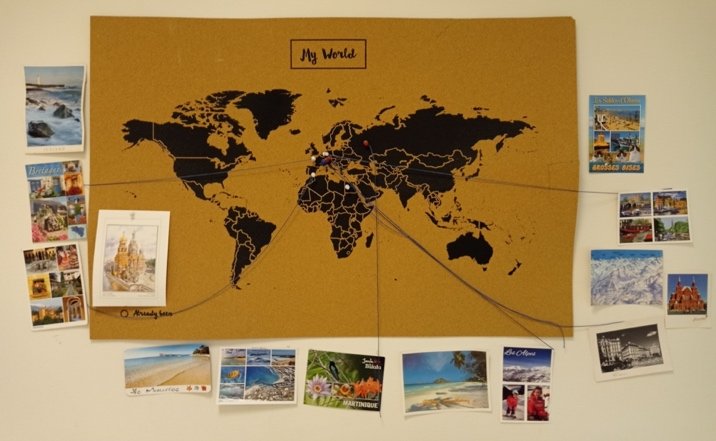
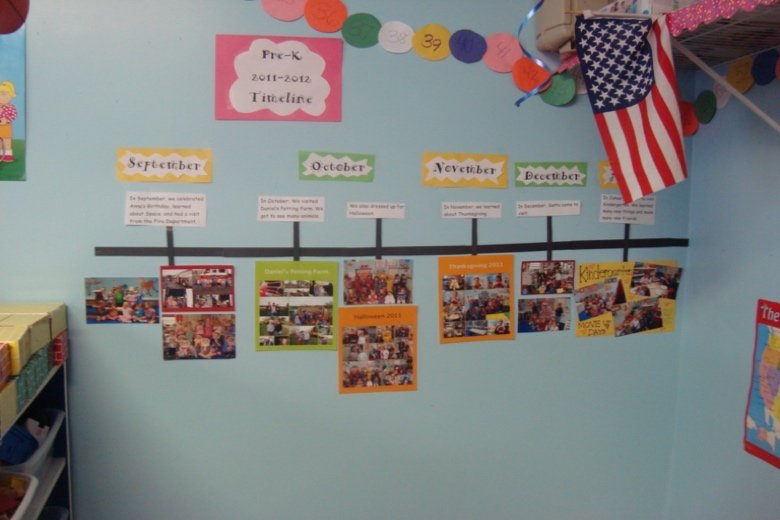
I have blu-tak available for the children as they enjoy sticking their drawings/metal inset paper/math calculations/random writings on the wall. Although it can sometimes get a little messy, particularly at the beginning of the year, they soon get better at displaying it, and it can’t get too out of control because they take everything home each Friday.
Storage and other admin
The materials need to be rotated throughout the year, so it’s important to be able to access them: messy or disorganised storage spaces result in a lot of wasted time and energy. This is the storage I reorganised in Shanghai. Before:
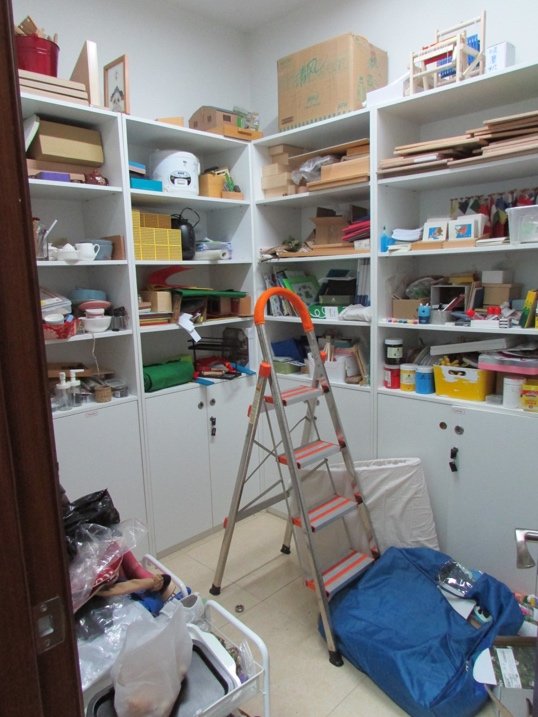
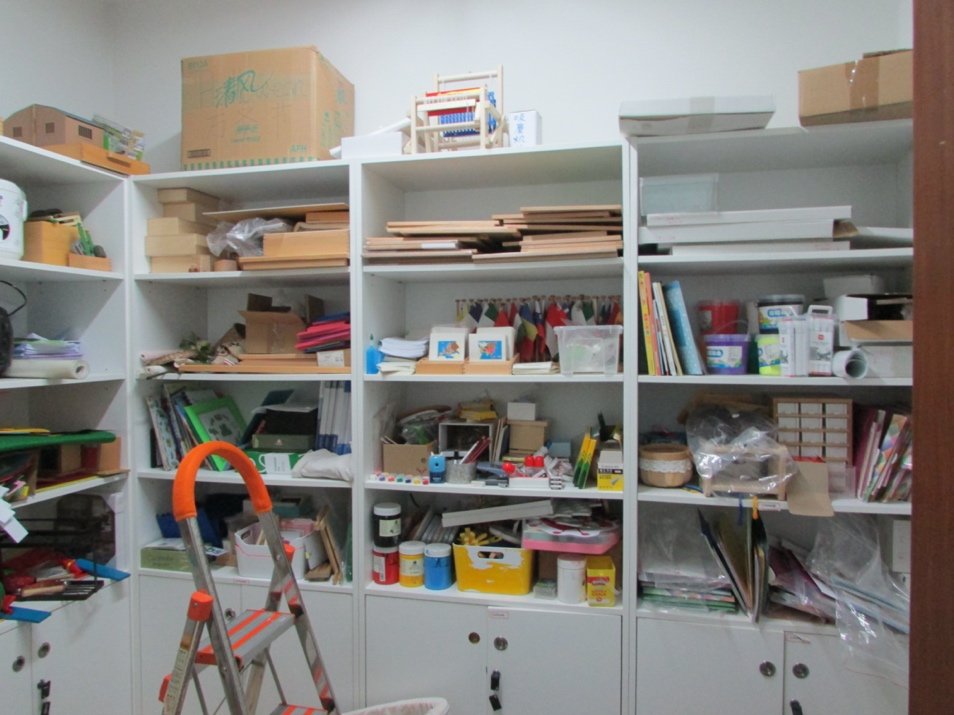
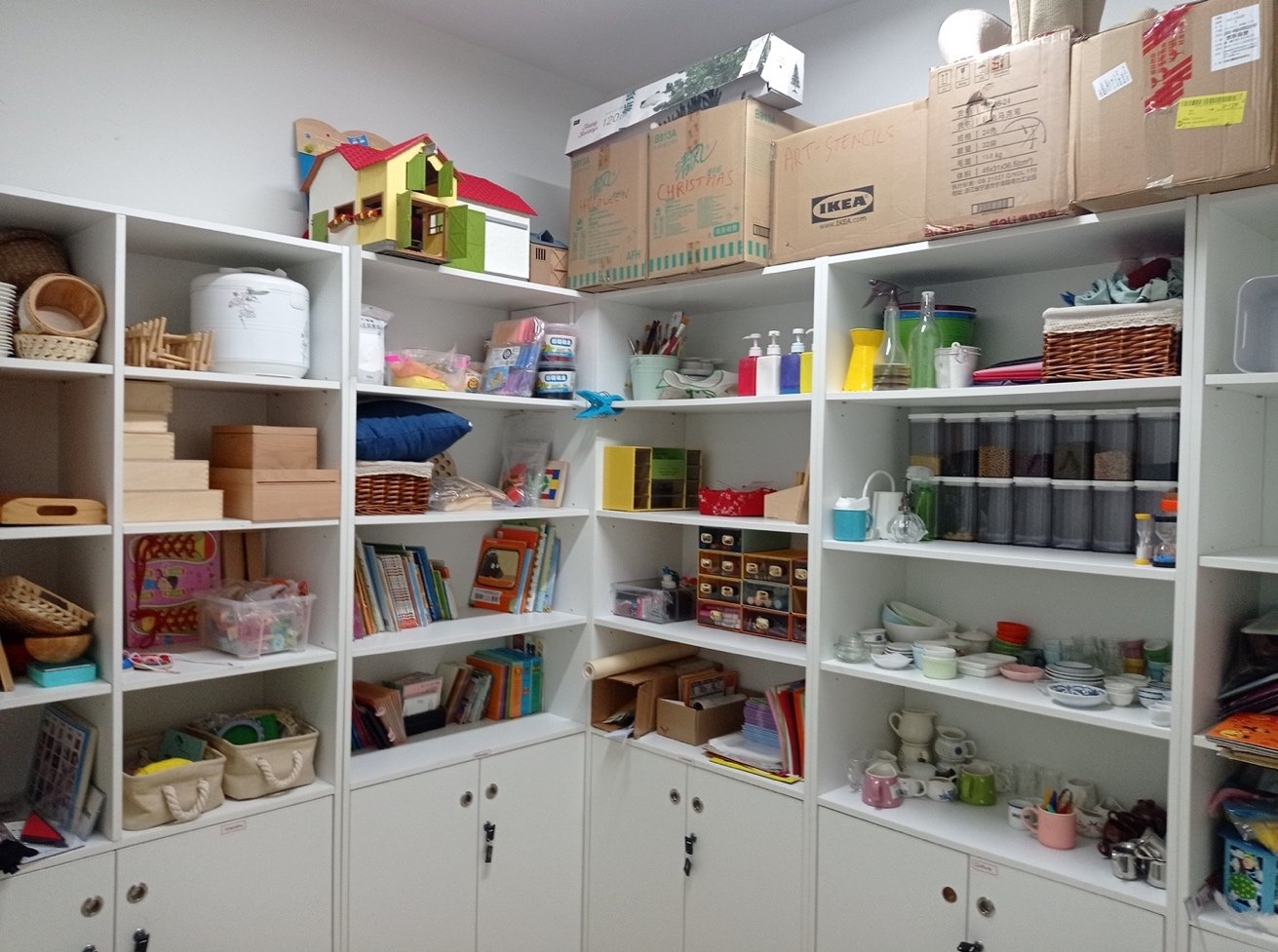
After. Top: boxes for celebrations/holidays. Left to right: baskets/trays – Sensorial – Language + Art – Practical Life.
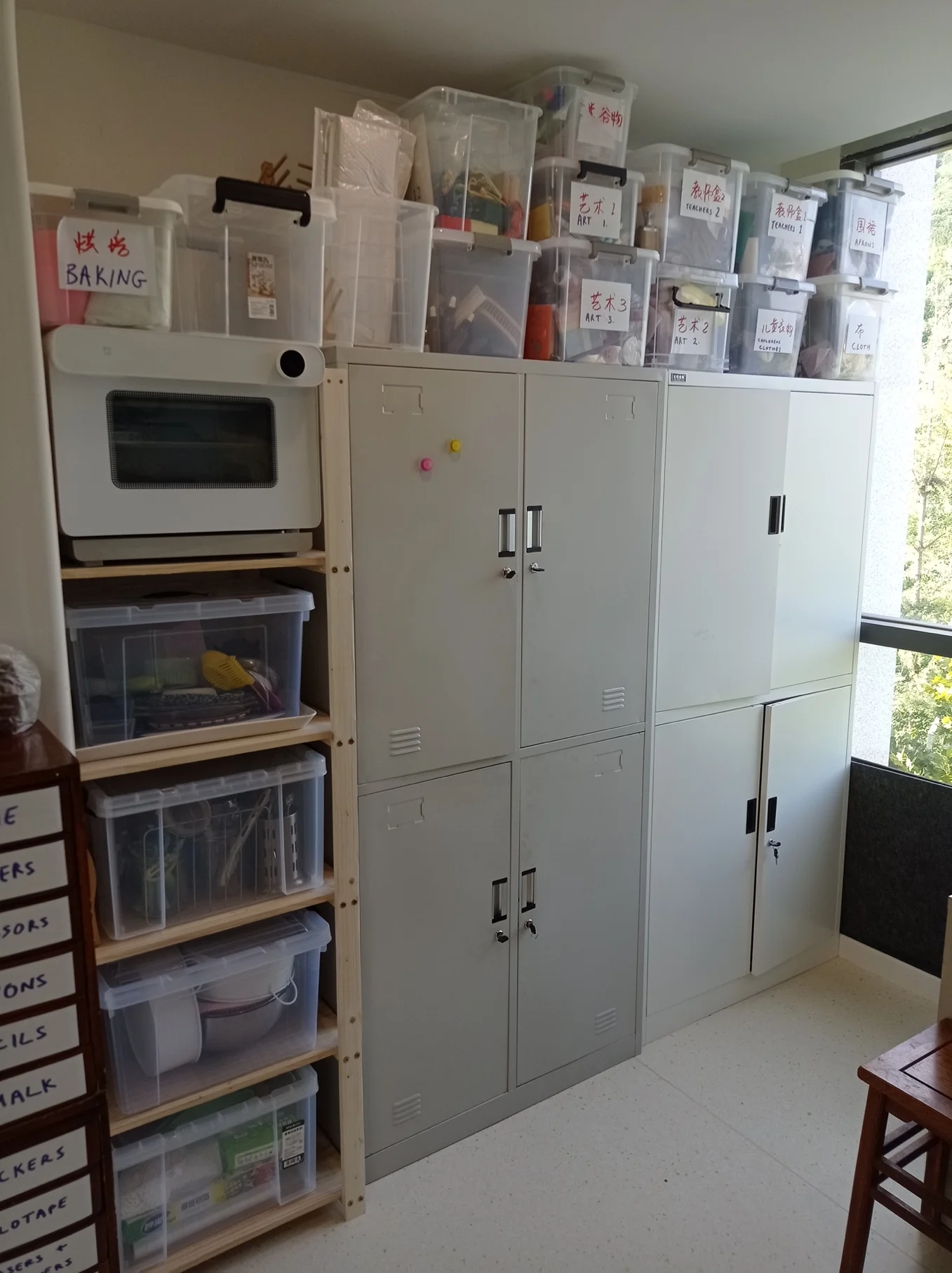
Unfortunately, I don’t have a photo of the madness before, but this was my class in Beijing, after I’d rearranged the storage room. I measured the space between the grey storage boxes, then bought, assembled and installed the shelves to the left, the dimensions perfectly fitting the oven that was previously kept in the class, taking up valuable space. I also bought the boxes, and added (bilingual) labels to both them and the drawers to the left.
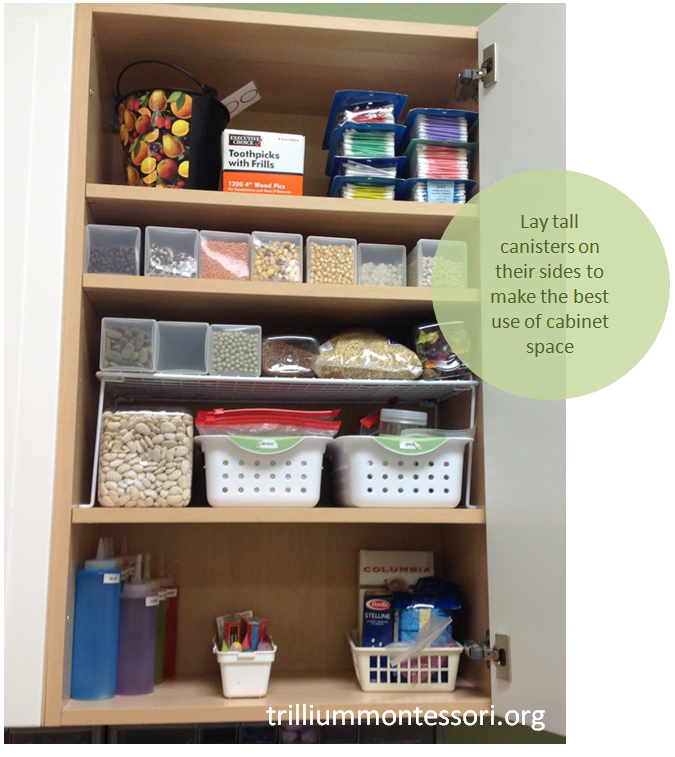
Trillium Montessori are an excellent resource for teachers, with lots of good advice and ideas, for example:
In her article on Preparing the Adult’s Environment, Julia Volkman suggests:
‘Two important areas that are often overlooked in the design of a classroom environment are the need for storage (for the guides personal items, for the didactic materials that are not currently in use and for consumable supplies that will be refilled during the day) and privacy.’
I’m in complete agreement with this. Yes, it’s a house of children, but we -the adults- are also part of the environment, and it’s important that we have our allotted space, even if it’s just somewhere to store a bag or hang a coat. Doesn’t seem too much to ask.
Ms. Volkman also has some practical advice on Setting up the Environment (Primary).
Storing children’s unfinished papers, etc
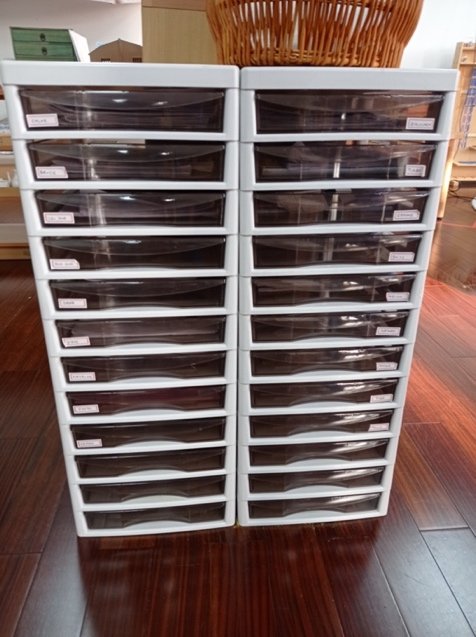
A cabinet like this is invaluable, as it’s easy to label (although I prefer my labels to have photos of the children alongside their names) and doesn’t take up a lot of space. Storage/display of materials on the shelves is a whole other issue, which I plan to address in a separate post.
Windows
Having a source of natural light is important. Particularly when it begins to snow.