Introduction
When I did my AMI training I created Albums of presentations and exclusively used these albums for many years. I use them still, but no longer exclusively: over the course of 20 years I have accumulated a collection of alternative albums containing alternative presentations and alternative ways of doing the presentations in my albums. I see many flaws and gaps in the AMI Albums, and I feel it is important to utilise all resources in order to improve my class, so I’ve been presenting many of these activities for many years now. In this essay I’ll reference some of the options, so teachers have some sense of which options are available. There are four aspects to language -Speaking and Listening, Reading and Writing- and the English Language curriculum covers each of these, although some in more detail than others. Below are the list of presentations in an AMI Language album.
Spoken Language
Enrichment of Vocabulary
Naming objects in the Environment
Social Language
Qualities in the Environment
Parts of Speech
Classified Pictures
Expansion of Oral Language
Conversation
Picture Folders
Stories
Book Corner and List of Children’s Books
Poems and Songs
Anthology
News Period
Question Game
Sound Game
Keys to Literacy
Sandpaper Letters
Movable Alphabet
Writing Stages
Metal Insets
Materials for Writing
Writing Letters
Letter Families
Placement of Letters
Writing Copies
Capitals
Sequence of Letters
Punctuation
Written Question Game
Free Composition
Presentation and Storage of Work
Reading Stages
Object Box 1
Object Box 2
Action Cards
Phonetic Reading
Puzzle Words
Reading Booklets
Reading Folders
Environment Cards
Classified Reading
Definition Stages
Function of Words
Symbol Box, Questions for Symbols, etc.
Article
Adjective
Conjunction
Preposition
Verb
Adverb
Continuation of Commands
Word Study
Word Study
Reading Analysis
Reading Analysis
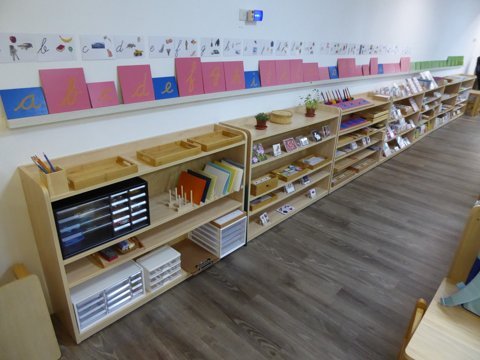
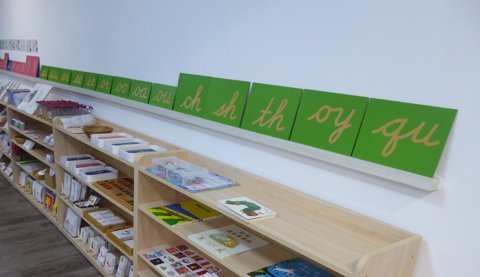
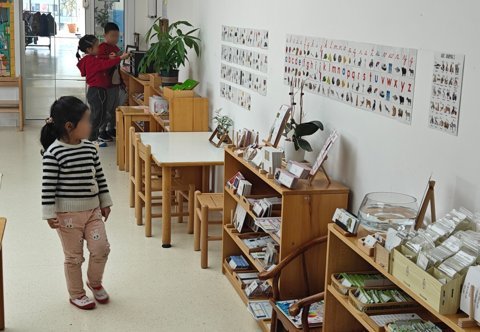
These are photos of the Language area in my classroom in Taipei; the last two shelves were (traditional) Chinese, and the first five shelves were English and contained all of the presentations listed above and many more. Along with the standard AMI-approved materials, there is a wide range of supplementary materials available, so teachers are faced with the choice of whether to include them or not, and if so, which ones. Dr. Angeline Lillard has published a number of papers on this subject, and in an article for the Montessori Society (UK) she discussed some of her findings:
‘As Montessori has evolved, we might say two courses have been taken. One course has been to keep very much to Dr. Montessori’s sets of materials [at each classroom level], with few changes; for lack of a better word I will call this the Traditional approach. The second approach, which I will call the Modified Montessori approach, has been to adopt modifications in a democratic fashion, with each teacher trainer and teacher making decisions about new materials to add to the set [or in cases what to take out]. Some of the added materials are readily available commercially and are not special to Montessori [puzzles]; others are presented at and sold at Montessori teacher conferences or are in Montessori catalogues. The result after some fifty years of this is a wealth of alternative materials in many Montessori classrooms, materials in whose creation Dr. Montessori did not have a hand or mind.’
While I’m in complete agreement that diluting the materials is widespread and generally misguided (the number of environments I’ve visited containing play-kitchens and boxes of Lego, dolls and even toy guns, doesn’t bear thinking about), I also feel that there are gaps in the curriculum, a curriculum that, like The Bible, isn’t updated terribly often. As I discuss the materials in each area, I’ll explain why I’ve ignored some materials and felt the need to include others that aren’t on the approved curriculum, including various alternative non-AMI albums.
Spoken Language
Enrichment of Vocabulary
Naming objects in the Environment
Social Language
Qualities in the Environment
Parts of Speech
Classified Pictures
Expansion of Oral Language
Conversation
Picture Folders
Stories
Book Corner and List of Children’s Books
Poems and Songs
Anthology
News Period
Question Game
Sound Game
The Spoken Language curriculum listed here is rarely prepared in Montessori environments, or at least in the 75+ environments that I’ve visited. I generally have a hundred questions at the end of an observation, but why AMI trained Montessori guides don’t actually utilise the presentation in their albums is far down the list, so I haven’t discussed it with many teachers. My best guesses are that it’s because they’re time-consuming and unnecessary.
Time-consuming
Classified Pictures are sets of (10, 12, 15) pictures in some classification: the kitchen, animals, sports, etc. The presentation takes about 10 minutes, and at the end of it I’m supposed to introduce new vocabulary to the child using a three-period name lesson. This lesson should take about three minutes, so I’ve spent almost a quarter of an hour with one child, and I’ll have taught them three new words. If I only did this activity for a full three-hour work period, at the end of the morning I’d have taught 12 children three new words each, so in a week I could teach 25 children less than 10 new words each, or less than 500 new words a year, assuming we stopped taking holidays. And of course, I’d have done nothing else for the entire year, including teaching any of the other presentations in any of the other four areas.
Unnecessary
Before every presentation, the guide must ask himself, What is the aim of this presentation? The aims of the Spoken Language presentations are as follows:
Enrichment of Vocabulary
Enlargement of Vocabulary
Classification of the Environment
Preparation for Cultural Studies
Expansion of Oral Language
Enlargement of vocabulary
Thinking logically around a theme
Preparation for self-expression
Preparation for Cultural Studies
Appreciation for literature
The questions I ask myself are, “Does the child need help in enlarging their vocabulary?” and “Are there other, more effective ways for a child to learn how to classify their environment and/
“A child must go where he can hear people speaking. But he is more fortunate if he has little children speaking around him because they talk incessantly and he will hear a great deal more.”
- Maria Montessori, The 1946 London Lectures, p. 77.
Completely agree with this quote, so the answer to the first question is no, and I think the answer to the second question can be had by studying a few non-AMI Language Albums. Below are the Table of Contents of two alternatives:
Spoken Language
Nomenclature Cards
Opposites
Rhyming Objects
Rhyming Pictures
Go-Togethers
Classification - Rooms and Furniture
Classification - Object Pictures
Object Boxes for Beginning Sounds
Sort Beginning Sounds Using Pictures Of 2 Different Sounds
Listening For Ending Sounds
Sorting Ending Sounds Using Pictures Of 2 Different Ending Sounds
Listening For Middle Sounds (Vowel)
Sorting Middle Sounds Using Pictures Of 2 Different Middle Sounds
Matching Objects to Pictures and/
Parquetry Patterns
Shape Matching, Part to Whole
Figure Ground
Matching Shapes (Lotto Cards)
Matching Alphabet Letters to Model
Simple Patterning Using Objects
Simple Patterning Using Shape
Simple Patterning Using Letters, Numerals
Advanced Patterning
Sandpaper Letters
Here’s another option, from the Supplemental Language Album created by Kate Millie, my supervisor when I taught at Daystar Academy in Beijing:
Spoken Language
Enrichment of Vocabulary - Classified Cards/
Command Cards
Classified Card Extensions
Logical Stories
Guided Conversations
Alphabet Books
Sandpaper Letter Sound Boxes
Alphabet Picture and Letter Match
Consonant Blends Sound Card

This is a photo of the Spoken Language shelf that I prepared in Taipei, and it includes some of the presentations from those two albums, activities which develop logical thinking and help the child learn how to classify their environment and think logically around a theme. Language is a tool for communication and expression, and it follows from this that in order to develop their spoken language, what children need are opportunities to communicate and to express themselves. The adult creates these opportunities by facilitating social interactions and encouraging children to help and guide one another; when a child comes to me for help, my first response is always, “Ask your friends to help you.” Repeat this phrase often enough, and children get into the habit of seeing the other children as their friends and of turning to them for help. This is a simple but effective way of encouraging social interactions and communication skills.
In a Montessori environment, we help the children to build an extended vocabulary and develop the confidence to express their thoughts and feelings. We do this in a multitude of ways, including use of a Peace Table, via a variety of activities during Circle Time, and by following up after presentations, once the child has had the opportunity to engage with the materials:
“In her duty of guiding a child in using the material, a teacher must make a distinction between two different periods. In the first she puts the child in contact with the material and initiates him in its use. In the second she intervenes to enlighten a child who has already succeeded in distinguishing differences through his own spontaneous efforts. It is then that she can determine the ideas acquired by a child, if this is necessary, and provide him with words to describe the differences he has perceived.”
- Maria Montessori, The Discovery of the Child, p. 153. (1948)
Circle Time
Montessori circle time is a daily gathering where children come together to engage in a variety of activities designed to foster social, emotional, and cognitive development. Unlike traditional circle times, Montessori circle time is characterised by its emphasis on child-led activities, respect for individual differences, and fostering a sense of community. Frederic Froebel was the first educator to have children sit facing each other, talking, singing, dancing, doing different movement activities as a collective and in a circle and many schools continue to use Circle Time to support the child’s oral language. During this time, children participate in a series of activities that promote group cohesion while honouring the Montessori principles of freedom within limits. These activities might include:
Group songs and finger plays
These activities encourage the children to participate actively, promoting language development and coordination.
Storytelling and book readings
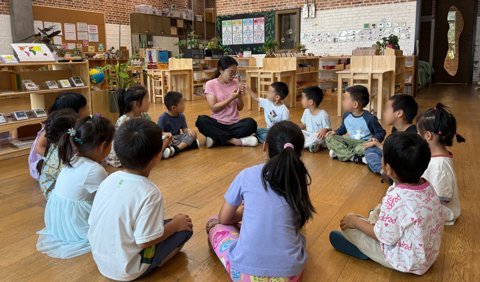
Children sit together to listen to stories, enhancing their listening skills and expanding their vocabulary and imagination.
Show and tell
Children take turns sharing something from home, encouraging communication and self-expression.
Group discussions
These discussions can centre around topics like feelings, the weather, or classroom rules, instilling a sense of belonging and community.
Movement and mindfulness exercises
The routine of circle time instils a sense of community and belonging within the classroom, provides opportunities for children to interact with their peers, fostering empathy and cooperation while gaining an understanding of the perspective, ability and the feelings of others. Yoga, deep breathing, and other movement activities help children regulate their emotions and through discussions and group activities, children learn to identify and express their feelings. All the while, storytelling and problem-solving activities stimulate children's critical thinking and help to develop their language and communication skills.
The Peace Table
The Peace Table works like this:
- Two children sit facing each other across a table with an object (e.g., a small stone) upon it.
- One child holds the object and talks about how they feel, e.g. “I feel sad because … you won’t play with me/
choose the material I want/ had snack when it was my turn...” etc. - When the child has had their say, they hand the object to their comrade, who responds “I can’t play with you now because…/I wanted to play with that now because…/I was hungry so …” etc.
The conversation continues back and forth until the children reach a consensus, at which point they shake hands. It is a wonderful way to encourage communication and problem-solving, independent of the adults in the room.
In the environments I have prepared, the two essential items on the AMI list of Spoken Language presentations are Book Corner and The Sound Game.
Book Corner
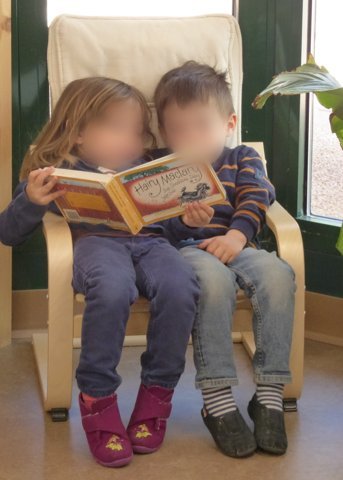
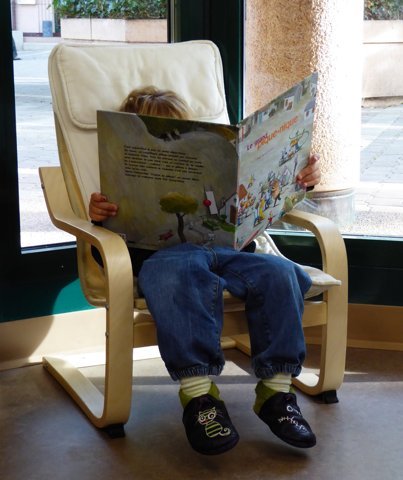
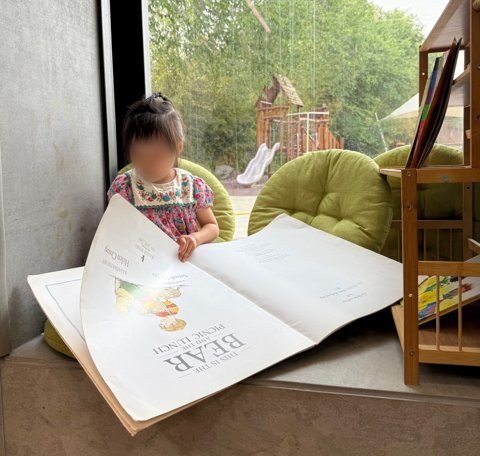
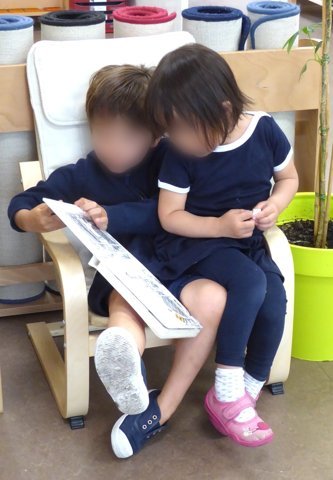
It is essential to have a place where children can sit and flip through picture books. It is calming (sometimes too calming), helps the children to develop their imaginations, and engenders a love of books and a love of reading.


The Sound Game
Also called I-Spy, this game helps the child to build skills in analysing and discriminating sounds in words by breaking words down into their smallest units (phonemes) and training the ear to identify them, a process called oral segmenting. The child progresses through an ordered, logical sequence of stages that grow progressively more challenging, but as each succeeding stage is just a little bit more difficult than the preceding one, it feels effortless.
Materials
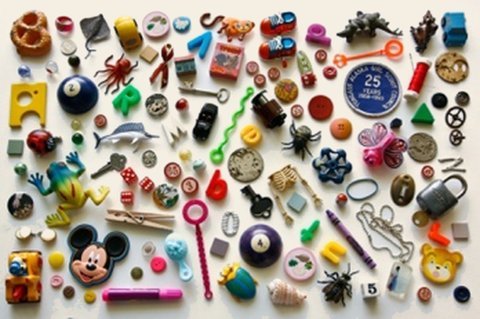
A collection of objects representing each of the sounds in the English language. AMI advise sending the child off on some wild goose chase around the class, collecting objects as they go, but there are obvious advantages to having a large collection of pre-prepared objects in a basket on the shelf.
First stage
3 to 5 objects, identifying the beginning sound. As the child gains experience, the challenge is increased by adding objects: 7, 9, 11, 13, 15 …. 35, always identifying the beginning sound:“I Spy with my little eye, something beginning with ….”

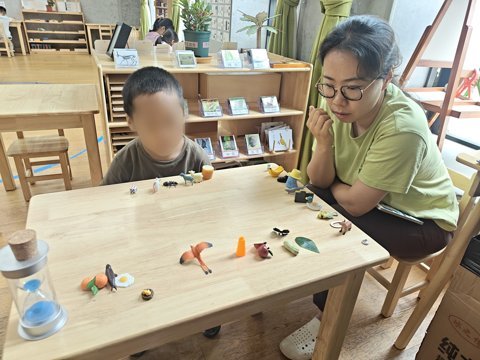
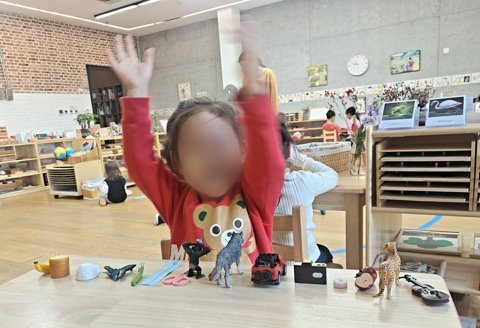

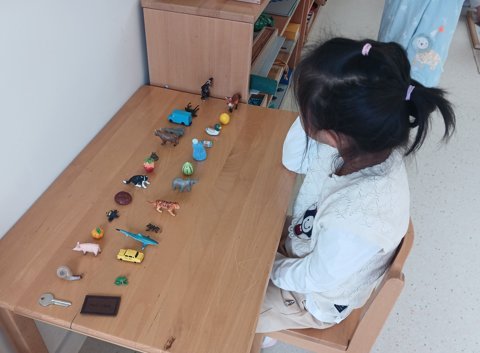
Second Stage
3 to 5 objects, identifying the ending sound. As the child gains experience, the challenge is increased by adding objects: 7, 9, 11, 13, 15 …. 35, always identifying the ending sound.“I Spy with my little eye, something ending with ….”
Once the child can identify the ending sound of 20+ objects, I generally begin presenting the Sandpaper Letters. Nevertheless, we keep playing the succeeding (more challenging) stages of I Spy, as they will be of huge benefit when the child starts to read.
Third Stage
3 to 5 objects, identifying the middle sound. As the child gains experience, the challenge is increased by adding objects: 7, 9, 11, 13, 15 …. 35, always identifying the middle sound.“I Spy with my little eye, something containing the sound ....”
Fourth Stage
Unlimited: identifying the beginning, ending or middle sound of any object in the room: table, mat, pencil, window, flower, etc.
“I Spy with my little eye, something in this room containing the sound ….”
Fifth Stage
Unlimited: identifying all sounds of any object in the room: table, mat, pencil, window, flower, etc.
“I Spy with my little eye, something in this room containing the sounds ….”
What the child is doing here is encoding: this is the term for identifying and enouncing all sounds in a word.
Notes
- What I’ve described above is very different to the AMI-approved presentation that my trainers taught us, but I’ve been experimenting with the game for a long time, and this approach works quite well: the children love it, and it succeeds in its aim: helping them to identify the individual sounds in words.
- The game can be played with 1 or 2 or 3 children; with 4 or 5 things can sometimes get a little raucous. Which can be fun too.
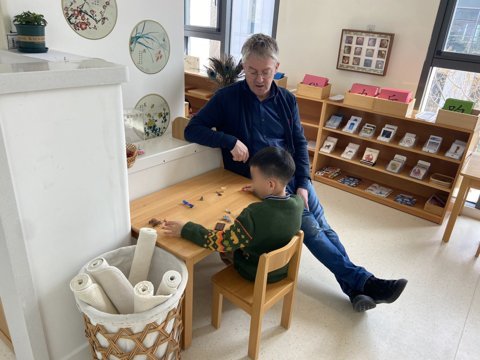


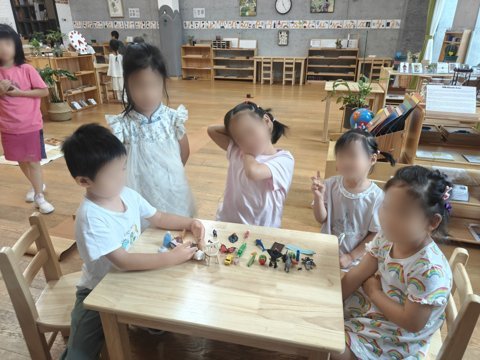

- It’s better if the children are at approximately the same level, but it also can be fun to mix children of different abilities so their competitive instinct kicks in. Observation is also allowed and encouraged, as long as the observers remain silent; they can join in if they want, but if they want to play, they must sit down.
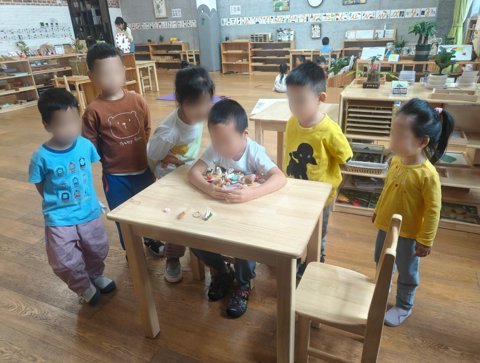
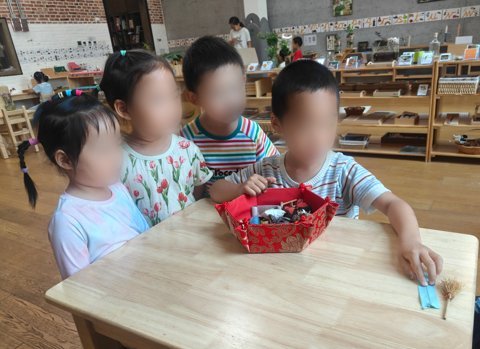
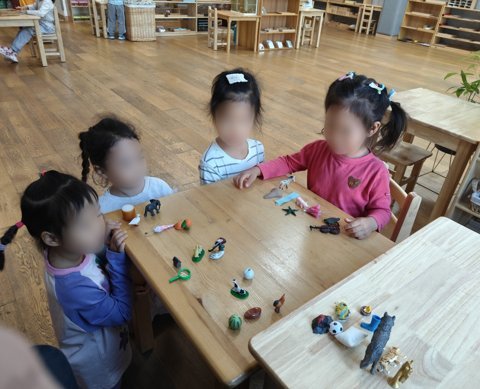

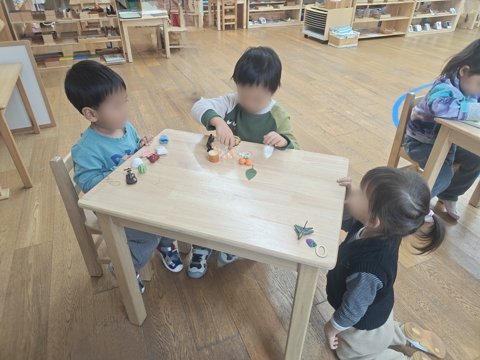
- Mixed-aged groups and freedom of movement and choice are fundamental principle in Montessori, and one of the many advantages of creating opportunities for the children to observe is that it piques the interest, so an observer soon becomes a participant.
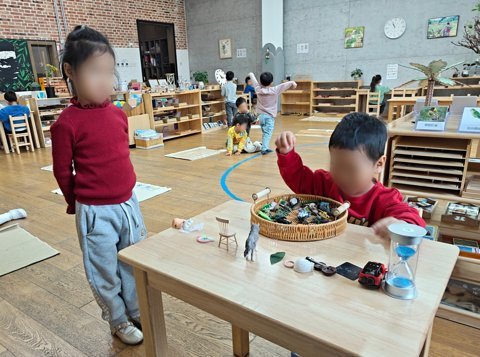
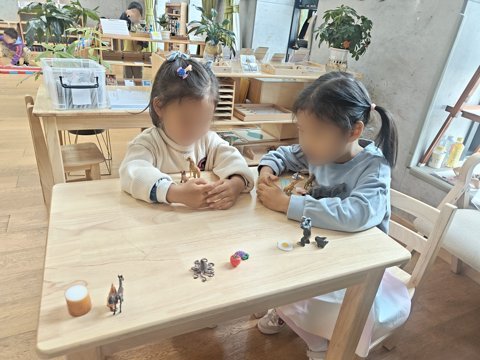


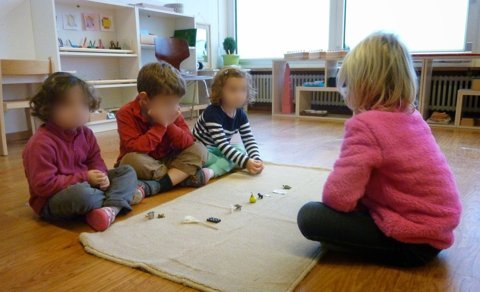
- Once the child develops an interest on I-Spy, progress tends to be rapid: the photos below were taken over a span of two months; not enough time for the boy to grow out of his t-shirt, but plenty long enough to progress from being able to identify the first sound from amongst 5 objects to amongst 25 objects.
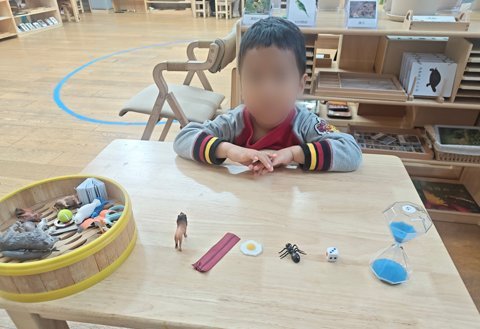
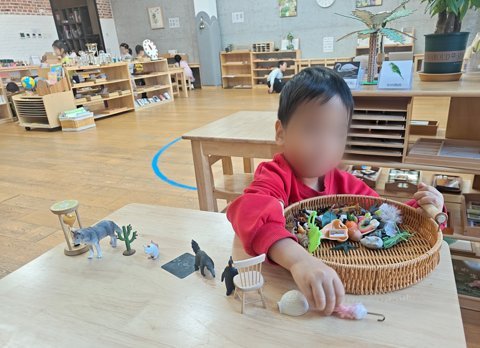
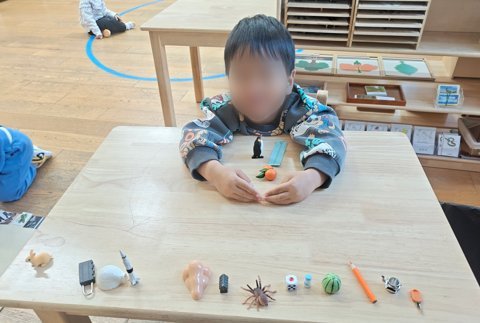
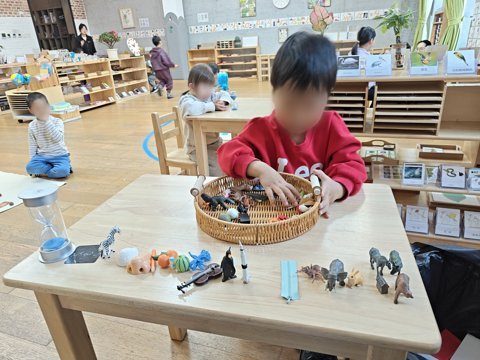

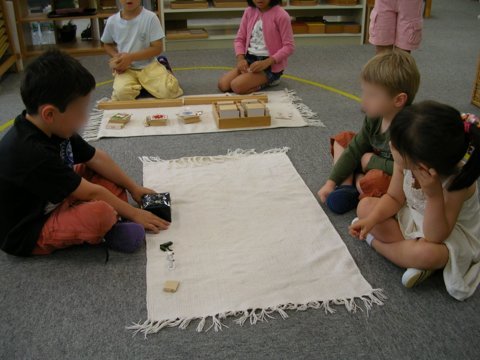
- Once a child has mastered Stage 5, they are more advanced than many of adults and ready to teach I-Spy. In order to do this, a child needs to be:
- Able to guide the younger children so the game doesn’t become noisy or disordered.
- Familiar with the steps of the game.
- Able to enunciate the sounds of the language perfectly, and
- Sensitive to the emotions and feelings of the children who are just starting to play and may be disappointed not to win the most objects.



Writing - Abstract
Definition: ‘The act of creating a representation of language.’ i.e. words, phrases or sentences.
In traditional systems of education, writing is done using a pencil, but in the Montessori approach handwriting is separated from word-building, so the child first creates words using a Moveable Alphabet and only after much experience will they write words using a pencil.
Phonemes to graphemes.
Phoneme The smallest unit of speech, the individual sounds of a language.
Grapheme The letter(s) used to represent those sounds.
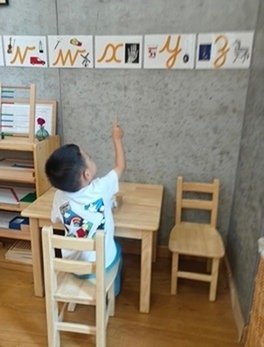
The English language has 44 phonemes -which the child has learned to identify by playing The Sound Game- and approximately 250 graphemes or letters (because one sound may be written in a variety of different ways). The children are surrounded by these letters, at home and at school and at this stage of their development they have an absorbent mind, so they unconsciously absorb the shapes of the letters. I support this in a variety of ways, such as by putting sample first-sounds-and-pictures on the wall, and after a while the children spontaneously and independently begin to identify letters by associating them with the first sounds in the words: ‘y’ … ‘y’ … yogurt … yo-yo … yellow … ‘y’ … ‘y’ …

Keys to Literacy
Sandpaper Letters
Movable Alphabet
Sandpaper Letters (graphemes)
“Now the hand can be prepared directly to trace the signs of the alphabet by the help of the tactile and muscular senses, not by that of sight. We have, therefore, prepared for our children letters cut out in sandpaper, and pasted on smooth cardboard. They reproduce in dimension and shape the letters of the movable alphabet. We teach the children to trace them in the same way as is followed in writing. This is a very simple procedure which leads to marvellous results. Thus the children stamp, so to speak, the shape of the letters on their hands. When they begin to write, spontaneously their penmanship is well-nigh perfect.”
- Maria Montessori, The Formation of Man, p. 93. (1949)

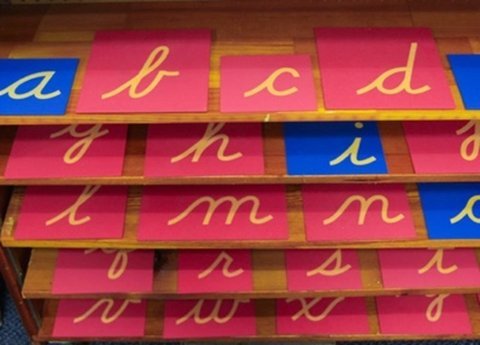
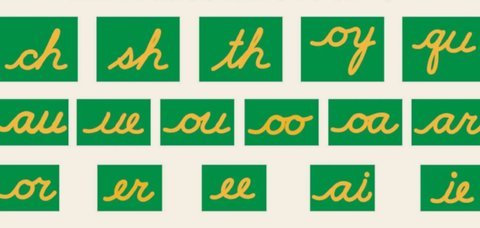
Single letters are coloured blue (vowels) or pink (consonants) and the most common double-letter combinations are coloured green. The children are presented with three letters, using a multi-sensory approach where they trace the sandpaper with their fingers while repeating the sound of each, and this combination of sight and sound and touch greatly aids the child’s memorisation of the letters.
“When a teacher has a child see and touch the letters of the alphabet, three sensations come into play simultaneously: sight, touch, and kinaesthetic (muscular) sensation. This is why the image of the graphic symbol is fixed in the mind much more quickly than when it is acquired through sight in the ordinary methods.”
- Maria Montessori, The Discovery of the Child, p. 213. (1948)
As with I-Spy, children who are advanced enough can often teach the letters as good or better than an adult.


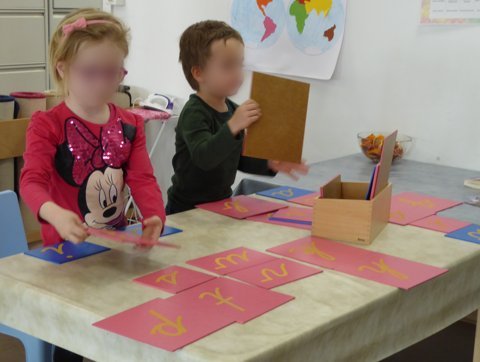

The Moveable Alphabets
Once they’ve been presented with the Sandpaper Letters, the next presentation in the AMI curriculum is the Large Moveable Alphabet, but the gap between these activities can be challenging for many children to bridge. AMI suggest that the guide ‘familiarise the child with the letters by introducing them, perhaps organising or dusting them’, but as an alternative to a quick spot of dusting, I’ve introduced a range of different exercises that help to reinforce the Sandpaper Letters, ones which I’ve seen used in some of the many excellent Montessori environments that I’ve observed and discovered in some of the alternative language albums I possess.
Materials such as ‘Matching Letters and First Sounds’ are an excellent way to improve vocabulary whilst reinforcing the shapes and sounds of the letters, which can be played using the Sandpaper Letters or the letters from the Moveable Alphabet, or both. There are also many writing activities which provide invaluable opportunities for the child to practise copying or tracing the shapes of the letters, either on paper, using the easel, in sand, on another child’s back, or in the air. This is the sequence of presentations that I follow:
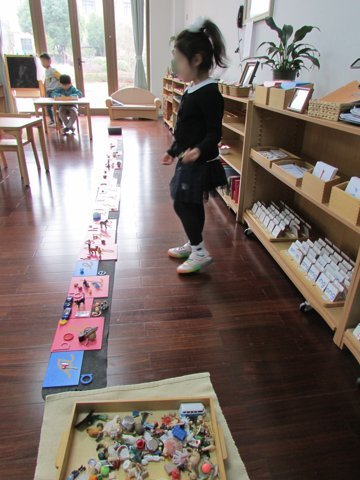
- I-Spy
- Sandpaper Letters
- Reinforcement of letters
- Moveable Alphabet(s)
- Reading (the sequence of reading presentations are listed below).
“I struggled through the alphabet as if it had been a bramble-bush; getting considerably worried and scratched by every letter.”
- Charles Dickens, Great Expectations, Chapter 7, Pg. 26. (1861)
Reinforcement of Letters
“Summing up, we may say that the two mechanical factors of writing are resolved into two independent exercises, that is, drawing, which gives the hand the ability to handle the writing instrument, and touch the letters of the alphabet, which serves to establish a motor memory along with a visual memory of the letters. ”
- Maria Montessori, The Discovery of the Child, p. 209. (1948)
Matching first sounds, letters and objects
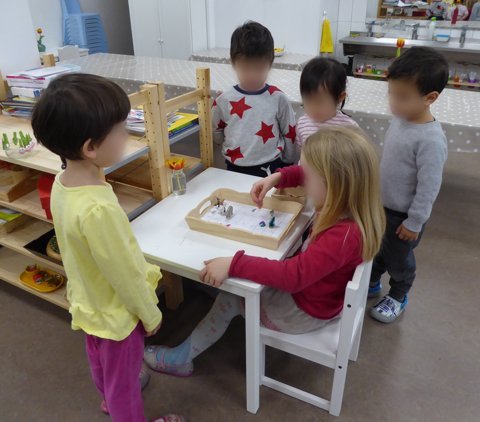

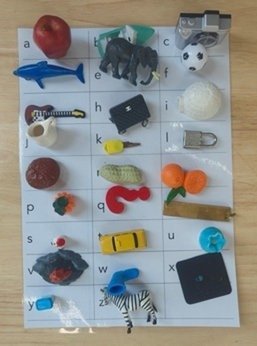

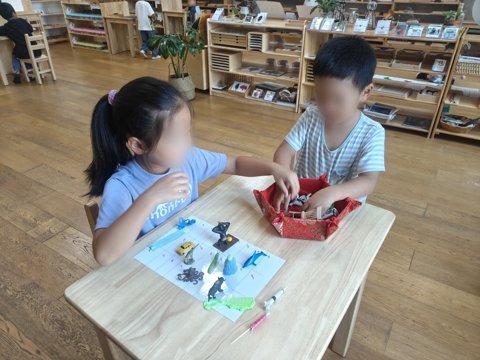
Letter + first sound + picture correspondence

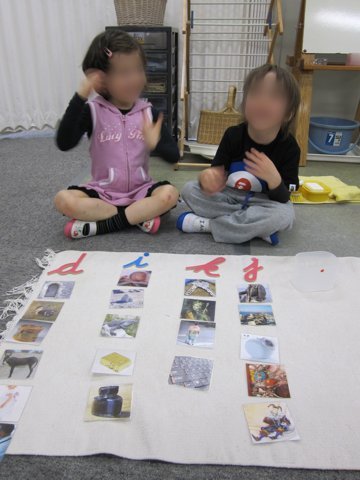

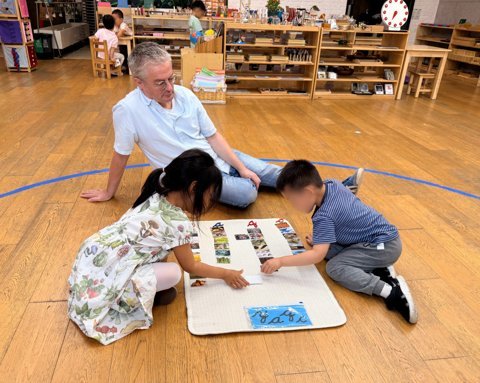


Letter Bingo: learningLetter Bingo: teaching
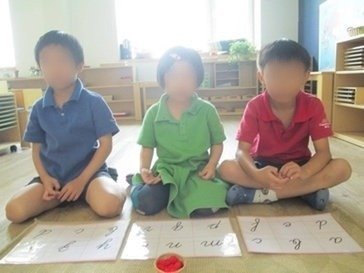
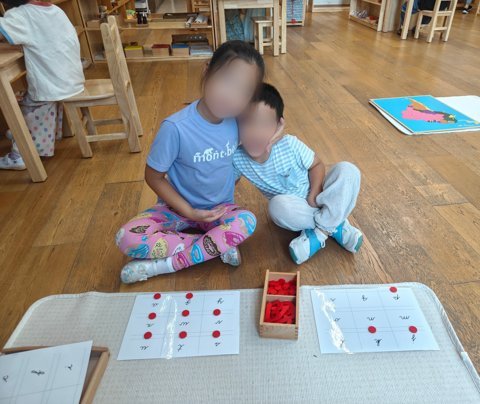
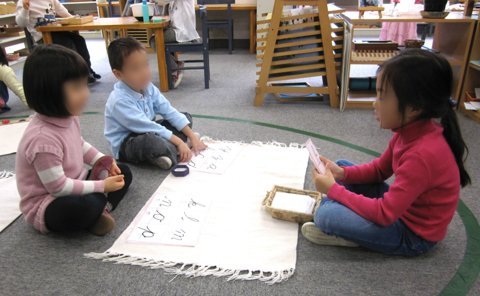

Lynne Lawrence writes about these and some other supplementary games in her book, ‘Montessori Read & Write: A Parents' Guide to Literacy for Children*’, a very informative resource for parents looking for a detailed introduction to the theory and practice of how to teach reading and writing in a Montessori way.
* Trigger warning: not all of the materials she uses are AMI-approved, despite the fact that Lynne Lawrence is the Executive Director of AMI.
Moveable Alphabets
The child uses the Large Moveable Alphabet to create words, phrases and short sentences by sounding out the individual letters of a word, for example m - o - p, and repeating it until they coalesce into ‘mop.’ This is known as blending and is the opposite of the segmenting that the child has done with the Sound Game.
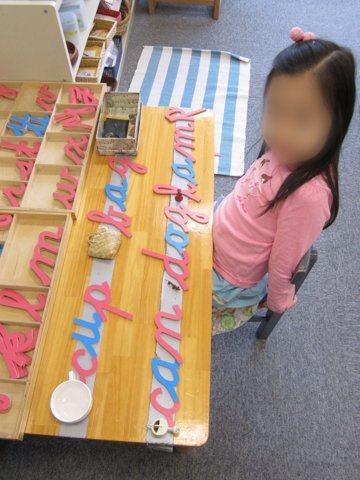


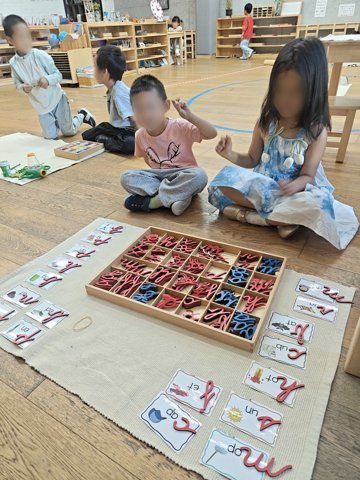

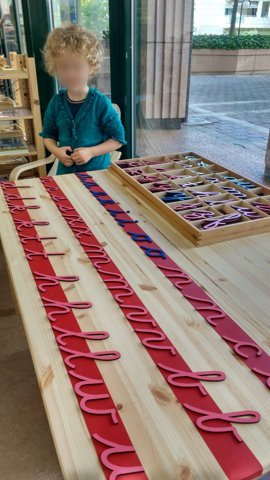
The Small Moveable Alphabet is often used to teach phonograms, and to write longer and more elaborate sentences and short stories.
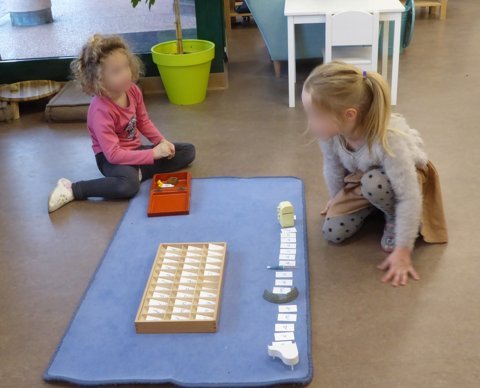


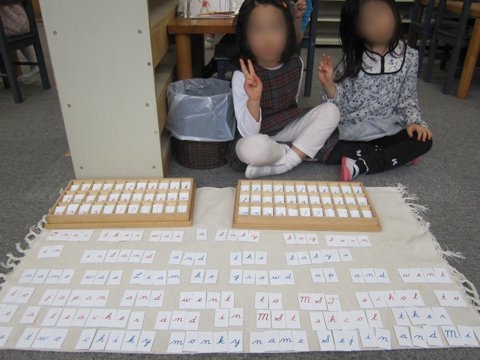
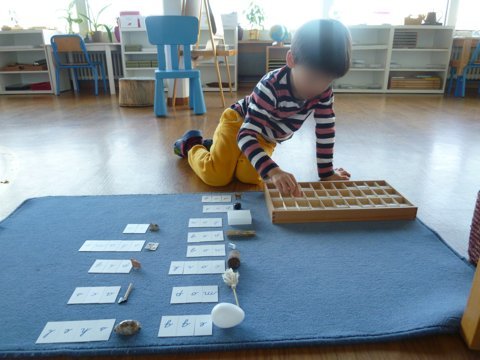
After a great deal of experience with the Large and Small Moveable Alphabets, the child starts to read in an entirely natural and stress-free way: they begin to decode the words they see around them. Recently I was teaching the Sandpaper Letters ‘i’ and ‘m’ and ‘s’, and at the end of the three-period lesson the child looked at the letters and then rearranged them on the table and said, ‘sim.’
“The first word to be written by one of them brought a great outburst of joy and laughter. Everyone looked admiringly at the ‘the writer,’ and thus they felt moved to follow his example. ‘I can do it too!’ they cried. The achievement of one started off the whole group.”
- Maria Montessori, The Absorbent Mind, p. 231. (1995)
Writing - Concrete
noun writ·ing ˈrī-tiŋ ‘The act or art of forming visible letters or characters.”
‘Writing is the act of creating a persistent representation of language. A writing system includes a particular set of symbols called a script, as well as the rules by which they encode a particular spoken language. Every written language arises from a corresponding spoken language; while the use of language is universal across human societies, most spoken languages are not written. Writing is a cognitive and social activity involving neuropsychological and physical processes. The outcome of this activity, also called writing (or a text) is a series of physically inscribed, mechanically transferred, or digitally represented symbols. Reading is the corresponding process of interpreting a written text, with the interpreter referred to as a reader.’
From this definition we can extract three key points:
- Writing is a physical manifestation of language.
- Writing with a pencil is one way of manifesting language.
- Reading is inextricably connected with writing.
In traditional systems of education, writing is done using a pencil, but in the Montessori approach we separate handwriting from word-building, so the child first creates words using a Moveable Alphabet, and only after much experience will they write words using a pencil. In order to use a pencil, children first need to learn to:
- relax the arm, hand and fingers
- control pressure on the pencil
- work in a limited space
- turn the wrist to guide the pencil
- make continuous strokes
- make up and down strokes
- move from left to right
This necessitates a great deal of preparation, in two broad areas:
“Writing is a complex act which needs to be analysed. One part of it has reference to motor mechanisms and the other represents a real and proper effort of the intellect.”
- Maria Montessori, The Discovery of the Child, p. 204. (1948)
Preparation of the mind
- Develop will and concentration
- Complete a cycle of work
- Establish good work habits
- Develop a left to right mental orientation
- Appreciate order and sequence
- Develop a large vocabulary
Preparation of the hand
- Coordinate movement of the body
- Coordinate wrist and arm movements
- Coordinate and refine hand movements
- Develop hand-eye coordination
- Strengthen and refine the pincer grip
- Practise left to right muscular orientation
“A necessary condition for writing is to have what is called a ‘firm hand,’ that is, a hand under the control of the will.”
- Maria Montessori, The Discovery of the Child, p. 206. (1948)
“The hand needs its own preparation. What is needed before one actually writes is to learn writing by means of a series of interesting exercises which form a kind of gymnastics similar to those used to give agility to the muscles of the body.”
- Maria Montessori, The Formation of Man, p. 91. (1949)
After spending 18 months practising with a wide variety of Practical Life and Sensorial materials, the child has integrated a left to right orientation and has developed a strong pincer grip and a lightness of touch, so their hand has been indirectly prepared for handwriting.
“The little hand which touches, feels, and knows how to follow a determined outline is preparing itself, without knowing it, for writing.”
- Maria Montessori, Montessori’s Own Handbook, p. 96. (1965)
“Whilst moving the objects used in our sensory exercises, the children's hands are being prepared for all the actions necessary for writing.”
- Maria Montessori, The Formation of Man, p. 91. (1949)
However, on the language shelves we also have some materials that directly prepare the child for handwriting: colouring, cutting, pinning and Metal Insets.
Art/
“The so-called ‘free drawing’ has no place in my system. I avoid those useless, immature, weary efforts and those frightful drawings that are so popular in ‘advanced’ schools today. [,,,] The hideous drawings which are exhibited in the common schools, as ‘free drawings’ characteristic of childhood, are not found among our children. These horrible daubs so carefully collected … are nothing but monstrous expressions of intellectual lawlessness.”
- Maria Montessori, quoted in ‘Character Development through Art Education: A Montessori Perspective,’ by Patrick R. Frierson. PDF
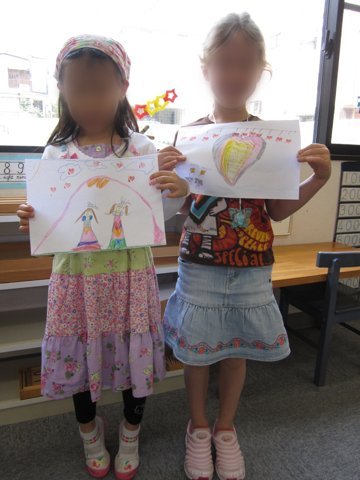
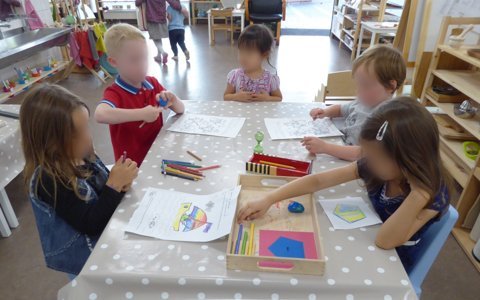
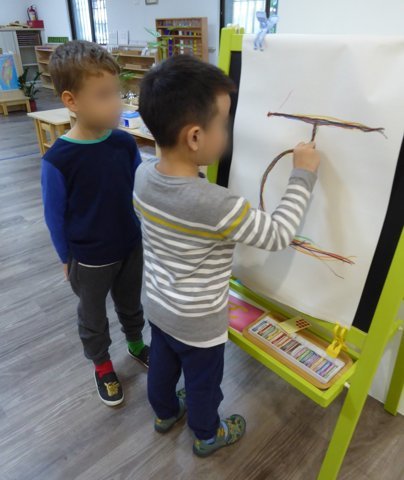
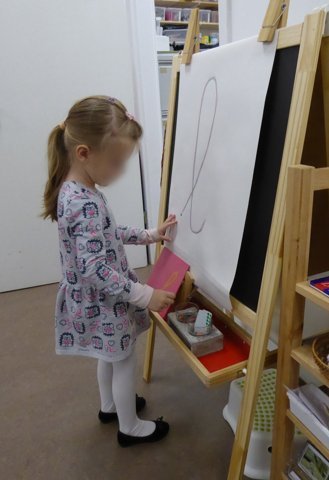
So one of the foundational principles of the Montessori approach is to follow the child’s interests, but not if they’re interested in drawing, I guess. Another key principle is that children benefit from practice, but we should stop them from practising with a brush or a crayon or a pencil, i.e. we should stop children from using pencils? Except if they’re using the Metal Insets of course: that’s the only time they’re allowed to colour? I have to confess a weakness for children’s frightful horrible daubs and am rather partial to their monstrous expressions of intellectual lawlessness, so I prepare a shelf containing a tray, paper, blank and lined chalkboards, chalk, crayons, colouring pencils and sharpeners.
A sample of some useless, immature, weary efforts and frightful drawings.
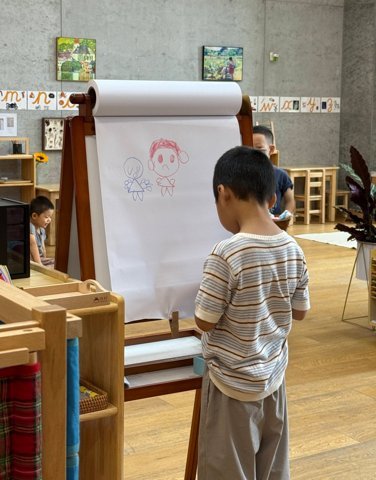


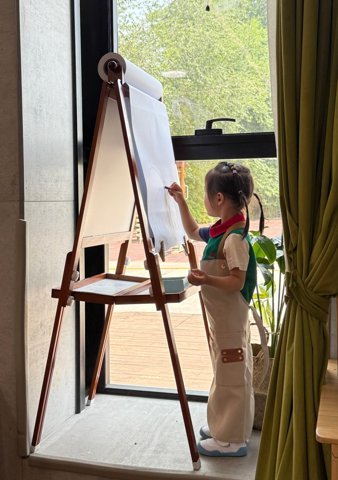

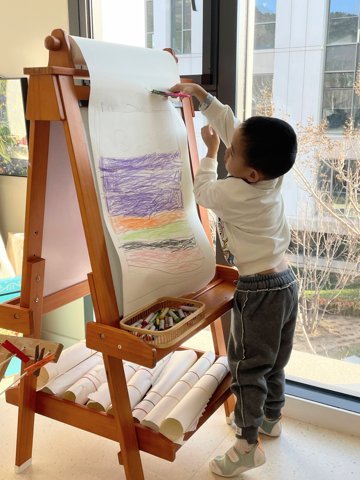
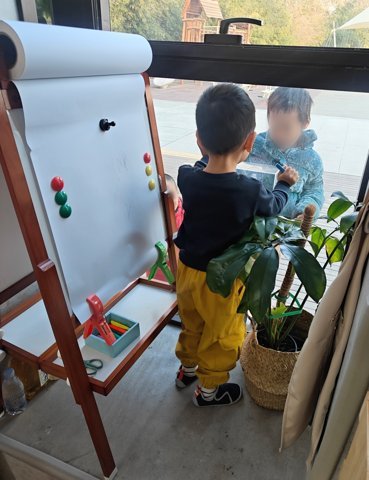

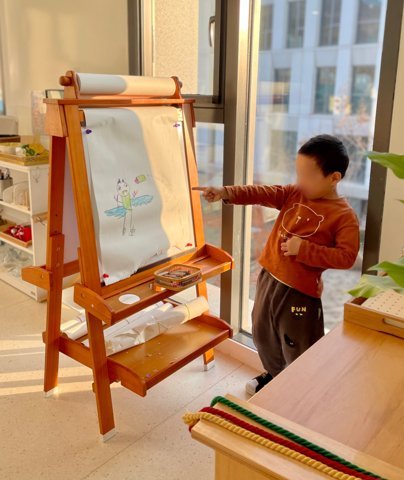
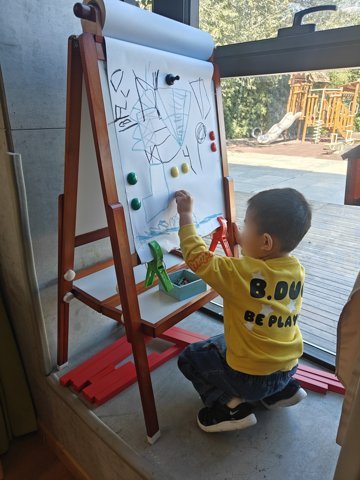
Children typically begin with crayons, and a huge advantage of this kind of activity is that many of them are likely to have used crayons at home, and this familiarity makes it stress-free and thus an ideal lesson on their first morning in the room. After a few weeks they progress to using chalk -which is a little more complex as it necessitates having a presentation on cleaning the chalkboard- and eventually they inevitably gravitate towards using pencils. I encourage the children to take a sharpener when they take the pencils, and this gets them into the habit of writing with pencils that are sharp.




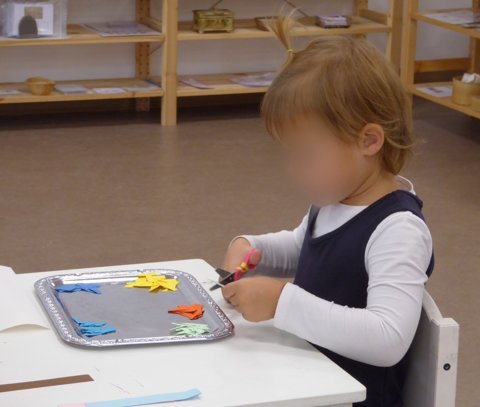
Cutting
On this shelf I prepare a range of different, increasingly complex cutting exercises, which change with the seasons and incorporate different festivals, celebrations, etc.
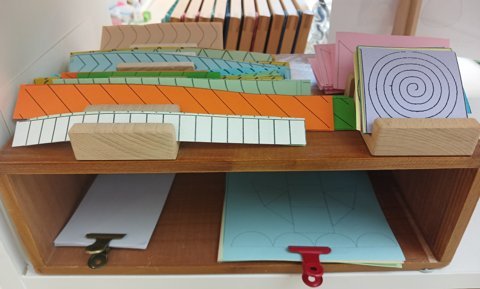
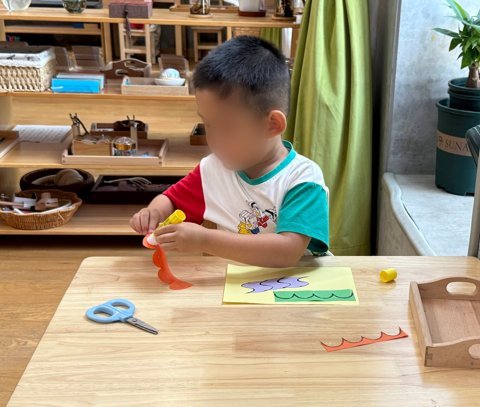
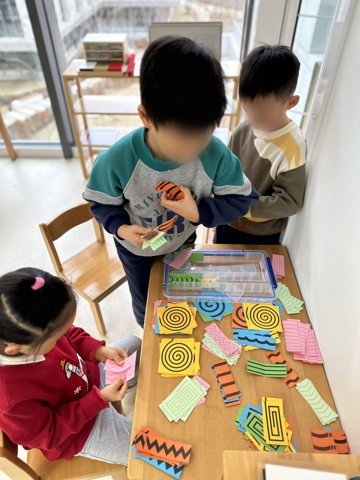

“Writing is not identical with the alphabet. Writing consists of a series of attempts to transmit thought in a practical and permanent way. Its history goes back to thousands of years ago. At first, man tried to represent the objects of his thoughts by means of drawings; then he tried to symbolise ideas by signs, and only much later has he found a simple solution in the alphabet.”
- Maria Montessori, The Formation of Man, p. 85. (1949)
Pinning
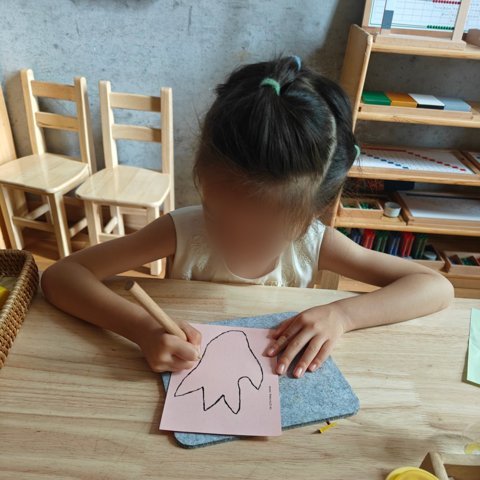
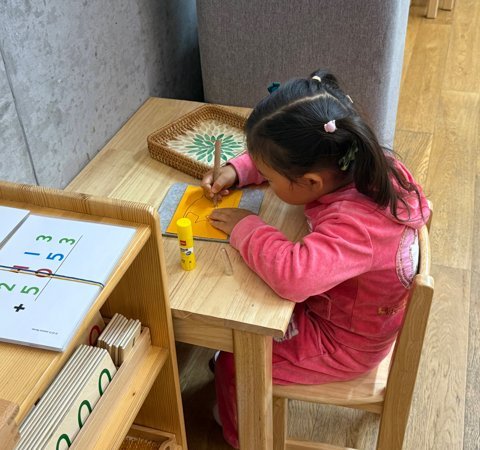
It’s impossible to overstate how popular this activity is with children of every age, and there are so many templates in such a wide array of topics - animals, dinosaurs, fish and other aquatic life, continents, transportation, etc - that it never gets old. Children also really enjoy using different shapes and sizes of punch-pin, so I place a wide selection on the shelf.



Metal Insets
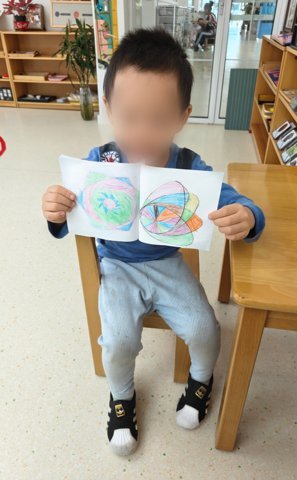
All of this happens in the 18 months before a child is expected to trace, copy or write letters, words, phrases and sentences, so that when they are presented with the Sandpaper Letters, it appears effortless and perfectly natural.

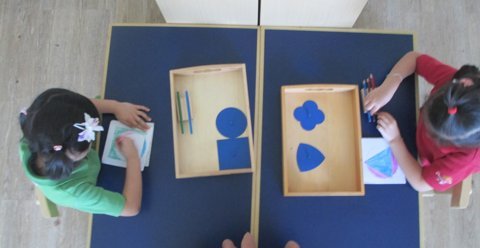
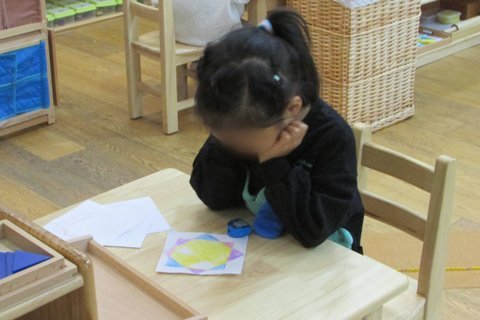
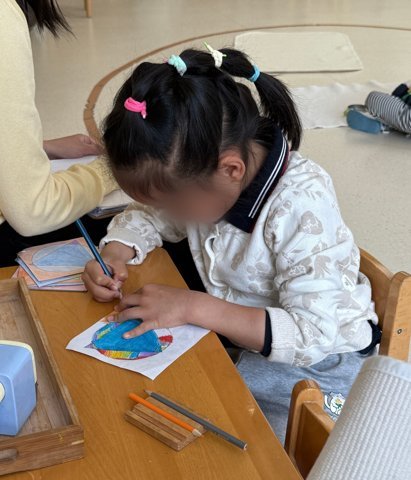

“Not one of them had ever before even taken chalk or any other writing instrument into his hand. This was the first time that they had written, and they traced out whole words, just as when they spoke for the first time they spoke a whole word.”
- Maria Montessori. The Discovery of the Child, p. 222. (1948)
How Parents Can Help
Parents can aid the development of handwriting by creating a workstation and an accessible supplies/
- Chalkboard
- Chalk
- Pencils: coloured and lead (triangular are best)
- Sharpener and eraser
- Crayons
- Scissors
- Paper: different thicknesses and colours
- Glue
“We thus began to communicate with each other through written language; and this proved to be most interesting to the children. They gradually discovered the wonderful property of writing, that it transmits thought. When I began to write, they trembled in their eagerness to know what I had in mind and to understand it without pronouncing a single word. Written language does not indeed need speech. Its whole grandeur is only understood when it is completely isolated from the spoken word. ”
- Maria Montessori, The Discovery of the Child, p. 239. (1948)
Indirect preparation at school or at home is crucial, because the AMI training includes very few presentations aimed at directly developing handwriting. This is the relevant section from the AMI Language album, with the presentations where the child uses a pencil in italics:
Writing Stages
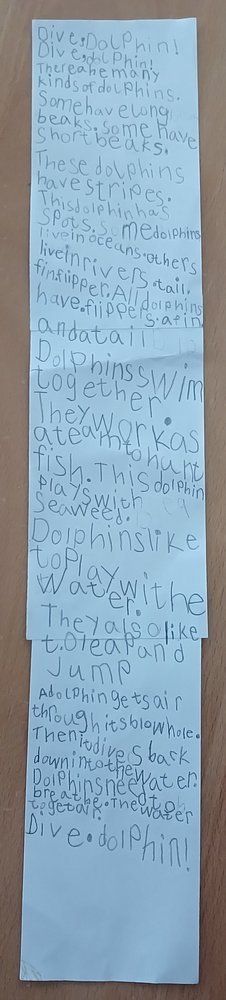
Metal Insets
Materials for Writing
Writing Letters
Letter Families
Placement of Letters
Writing Copies
Capitals
Sequence of Letters
Punctuation
Written Question Game
Free Composition
Presentation and Storage of Work
Writing emerged independently in multiple ancient civilisations, beginning with the proto-writing systems of Mesopotamia, Egypt, and China around 3400-3100 BC. Nevertheless, AMI suggest that in more than 5000 years of writing, across almost every civilisation on the planet, these are the five presentations worth presenting to a child, and that they have value beyond and to the exclusion of all others. Montessori Educators International, in fact, feel that five is three too many, so their concrete writing presentations are limited to Metal Insets and a (two-page) presentation titled simply ‘Handwriting.’ I kinda feel there could maybe be a few more, and the Montessori Teachers Collective seem to agree, as is indicated by the fact that they have a section in their album that is expressly devoted to handwriting:
Handwriting
Introduction
Preparation
Chalkboards
Sorting Symbols
Writing on Paper
Upper and Lowercase Letters
Capital Letters, Periods, Commas, and Question Marks
Transcription
Scripts
Creative Writing


Kate Millie includes the following handwriting presentations in her Supplemental Language Album:
Rainbow Letters
Writing Practice Series - Names
Writing Practice Series - Letters
Writing Practice Series - The Alphabet
Phonetic Writing Books
Phonetic and Phonogram Word Dictation
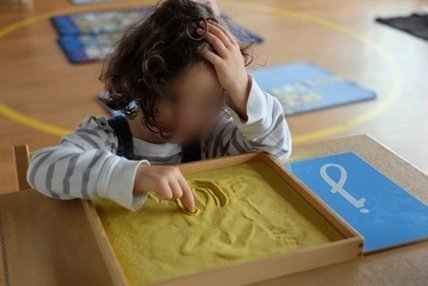
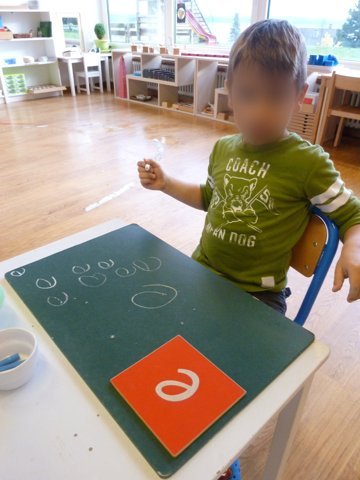
I’ve adopted many of those presentations in these albums, as well as others I’ve seen during observations or after talking with teachers. Once the child begins to learn letters, there are a range of fun tracing/
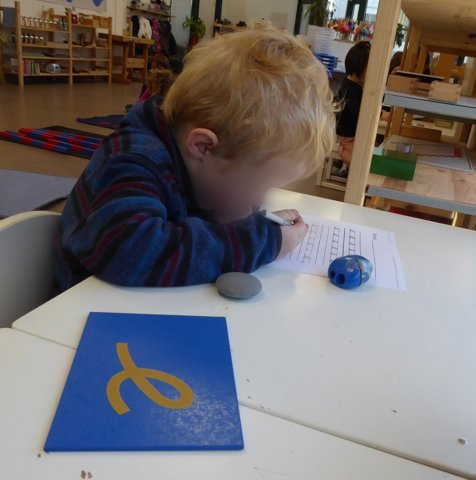
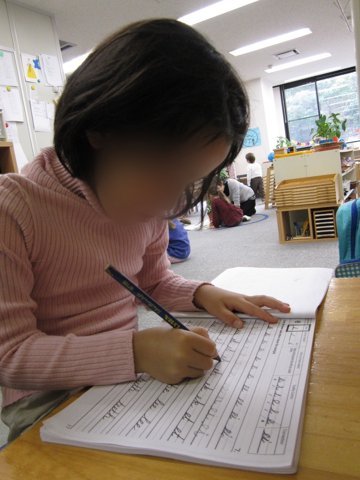
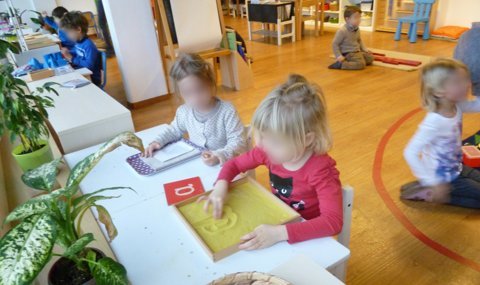

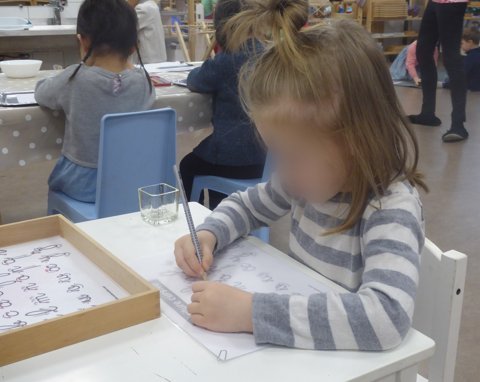


“One day a child began to write. He was so astonished that he shouted aloud, "I've written! I've written!" Other children rushed up to him, full of interest, staring at the words that their play-fellow had traced on the ground with a piece of white chalk... The discovery of being able write appeared as an unexpected event. ”
- Maria Montessori, The Secret of Childhood, p. 139. (1936)
Reading
Reading: ‘The process of looking at a series of written symbols and getting meaning from them.’
Decoding: ‘The ability to translate written words into spoken language by understanding the relationships between letters and sounds.’
The AMI Montessori reading system has the following sequence of reading presentations:
Object Box 1
Object Box 2
Action Cards
Phonetic Reading
Puzzle Words
Reading Booklets
Reading Folders
Environment Cards
Classified Reading
Definition Stages

Kate Millie’s Supplemental Language Album - Reading
3.1 Cursive and Print Letter Match
3.2 Alphabetical Order
3.3 Phonetic Object Box
3.4 Phonetic Object Cards
3.5 Phonetic Matching Cards
3.6 Phonetic Picture and Word Cards
3.7 Phonetic Rhyming Cards
3.8 Phonetic Books
3.9 Consonant Blends Matching Cards
3.10 Consonant Blends Rhyming Cards
3.11 Phonogram Matching Cards
3.12 Phonogram Rhyming Cards
3.13 Phonogram Flip Book
3.14 Reading Bingo
3.15 Constructing Phrases and Sentences
3.16 Scavenger Hunt
3.17 Riddles
Phonetic Reading and the Pink, Blue and Green Series
Compared with English, learning to read poses fewer challenges for Italian children because Italian is a phonetic language, with each letter in a word pronounced, and with consistency of pronunciation across the alphabet. English is much more irregular, so it is necessary to create materials and opportunities for children to practise reading phonetic words. In 1929, Margaret Homfray studied under Maria Montessori in London, thus beginning a 22-year collaboration between them, and Montessori had so much faith in Homfray’s mastery of the Montessori pedagogy that she permitted her to issue Montessori Diplomas, the only person she ever allowed to issue diplomas in her name. She also asked Homfray to create a reading scheme for English, and the ‘Pink, Blue, and Green’ is the result. Nevertheless, the Pink, Blue, and Green series aren’t on the shelves in AMI-accredited schools, which is a little puzzling considering the connection that Ms. Homfray had with Montessori, but if the Pink, Blue, and Green series was good enough for Maria Montessori, I feel it’s good enough for the children in my class.
The Pink Series consists of 3-letter CVC (consonant-vowel-consonant) words.
The Blue Series consists of consonant blends.
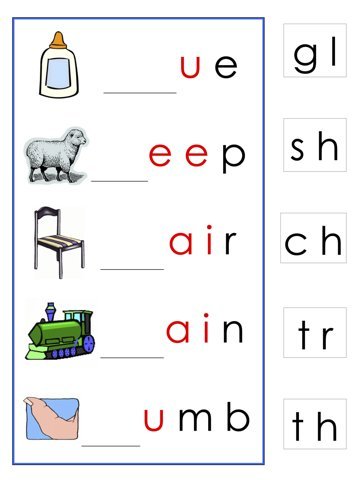
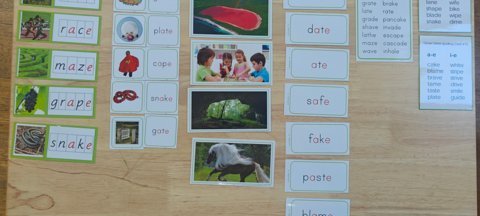
The Green Series consists of all the major phonemes.
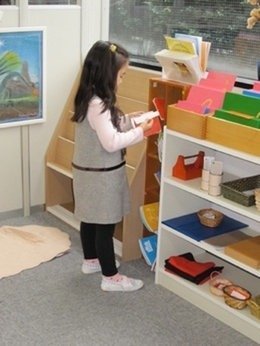
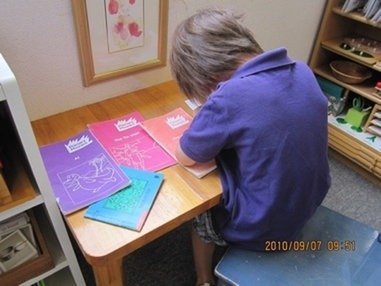
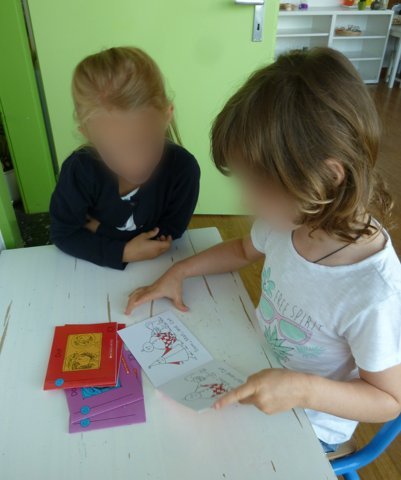
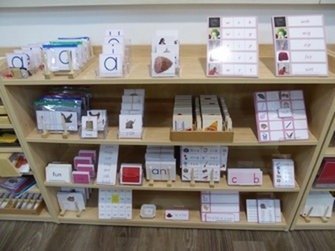
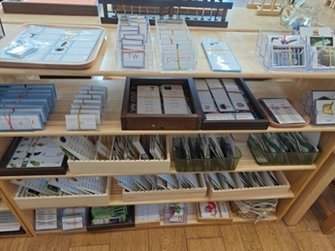
One of the reasons I like this series is that it contains a great deal of materials, useful when you’re trying to quench the insatiable thirst that new readers have for reading. The following photos are of the reading shelves in the classes I established in Taipei and Beijing, the first pair displaying approximately 75% of the Pink Series and the second pair containing perhaps 75% of the Blue and Green Series, which gives a sense of how extensive the complete series is, as does the ‘Reading’ section from the College of Modern Montessori album which is listed beneath. ‘L.M.A’ = Large Movable Alphabet


Pink Language Materials
L.M.A. - Pink Object Box
L.M.A. - Pink Picture Box
Pink Object Word Box
Pink Picture Word Box
Large Pink Picture Word Card
Pink Word Lists
Pink Booklet
Puzzle Words
Pink Phrase Cards
Pink Secret Box
Blue Language Materials
L.M.A. - Blue Object Box
L.M.A. - Blue Picture Box
L.M.A. Blue Object Word Box
Blue Picture Word Box
Large Blue Picture Word Card
Blue Word Lists
Blue Booklet
Blue Secret Box
Blue Sentence Cards
Green Language Materials
Phonogram Sandpaper Letters
Phonogram Box
Small Phonogram Alphabet
Phonogram Word Lists
Phonogram Booklet
Family Folders
Green Sentence Cards
Montessori Reading Systems
Broadly speaking, there are three main reading systems used in Montessori classes:
- Follow the presentations in the AMI Language manual.
- Follow the Muriel Dwyer approach.
- Follow the Pink, Blue and Green series.
I use a mixture of these three different but complementary approaches, using the following sequence of presentations:
Object Box 1
Pink Series
Action Cards 1
Object Box 2
Blue Series
Action Cards 2
Green Series
Puzzle Words (Sight Words)
Early Readers
Grammar, etc.
Object Box 1 to The Pink Series.
With the moveable alphabet, the child creates their own words. Object Box 1 is the first time they read - i.e., they decode the words and thoughts of someone else by matching the words they are reading with objects- and after this important milestone they have all of the skills required to read, they just need something to read. Hence, The Pink Series …

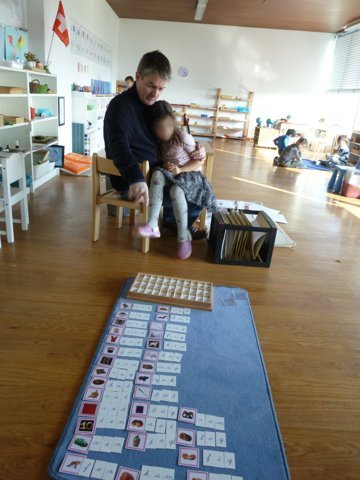
Action Cards - Set 1
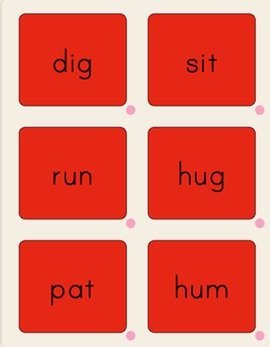
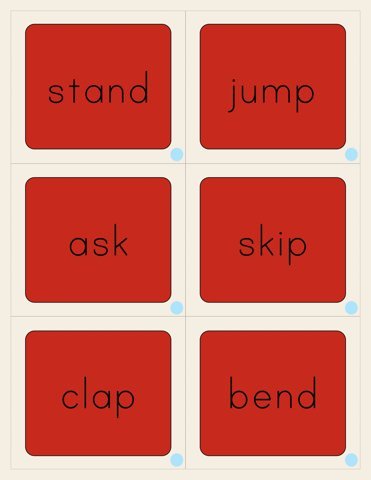
This game is played by a pair of children, with one child reading the action word on the card, them miming the action - hop, sit, hum, tap, etc.- with their friend having to guess the word, a fun-filled way of teaching what verbs are without ever using the word ‘verb’.



Early Readers
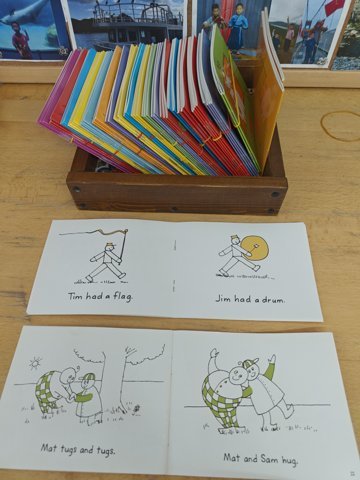
These are the first books the child will read. There are many different options available these days, but I’ve always liked the Bob Books, because the children always enjoyed reading them.



Grammar

I’ve been working as a Montessori guide for almost two decades, and every class was bilingual (English/
“Experience has shown us that little children take the liveliest interest in grammar, and that this is the right time to put them in touch with it. In the first period (from 0 to 3). the acquisition of grammatical form was unconscious; now it can be perfected consciously.”
- Maria Montessori, The Absorbent Mind, p. 174. (1995)
“Not all children of the same age are at the same point in this matter of reading and writing. We not only do not force a child, but we do not even invite him, or in any way attempt to coax to do that which he does not wish to do. So it sometimes happens that certain children, not having spontaneously presented themselves for these lessons, are left in peace, and do not know how to read or write. If the old-time method, which tyrannized over the will of the child and destroyed his spontaneity, does not believe in making a knowledge of written language obligatory before the age of six, much less do we!”
- Maria Montessori, The Montessori Method, p. 302. (1912)
So, in her classroom Montessori had some 5 or 6-year-olds who were studying grammar, while some of their peers couldn’t read or write. Oh, the joy of low expectations from her parent group. I can only imagine the reaction of my parents if I explained that no, their child couldn’t read or write because I chose to leave them in peace rather than tyrannise over the will of their child and risk destroying their spontaneity. For those children who are keen on a bit of Grammar, the following are the list of AMI-proscribed presentations.
Functions of Words
The Montessori Grammar Symbols are a set of colourful, geometric shapes designed to give a physical and visual representation to the abstract concepts of grammar. Instead of just memorising definitions, children use these tangible symbols to build sentences, making grammar a hands-on, engaging and logical activity.
Noun A simple, solid black triangle, a shape that suggests stability and permanence, representing the name of a person, place, or thing.

Article A small, light blue triangle, slightly smaller than the noun, and it is always presented in relation to it, foreshadowing its role as a determiner that accompanies the noun.
Verb A bold, concentric circle of red, a shape that implies action and movement from a still centre.
Adjective A medium blue triangle, also presented alongside the noun.
Symbol Box, Questions for Symbols, etc.
Article
Adjective
Conjunction
Preposition
Verb
Adverb
Continuation of Commands
“Reading penetrates directly the level of culture, because these exercises are not limited to reading only, but form part of a progress in knowledge - the study of one's own language. During this brilliant process of development all grammatical difficulties are met and overcome. Even those minute variations applied to words when they have to be adapted to the details of expressive speech such as prefixes, suffixes, declensions, etc., become interesting objects of exploration.”
- Maria Montessori, The Formation of Man, p. 95. [1949]

Word Study
Number Two sets of cards, one set with words in singular with their counterparts in plural in the other set.
Cards of a contrasting colour with the titles ‘singular’ and ‘plural’.

Gender Two sets of cards, the first set with masculine words, the second set with feminine words.
Cards of a contrasting colour with the titles ‘masculine’ and ‘feminine’.
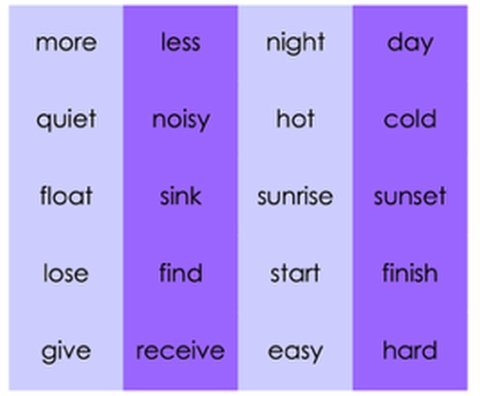
Antonyms Two sets of cards, one set with words each with an antonym in the other set.
Synonyms Two sets of cards, one set with words each with a synonym in the other set.
Homophones Two sets of cards with homophones.
Homonyms A single card with a list of homonyms.
Prefixes A single card with a list of prefixes in a different colour along the word they precede.
Suffixes A single card with a list of suffixes in a different colour along the word they come after.
Compound Words A single card with a list of compound words.
Word Families A single card with a list of words built up around a single head word by adding suffixes, prefixes or new words to create a family.


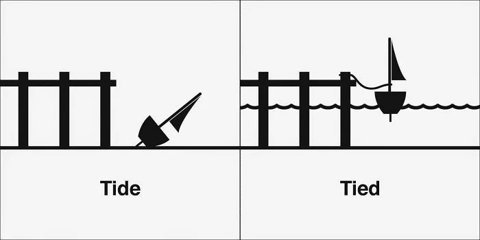

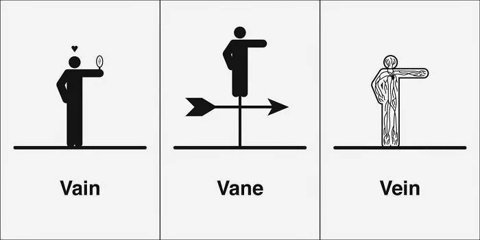
Homophones, weakly
“A visual exploration of words that look the same, sound the same, or are otherwise easily confused.”
Reading Analysis
By breaking down sentences into their logical components (e.g., subject, predicate, direct object, subordinate clauses), the child gains a tool for organising complex ideas and improving both written expression and reading comprehension. The following list of materials for this presentation (12 different presentations, in fact) give a sense of how complex and advanced this activity is, as do the aims, which follow.
Series of sentences of graded complexity selected from well-known children’s classics which offer the possibility of interpretation.
Series 1 Subject and Verb
a. Sentences with 1 subject and 1 verb.
b. Sentences with 1 subject and 2 verbs.
c. Sentences with 2 subjects and 1 verb.
Series 2 Subject, Verb, Object
a. 1 subject, 1 verb, and 1 object.
b. Sentences with 2 subjects, 1 verb, and 1 object.
c. Sentences with 1 subject, 1 verb, and 2 objects.
d. Sentences with 2 subjects, 1 verb, and 2 objects.
e. Compound sentences with 2 verbs and a variety of subjects and objects.
Series 3 Extensions of the Verb: One or more extensions of the verb.
Series 4 Indirect Object: Extensions with an indirect object.
Series 5 Extensions: Attribute and Apposition.
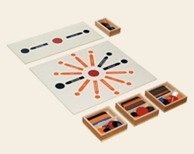
Symbol Box 1
2 very large red circles verb
2 large black circles subject
2 medium black circles object
4 blank black arrows
1 black arrow with the questions who is it that? what is it that?
1 black arrow with the questions whom? what?
A diagram with the subject on the left and the object on the right joined to the verb in the middle by the black arrows with the corresponding questions.
Symbol Box 2
2 very large red circles verb
2 large black circles subject
2 medium black circles object
8 medium orange circles extensions of the verb
1 small black circle indirect object
1 blue triangle adjunct
1 black triangle noun in apposition
4 blank black arrows.
1 black arrow with the questions who is it that? what is it that?
1 black arrow with the questions whom? what?
4 blank orange arrows.
1 black arrow with the questions to whom? to what?
1 blue arrow with the questions what kind of? which?
1 orange arrow with the question how?
1 orange arrow with the question when?
1 orange arrow with the question where?
1 orange arrow with the question why?
1 orange arrow with the question what for?
1 orange arrow with the questions with whom? with what?
1 orange arrow with the questions by means of whom? by means of what?
1 orange arrow with the questions from what? from where?
A diagram with the subject on the left and the object on the right, the indirect object to the top right and the extensions on all sides joined to the verb in the middle by the black and the orange arrows with corresponding questions.
Writing Tray.
A sensorial impression of syntax.
Awareness of the meaning of words.
Interpretive reading.
Awareness and appreciation of style.
Enhance self-expression.
AMI suggest that this material should be presented to a 6-year-old, and presumably that means a 6-year-old native speaker of English. Nevertheless, I’ve seen many ESL teachers presenting Reading Analysis to Chinese and Russian children who could barely tell you their name if you asked them. But that’s a different essay -on teaching English as a second language/