Elsewhere I discussed observations of the class by parents, so my focus here is on observations by Montessori professionals: teachers and assistants observing their own class, colleagues from other classes visiting, members of the management team such as an Academic Director or a Head of School, or teachers from other Montessori schools.
When parents observe a class, they’re almost exclusively interested in observing their own child to see what they get up to, although to a lesser extent they also take in something about what the other children are doing and the general the mood in the class. Montessori professionals tend to have a wider focus, one which encompasses the environment, the children and the adults, and how the relationship between these three elements is reflected in the class. When I did my training, AMI provided us with a set of guidelines on what to observe, which I’ve detailed further below, but in essence they tell their trainee teachers to spend 90% of their time observing the children and the remaining 10% observing the environment.
I question the efficacy of this advice. I like to use the analogy of a restaurant -possibly because I first trained as a chef- and ask this question: if you can only name one decisive factor, how do you decide whether a restaurant is good or not? Almost everyone answers this question the same way: the food. Similar question: if you can only name one factor, how do you decide whether a school is good or not? The children, surely: do they enjoy learning and do they enjoy the time they spend in school? To follow the analogy, if you wanted to learn to cook, what should you observe, the food or the chef? And if you wanted to learn to be a Montessori guide, what should you observe, the children or the adult?
For me, it’s obvious that the guide is the key element in the environment, the person who creates the conditions in which the children can succeed, and who sets the tone in the room, so that many classrooms closely mirror the personality of the guide: mellow or intense, reserved or fun-loving, passionate or sedate. For this reason, when I observe I’m mostly watching the guide: what they’re watching, when they intervene, when they don’t, how they intervene, how their intervention works out, etc. etc. etc.
The Aim of a Faculty Observation
The main reason I observe other classes is to learn something that I can use to make my class better: it could be a piece of material, the way the shelves are laid out, a rule or routine, a way of managing the class that is new and different and effective; there’s so many different ways to interpret the Montessori approach that means every observation is different, and the vast majority are valuable opportunities to learn something. What follows are some of the documents I have found helpful when observing.
The National Center for Montessori in the Public Sector

NCMPS have developed a selection of rubrics, ‘to assist with charter school audits for the classroom. They are designed to direct the observer’s attention to student engagement, with special focus on the characteristics of purposeful, effortful activity.’ I’ve used their rubric on ‘Observing in the Prepared Environment’ and found it to be very valuable, pithy yet precise, with logical categories covering all of the important elements.
Observing the Physical Environment
When possible, I try to enter the class at least 30 minutes before the children, so I have time to walk around and record the important details, which to me are as follows:
- Layout of the shelves, including how many are in each area of the class
- Number of shelving units and how many layers on each shelf
- Number of tables, including how many are for one child, or two children, or three, or four…
- Location of tables: in the middle of the circle? Facing a wall? Etc.
- Number of chairs (I once observed a class where the owner informed me that they had a total 22 children, but i counted 28 chairs in the room)
- Number, size and location of floor mats and table mats
- The ellipse: is it an ellipse or a line or a square or a rectangle? And are there shelves placed inside?
Montessori Educational Programs International (MEPI) have a two-page evaluation document, a very simple but logical list of the key elements to look for when observing a Montessori environment.
Observing Children
There’s a great deal happening in your typical Montessori environment, and it can be difficult to know what to record and how to record it. I’ve found the NCMPS rubric above to be quite helpful with this.
The Leuven Scale
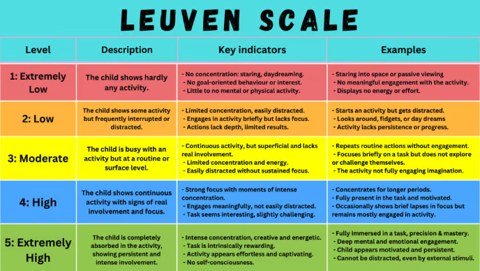
“The Leuven Scale is a five-point observational tool developed by Professor Ferre Laevers and his team at Leuven University to assess two key indicators of child development: emotional well-being and involvement. Now widely used in early years classrooms and care settings, the scale helps educators assess a child's emotional well-being and their level of involvement during classroom activities. These indicators offer valuable insight into a child’s capacity to learn, engage, and thrive.”
- Paul Main, Leuven Scale: A teacher's guide. (2021)
“Observations of children engaged in activities were used by Montessori (1964) and are the foundation of the Montessori approach today. The observations are recorded in different ways depending on their purpose, 80 Observing and assessing effective early learning in Montessori classrooms sometimes in a checklist format, or as an extended narrative and also as a brief narrative to complement a photograph; they also track progress of children working towards an early learning goal (EYFS) (BAECE, 2012 and DfE, 2012). Montessori’s own observation technique, the curve of work (Montessori, 1991) for tracking levels of children’s engagement and concentration is today used by practitioners and combined with the Leuven Engagement Scale (MCI, 2014). The main aim of the observations is to assess the child’s level of interest and concentration. This is why the Leuven engagement scale provides such an excellent complement to the curve of work.”
- Barbara Isaacs, Bringing the Montessori Approach to your Early Years Practice. (2007)
Observing my own class
When I observe the children -in my class or in another class- I’m looking for evidence of:
Motivation Are most of the children using most of the materials most of the time?
Concentration Can children focus on a piece of material and complete the cycle of activity?
Social development Are there positive social interactions?
These labels are vague, but it’s the mood in the room that I’m most interested in, and I feel that these three factors are the most important ones in developing a normalised class.
The Montessori School of Shanghai created the following set of expectations for planning and for teachers observing their own classes.
Classroom Observation and Planning Expectations
Observation is an essential responsibility for Montessori educators. The Montessori Method is founded in scientific, objective observation of children’s developmental characteristics and needs. Scientific observation is more than recording lessons and materials. In order to prepare an environment that will fulfil the child’s natural potentials, the teacher must be able to observe those tendencies, characteristics and interpret the behaviour so that the Montessori educator can guide the child appropriately.
- Observe daily and record objective observations of the student’s social, emotional, physical and intellectual development. Attend to the child’s work, the work habits, cycle of activity and the procedures used with the works. Note the level of attention and interest in the work and especially note the level of concentration.
- Create an easy-to-use document that is readily assessable for quick notation throughout the day.
- A Journal or notebook option.
Throughout the day from arrival through dismissal take regular quick observation notes. Step or sit back from the activity when observing from a vantage to see the largest classroom space. Use a sweep/
Stop fully for at least 5 minutes each hour-to-hour half and collect note of the whole class. You are available to immediately attend to children if you see behaviour that needs attention
- Daily reflect and objectively review the day’s activities, adding notes to the daily observation record to create a full spectrum of the child’s daily habits and activities.
- At the end of the day, add remembered information to the observation document
- Reflect and analyse the data using Montessori philosophy and principles
- Maintain records regularly and at a minimum on a monthly basis. These records summarise the child’s developmental social/
emotional, physical and intellectual progress noting changes or challenges. Also record the progress with the materials and lessons presented, practised or done independently. - Prepare individual and/
or class plans and goals for each curriculum area, social lessons, grace and courtesy lessons, peace education and movement lessons, and other class projects. Children may be grouped according to broad categories for similar works and lessons.
- Monthly/
weekly - these come from the observation of the children with consideration for the annual goals for the child. They are highly individualised for the three- and four-year-old with some consideration given for group lessons for extended day - five year olds. - Planning includes an appropriate blend of the use of sequential lessons from the albums as a guide for presentations and the following of natural desires and interests of each child.
- Lesson Planning is always in response to observations, reflections and inquiry. They are the method used to formalise decisions on what and how to present materials to the child. Plans should be flexible and most importantly they should follow the (inner) child and not the method.
- Focused Observations: Establish a pattern for regular and focused observation of the class. Set aside 20 - 30 minutes regularly to observe for an identified developmental characteristic or habit.
- For example, observe the class for self-confidence/
risk taking: The ability to exhibit awareness of skills, abilities, talents, display a total believe in one’s self; ability to take reasonable risks by trusting one’s own abilities, the ability to meet challenges with appropriate support. - For example, observe one child; one age group; one gender; whole class; time sample observations (30-minute segments).
- During the observation session, sit quietly and observe the class/
individuals for the defined behaviours. Describe the observation. - Use collected data and interpretation of information for individual student planning.
The habit of scientific observation, teacher reflection and analysis of the child’s development guides the teacher to prepare and adjust the environment and materials to satisfy the children’s sensitive periods and natural tendencies. The teacher reflects on the instructional methodology and adjusts the lesson techniques to engage the child’s interest. The teacher understands the child’s level of knowledge and skills which determines the child’s readiness and the instructional approach.”
Prepared by Mary MacIntosh, February 12, 2022.
Montessori Teacher-Training Observations
There’s a great deal of literature on the topic of observation, a lot of it along the lines of the two next examples, excerpted from ‘The Bloomsbury Handbook of Montessori Education’, Chapter 22, Assessment in Montessori Education, by Susan Zoll, Laura Saylor, and Arya Ansari:
“Montessori teacher education programmes provide comprehensive training on the attributes needed to be an effective observer, including the ability to observe a child and remain aware of the needs of the rest of the group and to be patient, objective, and understanding of children’s development.” (Patell, Hilla. 2016. Observation. The NAMTA Journal 41 (252))
“As a physician and a scientist, Montessori valued careful observation and insisted that her teachers be trained and well-practised in using observation to understand the needs of children (Montessori 1965); from the outset of her career, Montessori valued forms of assessment that differed from those that were used in typical school settings (Standing 1984). Montessori equated systematic and rigorous observation with a primary type of diagnostic or formative assessment so a teacher may understand what a child had understood, where the child was struggling, and then adjust the environment as necessary”. (Montessori 2012)
She explained, “If you do not possess this capacity (to observe), especially this sensitiveness, which allows you to learn the intimate facts, which the children reveal without warning anyone as to which is an important thing or which is worthy of claiming attention, then this sensitiveness, this capacity for observation is the labour you must accomplish in yourselves.” (Montessori 2013, 20)
For Montessori, observation was assessment, and it was central to the method. Although two educators may observe the same child at the same time, the more expert observer will likely identify patterns in behaviour and, through reflection, make more meaning from what they observe (Ruiz-Primo and Brookhart 2018; Schon 1983, 130). Montessori also recognised how observational data could be influenced by the observer’s own biases, an idea that has been supported by decades of educational research (Gilliam et al. 2016; McGrady and Reynolds 2013).
To minimise bias, she developed a systematic methodology of observing and assessing students that promotes greater objectivity by asking teachers to separate observations from inferences. This methodology is a significant part of training and daily teacher practice in a Montessori classroom. Further, unlike more typical classrooms in which teachers are expected to spend most of their time engaging with children, Montessori teachers are expected to spend time observing their students at work and meticulously recording those observations.”
Careful, systematic, rigorous, scientific observation: this is right up there with ‘follow the child’ as one of the most common mantras in the Montessori world, but is it really a significant part of the training? AMI offer some guidance for students doing their 3-6 training (below) but it was pretty basic stuff: we sat observing children we knew absolutely nothing about, we had no opportunity to speak with them or learn anything about their background or passions, what they liked or disliked, we just sat jotting down our careful, systematic, rigorous, scientific observations, submitted them to our trainers, and had a 15-minute debrief about what we’d observed. That was it. There was no analysis of what we’d seen, no discussion, and precious little methodology. As indeed, there is precious little analysis, reflection or methodology in most Montessori classes which are managed by AMI graduates with AMI training in how to observe.
I recently observed a class where the assistant spent most of her time furiously scribbling down notes, while the guide continually gave presentations and the children received zero guidance. The class was in disarray, and I desperately wanted to ask the assistant: “What are you writing?!” Because there was no evidence that her notes had any tangible effect upon the life of the class. Perhaps she was creating a shopping list for after school, I don’t know.
For what it’s worth, this is the advice careful rigorous, systematic guidance that AMI give to their teachers in training:
- Use a fresh spiral notebook with your name on the outside.
- Begin a new page each day. Record the day of the week and the date. Briefly note the weather, your state of mind and any special circumstances (there is a sub, its picture day, etc.). Make a heading (the observation assignment for the day).
- You will be writing almost constantly. Follow the observation assignments but keep writing about anything you see if the assignment is not immediately relevant. Write during groups, lunch, outside, as a special class. As long as there are children present, there is something to write about.
- Keep a running record of the time on the left margin, every 10 minutes or so. A watch will be essential.
- Write each observation as it happens. You will be recording what you see, objectively. You will be writing about one small incident In a sea of many. You will not be writing a report or attempting to record the flavour of the day. You will not be writing summations or a synopsis of events. You will not be repeating yourself (“It’s time to clean up.”)
- Do not write conclusions or interpretations (write “Lee is frowning.” Rather than “Lee is sad.” She is smiling and talking with the directress” rather than “She is happy with her work.” Interpretations are valid, especially in our own classrooms when we make plans based on them. You may write interpretations or opinions if you want but separate them from the observations. If you have any questions for us, highlight them.
- A good check to see if your observation is objective enough is to see if your personality is coming through in any of them.
- Be ready to hand in your journal, along with the class list, daily schedule and the signed record of your observation days, on the day we resume classes.”
The Montessori School of Shanghai also have a teacher training centre (AMS) and offer the following advice to their trainee teachers.
MH and WHQ Classroom Observation Practices Beginning March 1, 2022
Purpose - To practise observing children and develop the habit for scientific observation. Refer to the MSS Observation Expectations.
Week 1
Day 1
Observe your environment for the following
- Arrangement of shelves: which the materials are available and determine appropriate sequence of materials.
- Practical Life activities for:
- Washing hands
- Scrubbing a table
- Dressing frames
- Snack table
- A detail list of Practical life activities will be attached for your reference
- Write a few lines or a small paragraph on the general atmosphere you observed within the classroom.
Day 2 and 3
Observe a different child on each of these days, keeping a record of the following:
- The child’s activities throughout the morning.
- The length of time spent on each task.
- How often an activity is repeated.
When an activity is completed....
- Does the child put it away?
- Does the child have to be helped to do so?
- Is he/
she encouraged to do so?
What happens between activities? Does the child....
- socialise
- wander around
- observes the others
- gets lost in a fantasy world
- disturbs others
- sits quietly and appear not to be doing anything o help and assist others
Day 4
Make brief notes (with examples) on the following situations
- Were the children independent? - Pinpoint various examples of children functioning independently.
- Did older children help the younger ones? How was this done?
- If a child did not want to put his work away at the end of an activity, what techniques did you employ to help the child to do so?
- How did you as an adult re-direct a disruptive child?
Make notes of all the group activities held during the morning, bearing in mind as many of the following points as possible:
- When was the group called?
- At what time in the morning and for how long?
- Number of children present
- Why was the group called?
- How was the group organised by the adult?
- What activity/
activities did the adult do with the children? - How did the children respond?
- How was the group dispersed?
Week 2
Observation Actions:
To focus on two children in some depth
To reflect on what observation can tell you about the child
Observe 2 children throughout the week - one child should be between 3-4 and one child is 5-6 older child.
Keep taking note of the following:
- The TYPE OF WORK chosen by the child during the week - what area is the activity from? Is it group activity or individual?
- The PROGRESSION of work with regard to level of challenge - did the child choose something to start with and move on to something more complex or was there a different pattern?
- Where does the MOTIVATION come from? Is the work self-directed? Is it influenced by other children? Is it suggested by the teacher?
- Is there REPETITION of activities? This may be on the day itself, during the week, partial cycle within a long activity (e.g., washing/
polishing) or by means of a related material etc. - How does the child show his/
her INDEPENDENCE? This may be through choice, completion of cycles of activity, overcoming challenges, helping others, language, care of the environment etc. - What kind of MOVEMENT/
CO-ORDINATION did you observe? Consider gross motor skills, fine motor skills, orderly/ disorderly movements, equilibrium, precise or exact movement, movement when concentrated upon some activity etc. - What kind of LANGUAGE skills did you observe? Consider use of vocabulary, expression of ideas, exchanges with children and adults, self-confidence in speaking etc.
- What kind of SOCIAL SKILLS did you observe? Consider child’s interactions with children and adults, how the child contacts others, how the child responds in a group situation etc.
At the end of the week on the basis of your daily record, prepare a summary for each child considering the points outlined above.
Prepare a work curve for each child using your observation notes as a guide and use this to make a list of the activities that the child repeated, concentrated or focused on, chose independently, carried out for a long time.
In addition, make a list of points or consciousness or challenges that you think the child would benefit from. These may include things to help the child overcome a challenge as well as things to increase the challenge for something he appears to find simple.
Week 3
Observation Actions:
To further the skills of observation, reflection and planning to follow the child
To use the work-curves to reflect on normalisation
Observe two children throughout the week following the guidelines as in week 2.
Reflect on the level of normalisation of the child from your observation notes and work curves.
For each child write a summary reflecting on the normalisation of the child, giving examples from your observation to consider the following:
- Self-discipline and level of obedience
- Pattern of work
- Joy in work
- Stage as exemplified by the work curve
- Concentration
- Social awareness
Faculty-to-Faculty Observations
Before any observation, the school needs to create the conditions in which the observer and the observed each feel at ease and where each has an awareness of the aims of the observation. The Center for Teaching Excellence at The University of Virginia offer the following set of guidelines.
Qualities of an Effective Peer Classroom Observation
Here are some qualities of an effective peer classroom observation designed to share teaching ideas and improve teaching i.e., formative evaluation:
- The programme or partnership is built on the premise of improvement and not considered remedial.
- The observed teacher and the coach trust and respect each other.
- Classroom visits are reciprocal, that is, a faculty member should be, in turn, observer and observed.
- Observations occur by invitation only; there are no surprise visits.
- It is most helpful if each member of the partnership can be observed more than once.
- The observed teacher focuses the observation and consultation on aspects of the course that interest them.
- Partners determine in advance how the observer will look for the information or perspectives the teacher desires.
- Lines of communication between the teacher and coach are open; feedback is both candid and tactful.
- A balance between praise and constructive criticism guides the feedback process.
- Results are kept strictly confidential and apart from any summative evaluation or evaluation processes used to make promotion and tenure decisions or decisions about salaries.”
Post-Observation Discussions
Unfortunately, I haven’t recorded where I found the following document, and although it doesn’t specifically refer to an observation in a Montessori class, the suggestions and advice are sound enough to be used in any educational context.
‘As soon as possible after observing a class, the instructors should meet to reflect. This conference will be most effective if both participants focus on what happened in the class (observation) and asking questions that allow both to consider different ways of teaching.
- Avoid evaluating the class. Instead focus on description and asking the instructor to explore his or her own choices.
- Focus on the issues the instructor defined in the pre-observation conference. If the instructor asked for recommendations, focus on concrete behaviours rather than generalisations.
- Allow the instructor of the class to reflect on what he or she thought went well and consider the strengths of the class.
- Think about how you could use strategies that you saw in the other classroom for your own classes. It might be tempting to say “I do this differently,” but it is more valuable to consider the strengths of another way, even if you decide not to change.
- Consider common problems and how you address those problems differently. It might be useful to spend some time brainstorming other additional options.
- What strengths did you demonstrate in this class? How could you build on those strengths? (And by extension how could someone else use those same techniques?)
- I noticed that you [exhibited some sort of strategy, i.e. called students by name, moved around the room, started class with an audio clip and so on] Why did you do that? Did the students respond in the way you expected?
- How well did you meet the goals you set for this class?
What other ways of teaching did you consider before class? Why did you reject them? - What did you do that helped your students better understand the purpose of this class? How did you clarify ideas for them?
- What would you change if you could teach that class again? Why?”
Resources
See The Prepared Environment page for many resources adjacent to observation.
Gina Peterson and Emily Elam
Dartmouth College
The Dartmouth Teaching Evaluation Project is an effort to advance educational practice at Dartmouth by developing instruments and implementing strategies to effectively and consistently evaluate teaching It offers measurement instruments that draw on three sources of data: students (student course evaluations), colleagues (peer observation of teaching), and the instructor (reflective self-evaluation).
There are seven dimensions of effective teaching and effectiveness within each dimension can be evaluated based on observable indicators that are supported by educational research. Examples of these indicators are provided below, but note that these example indicators are not exhaustive, and that indicators of effectiveness vary by context-by discipline, department, institution, and culture-and evolve over time.
Peer Evaluation
This form provides an opportunity for the instructor being observed to situate the observation within the larger course context for the observer.
This version of the observation form provides examples of observable teaching practices and space for note taking within each category.
This version of the observation form provides a checklist of observable teaching practices and space for note taking on the overall classroom observation.
Self-Evaluation
This is a downloadable, printable, interactive version of the teaching self-evaluation guidance.
Ronald A. Berk
The Centre For Teaching Support & Innovation, University Of Toronto
A. M. Joosten
Teachstone
‘A specialised resource developed by Teachstone in partnership with Montessori experts to help observers accurately score teacher-child interactions in self-directed, independent Montessori classrooms’ who also offer …
‘The idea of being observed while performing a job can make anyone feel a little nervous. But understanding what CLASS observations are really about can help teachers relax and approach their classrooms with the same skill and attention they normally do.’
The Montessori Notebook
Base Ten Montessori
Molly O’Shaughnessy
The National Centre for Montessori in the Public Sector
Structural Learning
Leuven Scale: A teacher's guide to making deeper, actionable assessments on children to improve learning and child development outcomes.
Arda Arikan
Maryellen Weimer
Yale-NUS College Centre for Teaching and Learning
Montessori in Action
Lady Gowrie Child Centres
Journal of Educational Supervision
The Froebel Trust
‘This paper describes a history of teachers of young children in their role as researchers, focusing on the way they used observation to understand child development and pedagogy. The idea of a teacher-researcher is explored through a biographical study of the Froebelian, later Deweyan, teacher Meredith Smith, with aim being to connect Smith’s experiences with the history of research about children in educational settings.’
Busy Bee Montessori CenterPDF
Valerie Polakow spent two years observing a preschool/
While the centre seems wonderful on the outside with its beautiful brick building, big playground, and trained staff, Polakow looks deeper to see how it shapes the lives of children. She argues that even well-meaning, high-quality schools can accidentally trap children in an adult-controlled world that strips away the true freedom of being young. Polakow points out that the highly organised and rigid nature of the Montessori method can sometimes act as a tool for control rather than real freedom.
The classroom is filled with specific tasks that must be done in a certain way, which leaves very little room for wild imagination, messy play, or spontaneous joy. Children are expected to behave like miniature, productive adults who focus quietly on their individual tasks. Polakow believes this environment values quiet obedience and work over the natural, loud, and shared play that children actually need to grow emotionally. What is presented as liberation through self-directed work becomes, for very young children, a system of tight external control that pathologises normal toddler behaviour and erodes the playful, transformative, social dimensions of early childhood. By turning childhood into a series of timed, organised lessons, the school changes play into a chore.