I’ve written about this topic in the Role of the Adult, but because it’s such a key part of the job, I felt it would be useful to recapitulate and elaborate on the points I made in that essay.
Many Montessori teachers find it challenging to manage their classes, and in particular they seem to have issues with deciding to guide:
- Children who are not yet normalised
- Children who need help with an activity/
material - Colleagues
Managing children who are not yet normalised
Classroom Management is also referred to as ‘classroom leadership’ or ‘classroom discipline’ and this word (discipline) is probably the one that causes Montessori guides the greatest difficulty: how to develop it, how to respond to its absence, and even how to recognise its absence:
"Let us always remember that inner discipline is something to come and not something always present."
- Maria Montessori, The Absorbent Mind, p. 248. (1949)
The first and most important responsibility of the Montessori guide is the creation of a peaceful and ordered environment, one which allows children to focus on their activities whilst developing both an awareness of their place in the group and an appreciation of the needs of others. By fostering collaboration and respect for others, the guide strives to engender a sense of teamwork and to develop a genuine community.
Nevertheless, in every community there are individuals who lack self-control and who don’t respect the needs of others:
“The teacher has two tasks: to lead the children to concentration and to help them in their development afterwards. The fundamental help in development, especially with little children of three years of age, is not to interfere. Interference stops activity and stops concentration. But do not apply the rule of non-interference when the children are still the prey of all their different naughtinesses.”
- Maria Montessori, ‘The Child, Society and the World: Unpublished Speeches and Writings’, p.16.
A major challenge for the adult is figuring out how to guide those children who are “still the prey of all their different naughtinesses”, and this can be hugely challenging for Montessori teachers. Many simply don’t know why or when they needed to interrupt children who disturbed others, and they certainly don’t know how to guide them.
Why and When to Interrupt Children
This is a crucial and challenging part of the job, and yet it is pretty much completely ignored in almost all teacher-training courses, irrespective of whether they’re run by AMI or AMS or any other organisation. On the first day of my AMI training, we were given a handout with the schedule for the year, containing all of the important dates: when we had to submit each album, when we’d observe in schools, when we’d do our practice teaching, when the holidays were, and all the other significant events up to the dates of the final exams. And then, right at the bottom of the page, after the final exam, the date when we’d receive a lecture on Classroom Management. Assuming this was a printing error, I raised my hand and pointed out the mistake. Except it wasn’t a printing error: if you do the AMI training, you can pass your exams and receive your AMI diploma without spending one minute studying classroom management.
The inevitable consequence of this is that AMI keep producing teachers who haven’t the faintest idea how to manage a class of children. Worse, the teachers have been led to believe that the essential part of the job is giving presentations, so that’s how they do all day, sitting with one child while their assistant (who has minimal or no training) is left to manage the other 20+. No wonder so many classes are in disarray, with little packs of children (usually the older ones, invariably the boys) roaming about, unable or unwilling to choose an activity, those children who are trying to focus having their concentration destroyed, All of which is frankly baffling, because Montessori gave clear, unambiguous and practical guidance on the topic of freedom and discipline:
“To let the child do as he likes,’ when he has not yet developed any powers of control, is to betray the idea of freedom. […] If freedom is understood as letting the children do as they like, using or more likely misusing, the things available, it is clear that only their deviations are free to develop”
- Maria Montessori, The Absorbent Mind, pp.205/6. (1949)
A few chapters later, she elaborated on this point:
"The teacher must entice the children. The teacher, in this first period, before concentration has shown itself, must be like the flame, which heartens all by its warmth, enlivens and invites. There is no need to fear that she will interrupt some important psychic process, since these have not yet begun. Before concentration occurs, the guide may do more or less what she thinks best; she can interfere with the children's activities as she deems necessary. She can tell stories, have some games and singing, use nursery rhymes and poetry. The teacher who has a gift for charming the children can have them do various exercises, which, even if they have no great value educationally, are useful in calming them. Everyone knows that a lively teacher attracts more than a dull one, and we can all be lively if we try. If at this stage there is some child who persistently annoys the others, the most practical thing to do is interrupt him, to break the flow of disturbing activity. The interruption may take the form of any kind of exclamation, or in showing a special and affectionate interest in the troublesome child."
- Maria Montessori, The Absorbent Mind, pp.277-81. (1949)
So, what is expected of the guide?
“What is expected is the ability to distinguish the child who has chosen the right path from the one who has erred.”
- Maria Montessori, The Child in the Family, P. 33. (1923)
The most effective Montessori environments I have observed in are those in which the children exhibit concentration and curiosity, and the guides in those classes always seem to demonstrate the same qualities: they’re kind yet authorative, calm and gentle yet firm and decisive, they’re sensitive to the feelings of the children and display obvious empathy, but they also set clear and consistent limits, establish some basic rules, remind the children of those rules, and when the rules are infringed, they implement clear, consistent and reasonable consequences.
“The term that better defines classroom management is “classroom leadership.” The Montessori teacher must become an effective leader. The seemingly magical way that students work and interact peacefully- -without adult interference--is a point of arrival that does not occur without a long period of active adult leadership.”
- Paula Lillard Preschlack.
Creating Classroom Rules and Expectations
The most practical and succinct explanation of this topic that I’ve seen is the one produced The School in the Hills, who explain how children have certain rights, but also how each of those rights comes with a responsibility:
Ground Rules
The Ground Rules are the rules by which the children run the classroom. Lessons are given on a daily basis in regards to the Ground Rules by using role playing, role modelling and discussion. These responsibilities become part of each child’s ability to be comfortable and have the freedom of movement and choice in the classroom.
Responsibility: The child must use the materials respectfully. That is, the child may not harm the materials, himself or others. The child may not use materials in a way that disturbs the activities of others in the environment.
Right: The child is free to work with any materials displayed in the environment.
Responsibility: The child may not work at or on a display shelf, as her presence there would obstruct other children’s access to the materials. All pieces of the work must remain on the rug or at the table.
Right: The child may work at a table or on a rug, whichever is suitable to the work chosen.
Responsibility: The child restores the environment during and after an exercise. She is responsible for mopping up her own spills, rolling up her own rug, placing her chair under her place at the table, and returning her work to the appropriate spot on the shelf.
Right: The child has the freedom to use the room as her needs dictate.
Responsibility: No child touches the work of another without an invitation to do so. No child is allowed to interfere with another’s learning cycle (this provides security for the child involved in an exercise to continue it too its completion). If the child must leave her work temporarily, she can continue later confident that it will be as she left it when she returns.
Right: The child has the right to work unrestricted by others. She may initiate, complete, or repeat an exercise alone and without a break in her concentration cycle.
Responsibility: The child is not allowed to interfere or disturb an activity she has chosen not to join; this is her responsibility to the group.
Right: The child does not need to join a group activity. She may continue working with an individual exercise during group activities, or she may stand apart from the group as an observer of group activities without becoming an active participant.
Responsibility: A child is not forced or even encouraged to share work. Generosity develops from within as a child matures and gains self-security. With adequate materials and supportive ground rules, sharing comes naturally in cases where sharing is appropriate or necessary.
Right: The child may work alone.
Responsibility: The child’s idleness is not allowed to disturb or distract others’ activities.
Right: The child is free to do nothing if she so desires. She may be learning by observing others, may be thinking, or may simply be relaxing.
There is a great deal of wisdom in this, and the expectations and consequences for the child and their family are similarly clarified in their Parent Handbook
Discipline
Discipline at School in the Hills consists of positive methods and guidance that encourage self-esteem, self-control, and self-direction. Our qualified, professional team does its best to prevent disciplinary situations from arising. Each child is accepted on an individual basis. No child is ever labelled, shamed, or humiliated. Striking a child for any reason, screaming, yelling, or withholding food as punishment strictly violates our discipline policy. We believe young children learn positive behaviour best through example. We encourage the team to commend children for their positive behaviour. Age-appropriate limits are set for behaviour, and the children know what is acceptable for them. This is done positively; we focus on the child's behaviour and not the child’s character. This approach preserves the child’s integrity and offers positive guidance for learning. The feelings of the children are recognised and understood when limits are set. Simple reminders to children also help in discipline. Ground Rules are the rules the classroom runs by, and ground rule lessons are given both in groups and individually daily. There are times when it is necessary to isolate a child from a group; this, however, is done for an age-appropriate amount of time.
All children work to be integral to the classroom/
From time to time, School in the Hills recognises that an individual child’s needs and/
That Handbook explains with absolute clarity what is expected of the teacher, the child and the family. From occasionally bitter experience I really appreciate this clarity, as I do the General Classroom Expectations of Monticello Montessori Public Charter School in Idaho, USA:
Rules and Standards
The mission of Monticello Montessori Public Charter School is in part to help students become intrinsically motivated learners. To accomplish this mission, we ask that students comply with strict dress and grooming standards so that the classroom environment is free of distracting media messages, commercialism, and undue focus of attention on external appearances. See the Student Handbook for Dress and Grooming Standards. We also ask that students follow certain general classroom expectations as listed below:
Any child can do a work as long as he or she:
- Has had a lesson on that work
- Works safely and appropriately
- Works quietly
- Respects themselves, others and the environment
- Takes materials to a mat or table.
- Returns work to the shelf in the condition it was found (or better).
- Abides by one child per activity (with exceptions governed by teacher).
- Does not touch the work of another or interfere with another’s activity by distracting, correcting, taking over or behaving in a way that disturbs another’s concentration.
- Restores the environment:
- Chair in
- Spills/
area cleaned up.
A child may join another if he is invited and has teacher approval. This includes watching. (Watching is eyes only, not touching or talking.)
No child is ever required to share his or her activity or materials. (Children may choose to share or may invite a peer to join their work, with teacher approval. A goal of the Montessori classroom is for children learn to respect for and have patience with others.)
Children are invited but not forced to participate in a group activity. They may watch. They cannot disturb an activity they choose not to join. They may be excused if they participate inappropriately.
Students may occasionally choose to 'do nothing'- to take time away from work choices to muse or think. (This may appear to an observing adult as wasting time, but can in fact be important set-aside time for the child's mind to rest, problem solve, and deepen learning.)
All students are encouraged and expected to engage in rigorous learning activities that stretch their comprehension, cognitive skills, ability to manipulate ideas and to creatively solve problems.
Children may reinforce their learning by assisting other students. Teaching someone else is one of the best ways to solidify mastery of a concept or skill, and helps build self-confidence, which in turn improves intrinsic motivation for learning.’
Once again, these rules are logical, practical and clear and have obviously been deeply considered and refined, and this clarity is hugely beneficial for children, parents and teachers. Similar levels of thought and consideration have gone into how to resolve disputes in Montessori classes.
Conflicts - The Peace Table
A common challenge that many adults experience is how to handle conflicts between children. In a home with more than one child, these are inevitable, so in a class with 20+ children -all of them striving for independence and many of them still developing their inter-personal skills- these conflicts can become hugely time-consuming for a Montessori guide. I’ve written about this topic in the Practical Life curriculum, but it bears repeating here.
‘Casa dei Bambini’ means ‘home of children’ but in even the most harmonious of homes, there will be disagreements from time to time, and when children have disputes, they typically look to the adults to resolve them. Cultures and countries may be hugely different, but they are remarkably similar in the ways they deal with these disputes: Mom or Dad -or both- listen to the evidence from both parties, call some witnesses, decide who is innocent and who is guilty, then pass sentence, with no appeal process.
For a teacher with a full classroom of children, this process isn’t feasible, and even if it were, our aim is to guide the children towards independence, so we remove ourselves from the process and create the conditions in which the children can work out their own form of justice. We use The Peace Table, which works like this:
- Two children sit facing each other across a table with an object (e.g., a small stone) upon it.
- One child holds the object and talks about how they feel, e.g. “I feel sad because … you won’t play with me/
choose the material I want/ had snack when it was my turn...” etc. - When they’ve had their say, the child hands the object to their comrade, who responds “I can’t play with you now because…/I wanted to play with that now because…/I was hungry so …” etc.
- The conversation continues back and forth until the children reach a consensus and is a wonderful way to encourage communication and problem-solving independent of the adult.

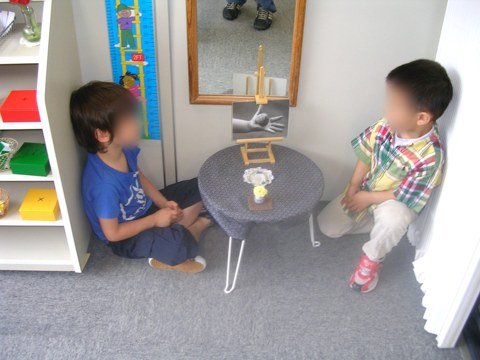
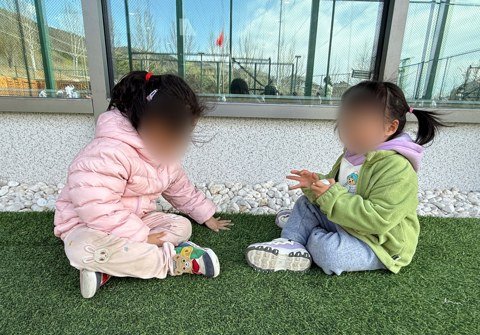
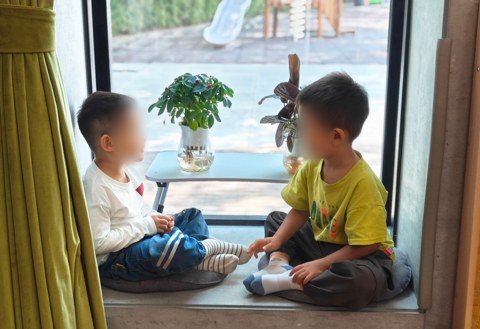
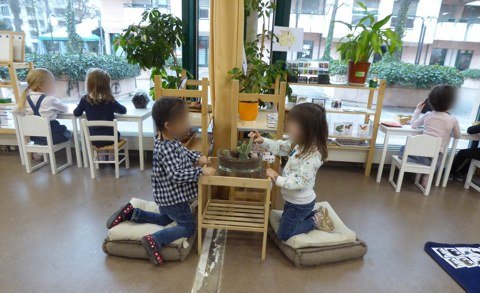
There are a few simple guidelines:
- Sit facing -and looking at- each other.
- Talk about how you feel.
- If you refuse to talk, you can’t play with the other children for the rest of that day.
- No raised voices.
- Take turns.
- Keep talking until you both agree that your problem has been resolved.
- Shake hands and leave.
What I particularly love about the Peace Table is that it turns something negative (conflict) into something positive (communication), and it eases the burden on the adult whilst empowering children. The other thing I love about it is that the children don’t have to be told that the Peace Table is merely a tool and that the underlying skills -developing the ability to communicate with others- is the true aim, they discover this by themselves, so that over time they visit the Peace Table less and less because they learn to make peace wherever they are and whomever they’re with.
Managing children who need help with an activity/
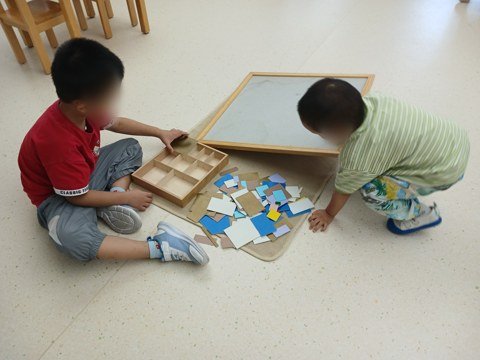
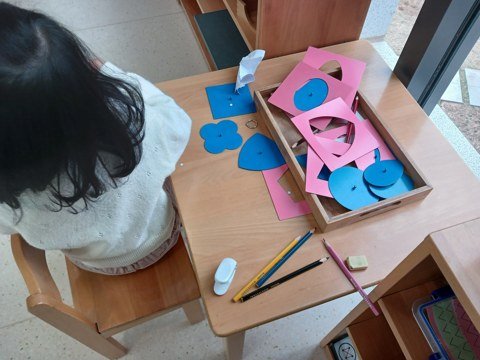
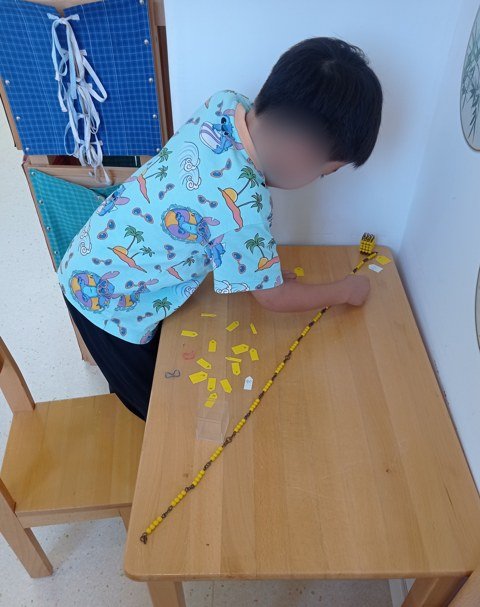
A few years ago, because it was just before a national holiday and many families in the school where I worked had decided to take some extra time off, so my class and another class were merged for a few weeks. It’s always an interesting experience working with a new colleague, and this was particularly interesting because we had to figure out how to work together, and whose rules and routines should take precedent. We decided that as we each knew our own children, it made sense that we each guide our own children. Makes sense, but it was challenging, in particular because of scenes like in these photos.
When I look at this, what I see are children very obviously in need of guidance, who lack a sense of order, control of movement, structure … the list of things that need to be resolves here is lengthy. To me, at least. My colleague, however (also an AMI-trained guide), felt that the children were ‘exploring’ and that in time they would self-teach and that any interference from the adult would somehow impede their independence, so she kept presenting materials or sat observing it all with a beatific smile, “silent as the sphinx” -

“One time I saw an entire class of disorganized children who were using the materials completely wrongly. The teacher drifted about in the class, silent as the Sphinx…This teacher was committing a grave error: She feared disturbing their disorder, instead of attempting to establish the order.”
- Mario Montessori, The Human Tendencies and Montessori Education, p. 140. (1956)
Like Mario Montessori, I look at certain scenes and don’t see order, I see the complete absence of order. In this instance, when a child is very clearly experiencing difficulty with a piece of material, it seems to me that a guide has at least five options open to them:
- Do nothing.
- Ask the child to put away the materials.
- Give a re-presentation.
- Offer some guidance - a minor tweak.
- Have another child offer some guidance.
All of these can be valid options, none of them are always right and none of them are always wrong; it really depends on the child, on the day, on many factors both inside and outside the class: whether the groups is normalised, how the mood is in the class that morning or at that particular moment, how well-trained the assistant is, how capable and experienced the guide is, etc etc etc. Knowing my children, I make an educated guess about how to guide them, choose one of those options, and afterwards I reflect on the results and decide whether I made the right choice and I use that information to try and make a more informed decision the next time.
Do nothing
This is the option that many guides choose, possibly because it requires so little physical, emotional or intellectual effort and it’s easy to justify: “ I’m observing the child” or “I’m following the child” or some such vapid nonsense. This is often code for, ‘I have no clue what to do’ but the consequence is that all too often children are abandoned in the middle of a mess that will never resolve itself.
Have the child put away the materials
The opposite of Option 1, and equally unhelpful, but tf the class isn’t normalised or one of more children need assistance at that moment, it mightn’t be possible to sit with one child for long enough to give a re-presentation. In this situation, asking the child to put away the materials isn’t ideal but it’s still better than doing nothing, leaving the child sitting there in confusion.
Give a re-presentation
Sometimes it’s clear that a new presentation is required and this can be time-consuming so it isn’t always an option, but if the class is normalised it should be possible to sit with the child and re-present the materials.
Offer some guidance - a minor tweak
In a normalised class, filled with normalised children (and assuming the originally presentation wasn’t riddled with errors) it’s often possible to offer some minor piece of guidance that gets the child back on track.
Have another child help
Even better is when you can ask another child to step in and fix the problem. Only possible if you’ve spent a long, long time guiding the children towards independence, and in particular encouraging them to resolve any issues that occur in the environment and if you’ve provided with the encouragement, support, guidance and opportunity to teach their classmates.
Managing Colleagues
All of the above is made much easier if there’s another well-trained adult in the room, either a second Montessori guide or an assistant. If I was able to choose, I’d choose an inexperienced guide over one with experience, for the same reason that when a new child joins the class it’s always better to have a 3-year-old rather than a 4 or 5-year-old: experience very all too often equates to bad experience.
The perfect balance for me is working with a new graduate (AMI or AMS, although I prefer the latter as they’re often better trained and more open to ideas that aren’t an acceptable part of Montessori orthodoxy) because they’re usually enthusiastic and keen to use their training, which means they’re keen to give presentations. Which leaves me free to manage the class, which is both more challenging but also more interesting: mt favourite class was then one in which we had 32 children, so while my colleague sat with one, I had to guide the rest, and this can be quite challenging but it is also tremendous fun, trying to anticipate when disorder will occur and redirecting the children before it takes hold:
“The teacher should intervene before, not after, the disorder has occurred.”
- Maria Montessori, The Call of Education, Volume 11, No. IV, December 1925.
Planning and communication are of paramount importance: all adults must be aware of their responsibility, and they should be in communication throughout the work-cycle. I’ve seen classes where two trained AMI guides never communicated for three hours, but I’ve seen others where the teacher and their untrained assistant were continually locking eyes and by the slightest movement of the head or by looking at a particular child the assistant knew what was being asked of her. Like everything else in a Montessori environment, communication gets better with practice. A few basic rules help:
This means that if one teacher is standing (‘up’) it means they are responsible for managing the class so that the other can sit with a child and present (‘down’).
This means that if one teacher has given a presentation or a direction to a child, then that teacher is responsible for that child until the child returns the materials to the shelf. I observed a class where the Lead Guide was missing so the Academic Director replaced her and also present in the room was a second guide, an assistant, and a cleaner. A child of 5 took the 8-cubed chain and put in on the long bead chains mat in great disarray. His first difficult was caused by the location of the mat: too close to a shelf and a pair of tables, and the second was caused by his failure to allow for the length of the chain, so the mat couldn’t be unwound sufficiently, a problem he resolved by winding the chain back on itself. A little guidance about where to place his mat would have resolved both of these issues, but no-one was managing the class, so guidance was in short supply. When he brought the materials he places them haphazardly on the chain, and then the emptied the numerals so that they were in a heap, some of them facing upwards but hidden in the pile, and many others facing down. Nevertheless, the poor child began counting.
About 45 minutes had passed and he’d gotten as far as 20 when the Academic Director came and spoke with him for about a minute, then got up and walked away. The boy sat there for another 30 minutes, immobile, before the other guide came and sat with him, offering god knows what piece of advice, but whatever it was, he didn’t budge and she also got up and left him after a minute. With grim and almost comical inevitability, after another 30 minutes the cleaner came and offered her two cents, before going back to mopping the bathroom. An hour later the boy hadn’t counted beyond 20 but he was finally rescued by the morning work period finishing and he put the materials away.
The lack of communication, the complete failure to decide who should guide that child and how they should guide him, the complete lack of responsibility or any kind of awareness of how to help the children - all of this was quite disappointing and depressing for all concerned, and such a waste, because with some very minor tweaks the child could have been set up for success.
A little classroom management goes a long way.
Resources
Jane Nelsen and Chip DeLorenzo
Paula Lillard Preschlack
The University of San Diego Division of Professional and Continuing Education
Created a detailed guide on How to Create a Classroom Management Plan, which includes many free downloads.
Trillium Montessori
A collection of articles on the topic of Montessori Behaviour Management
Head Start
A short video on Creating Classroom Rules MP4
Materials for Trainers
Presentation PDF
Optional Slide PDF
Presenter Notes PDF
Learning Activity: Determine Consequences PDF
Learning Activity: More Times to Guide PDF
Learning Activity: Making Rules Understandable Checklist PDF
Learning Activity: Writing Classroom Rules PDF
Supplemental Videos PDF
Supporting Materials
Tips for Teachers PDF
Tips for Teachers: Dual Language Learners PDF
Tips for Families PDF
Teacher Tools PDF
Tools for Supervisors PDF
Helpful Resources PDF