Introduction
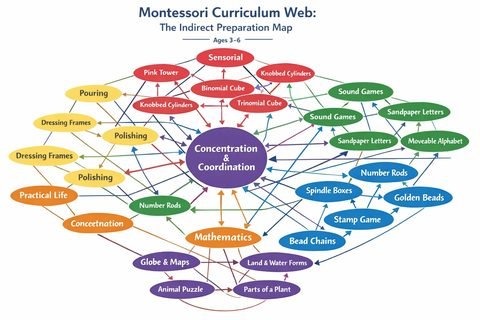
Developed and refined over the course of a century, the Montessori Curriculum is not a rigid syllabus but a holistic, developmental continuum, based on the understanding that children possess an innate drive to learn through purposeful interaction with their environment and the belief that by facilitating freedom of movement and choice within clear, respectful limits, self-discipline and a love for learning will inevitably develop. The goal of the Montessori Curriculum therefore is not the transmission of facts but to nurture autonomous and intrinsically motivated children who think critically and act responsibly, and to empower them cognitively, socially and emotionally to become capable, confident and compassionate lifelong learners.
The curriculum is divided into five interconnected areas, each supporting the child’s physical, intellectual, and psychological growth. Practical Life activities -pouring, buttoning, polishing, cleaning- are the foundation, cultivating care for oneself and the environment as well as a sense of belonging to a community, while developing concentration, coordination and independence. The Sensorial materials refine the five senses, enabling children to classify and order their perceptions of the world, forming the basis for abstract thought. Language begins with speech and vocabulary, with words then broken down into sounds, which leads to letters, those letters coming together to created words and phrases and sentences, in a logical and seamless progression from writing to reding. Mathematics is introduced not through drills but through tactile manipulative materials that make abstract concepts concrete, such as the golden beads used to represent the Decimal System. Cultural Studies -encompassing Geography, Biology, History, Science, and Art- are presented as keys to the world, explorations that foster a sense of the interconnectedness of all life and wonder about our world, with the curriculum adapted to local contexts while maintaining its core principles.
The Practical Life Curriculum
Maria Montessori’s development of the Practical Life curriculum was rooted in her observations of children and her belief that learning should be grounded in real-world experiences. Her work began in the early 20th century when she opened the first Casa dei Bambini (Children's House) in Rome in 1907, a setting which allowed her to study how young children interacted with their environment. As she observed the children, she noticed that they were naturally drawn to activities that mirrored adult tasks such as sweeping, pouring water, or buttoning clothes, and that these actions not only engaged the children but also supported their cognitive and physical development.
"Experience shows that it is useless and harmful to give the children Sensorial and Cultural apparatus before they are ready to benefit from it. Before introducing this kind of material, one must wait until the children have acquired the power to concentrate on something, and usually . . . this occurs with the exercises of Practical Life. When the child begins to show interest in one of these, the teacher must not interrupt, because this interest corresponds with natural laws and opens up a whole cycle of new activities. . .. The teacher, now, must be most careful. Not to interfere means not to interfere in any way. This is the moment at which the teacher most often goes wrong. The child, who up to that moment has been very difficult, finally concentrates on a piece of work."
- Maria Montessori, The Absorbent Mind, pp. 277-81. (1949)
Rather than dismissing such behaviors as mere imitation, Montessori recognized them as essential steps in a child’s growth toward independence and self-regulation, and she theorized that by engaging in meaningful, purposeful work, children could develop internal order, coordination, and confidence. Montessori emphasized that these exercises were not merely preparatory for academic learning but were fundamental to a child’s overall growth, fostering independence and self-discipline. From these observations, she developed a series of materials and exercises aimed at refining motor skills, developing control and coordination of movement and encouraging independence, her approach emphasising repetition, sequential learning, and the use of real-life tools adapted for small hands, ensuring that each activity provided both challenge and fulfillment.
‘If teaching is to be effective with young children, it must assist them to advance on the way to independence. It must initiate them into those kinds of activities, which they can perform themselves. We must help them to learn how to walk without assistance, to run, to go up and down the stairs, to pick up fallen objects, to dress and undress, to wash themselves, to express their needs, and to attempt to satisfy their desires through their own efforts. All this is part of an education for independence."
- Maria Montessori, The Discovery of the Child’ p. 56. (1967)
Aims
The Practical Life curriculum is designed to support a child’s holistic development by fostering essential life skills through purposeful, hands-on activities that have both direct and indirect aims. The direct aim of each exercise is to complete that particular exercise; for example, the direct aim when pouring beans is to pour the beans without spilling them, and the direct aim when using the Buckle Frame is to open and close each of the buckles. However, each task also has a variety of indirect aims which extend beyond the completion of a task, and include development of:
- Independence
- Coordination of Movement
- Concentration
- A Sense of Order
- Social Development


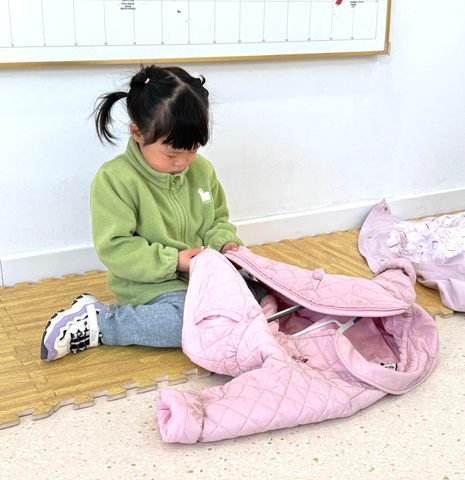
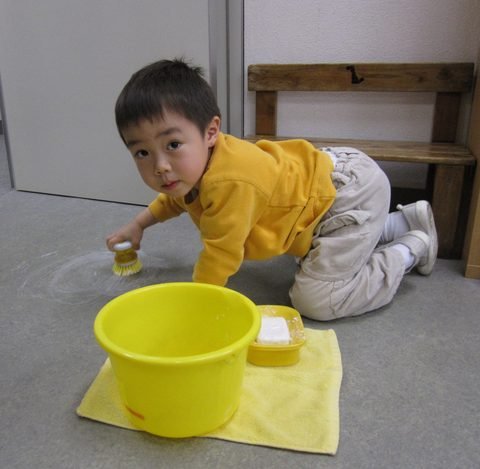
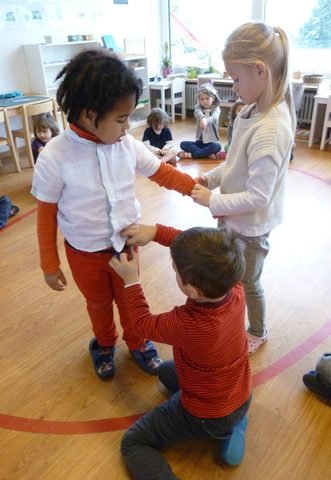
Groups of Practical Life
The exercises are categorised into six groups:
These are the constituent parts of every exercise, with these movements later used as the component parts of more elaborate, complex presentations.
These exercises give children the opportunity to practice controlled movements, refine their fine motor skills, and develop precise hand-eye coordination and concentration, improving balance and precision.
These exercises focus on personal hygiene, dressing skills, and bodily awareness, creating opportunities for the child to practice daily routines such as washing hands, brushing teeth, combing hair, and tying shoes.
The exercises in this area extend the child's sense of responsibility from themselves to their surroundings, encouraging children to take an active role in maintaining their environment.
The exercises of Grace and Courtesy teach the social conventions, polite interactions, and respectful behaviours necessary for community life, and are designed to help children navigate social interactions with poise and consideration, fostering a harmonious classroom atmosphere.
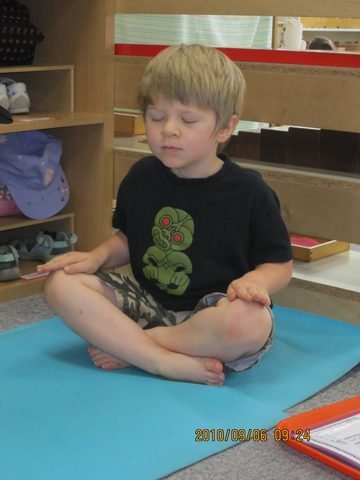
This area is focused on helping children to refine their movements and develop coordination and control over their bodies through purposeful movement, by moving about the environment, carrying trays or mats or chairs, practicing yoga and walking on the line, etc.
The Sensorial Curriculum
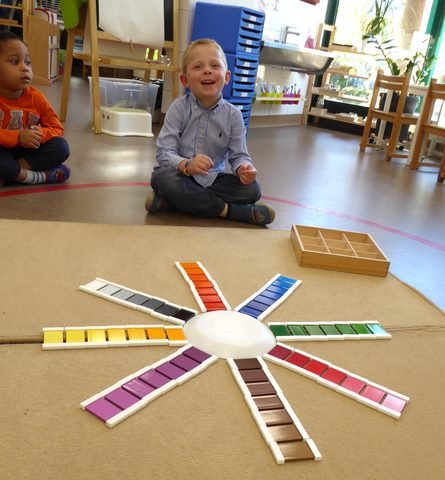
Maria Montessori recognised that sensory experience is the bedrock of all human intelligence, asserting that "The senses, open the way to knowledge.” Children have an innate drive to explore the world, and they do this through their senses: observe how a baby will look at an object, hold it in their hands, feel the texture and weight, shake it, lick it and probably bite it. They are bombarded by a kaleidoscope of sensory impressions -colours, sounds, textures, smells, tastes, weights, temperatures, and shapes flood their awareness indiscriminately, and from this profound insight emerged the Sensorial Curriculum, the primary aim of which is to help the child classify and order this incessant influx of information, laying the groundwork for abstract thought and intellectual development.
“The mind of a little child is certainly not a blank when he begins the education of the senses, but his concepts are all confused. He begins to distinguish various traits in objects already known. He distinguishes quantity from quality and separates form from colour. He distinguishes dimensions in objects that are long or short, thick or thin, large or small. He separates colours into groups and calls them by name. He notices the varying intensities of colours, calling the two extremes light and dark. Finally, he distinguishes tastes from smells, lightness from softness, and sounds from noises. He succeeds through the education of his senses in ordering his mental images. This is the first act of ordering in his developing mind. This sense of order that has been acquired early is of utmost importance for later life.”
- Maria Montessori, The Discovery of the Child, p.100. (2004)
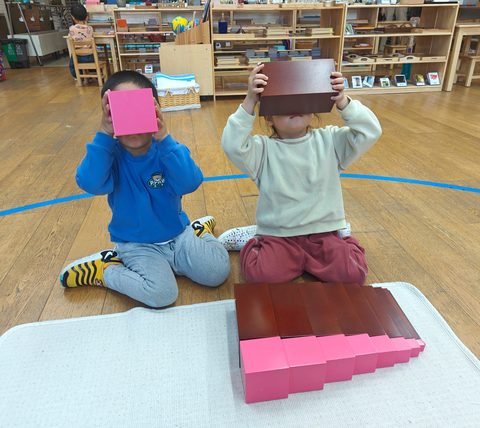
The meticulously designed sequence of materials help to refine their sensory apparatus via tactile exploration (sorting, matching and grading an array of materials) and by isolating one defining quality - dimension, colour, weight, shape, texture, size, sound or smell, etc.- emphasising one particular quality by eliminating or minimizing other differences; for example, the sound boxes are all the same size, same shape, same colour, and same texture; they differ only in the sounds which are made when the child shakes them. Montessori asserted that by isolating specific qualities and offering controlled, purposeful interaction, the child develops:
The ability to perceive subtle differences e.g., slight variations in shade, minute differences in pitch, gradations in texture or weight.
The mental capacity to categorize and sequence sensory input based on identifiable properties e.g. arranging cylinders by height/diameter, grading colors from light to dark.
Precise language e.g., rough/smooth, loud/soft, thick/thin, dark/light- is introduced to label and communicate these sensory distinctions.
Concrete sensory experiences become the foundation for later abstract concepts in mathematics (seriation, geometry), language (descriptive words, comparisons), science (observation, classification), and art (aesthetics, composition).
Activities inherently involve fundamental mathematical processes such as comparing, contrasting, grading, and sequencing.
Senses
| Visual Discrimination | |
|---|---|
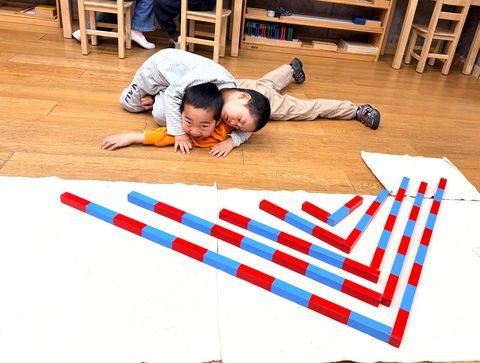
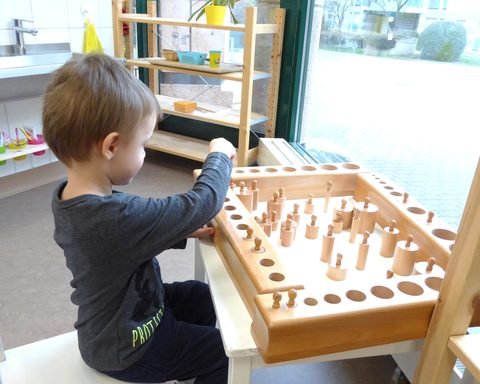
| Dimension | Pink Tower (cubes, size), Brown Stair (prisms, thickness), Red Rods (rods, length), Knobbed and Knobless Cylinders (diameter/height). |
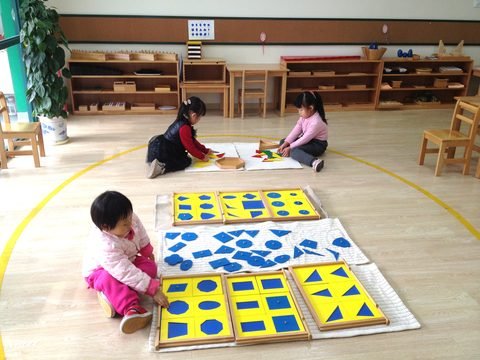
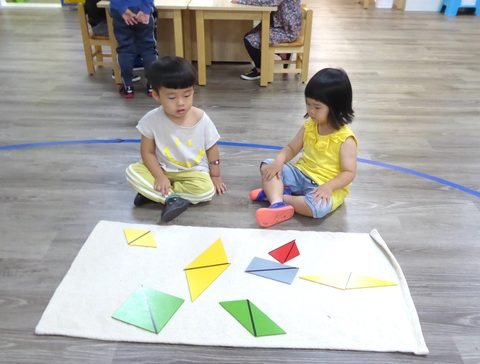
| Form | Geometric Solids (3D shapes), Geometric Cabinet with Cards (2D shapes, progressing from concrete to abstract representation). |
| Colour | Colour Tablets - Box I: primary colour matching; Box II: primary/secondary grading; Box III: subtle gradations of tint/shade. |
| Tactile Discrimination | |
|---|---|
| Touch | Touch Tablets (graded rough/smooth), Touch Fabrics (matching various textures). |
| Baric | (Weight) Baric Tablets (discriminating weight differences). |
| Thermic | Thermic Bottles/Touch Boards (discriminating temperature differences). |
| Stereognostic | Mystery Bag/Geometric Solids (identifying shapes by touch alone). |
| Other Methods of Discrimination | |
|---|---|
| Auditory Sense | Sound Boxes (matching and grading sounds by volume/pitch), Bells (matching and grading musical pitches). |
| Olfactory Sense | Smelling Jars (matching and identifying different scents). |
| Gustatory Sense | Tasting Jars (matching and identifying basic tastes: sweet, sour, salty, bitter). |

The Culture Curriculum
The Cultural curriculum provides children with an opportunity to explore the larger world. As part of a rich exploration of the different cultures of the world, students learn about the people, terrain and animals of each continent as they study them in the course of the three-year cycle.
Cultural Studies also introduces children to the physical world that surrounds them, providing them with the opportunity to explore and learn the scientific names for plants and animals. Areas studied include geography, zoology, botany, physics, earth science and social studies.
As part of a rich exploration of the different cultures of the world, children are introduced to the knowledge, ideas, beliefs, customs, and social behaviour of each continent. Using materials such as globes, puzzle maps, science experiment kits, and cultural artifacts, children learn about diverse cultures, developing their curiosity, global awareness, and appreciation for diversity. The cultural materials can be categorised into the following units of study:
- Biology -
- Botany
- Zoology
- Earth Sciences -
- Geology
- Meteorology
- Geography
- History
- Science
- Arts -
- Art (painting, collage, origami, etc.)
- Music and Movement
Culture 1 - Biology
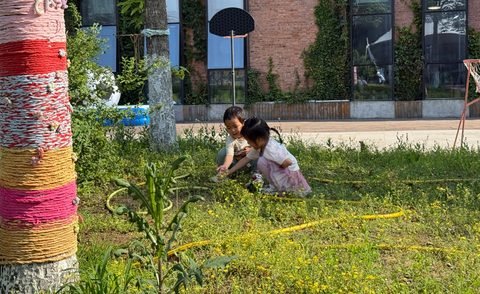
In a Montessori class, children explore three of the seven branches of biology:


Also known as Physical Geography, Earth Science is the study of the Earth's air, water, and solid matter. We introduce children to two of its aspects, Geology and Meteorology, using materials such as Land and Water Forms, the Land and Water Globe, Land, Air and Water cards, and Weather Charts.
Culture 2 - Geography
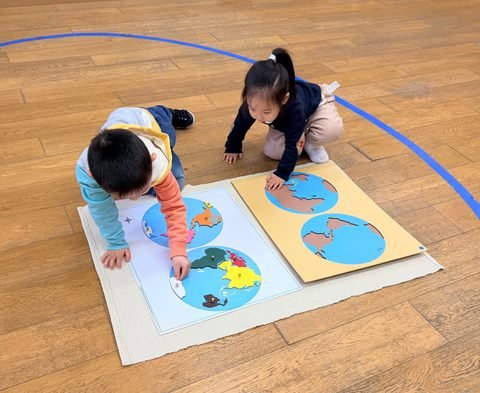
Human Geography focuses on aspects of the environment that are man-made (as distinct from Physical Geography, which deals with features of the environment that were created by nature) and focuses on human activity - how people interact with their environment and with each other. The topic introduces concepts that illustrate cultural diversity and help children learn about different continents, countries and cultures using materials such as Geography Folders, Flags and Puzzle Maps of the Planisphere and the continents: North America, South America, Europe, Asia, Africa, Oceania and Antarctica.
Culture 3 - History
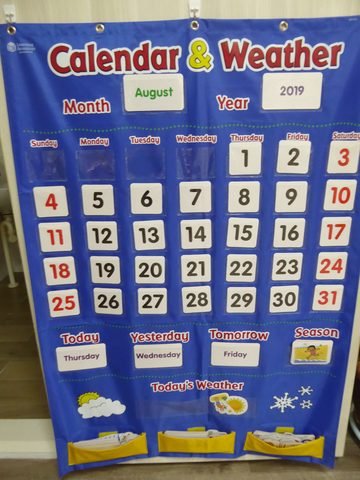
History is taught in order to help children understand their place in time and space, and how we measure it - in seconds, minutes, hours, weeks, months, seasons, years, etc., using materials such as Timelines, Events Charts, The Clock and The Calendar.
Culture 4 - Science
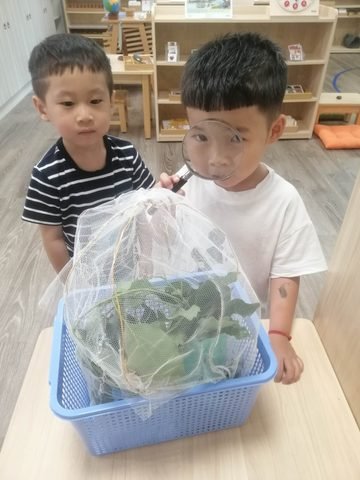
Physical Science introduces concepts such as energy, motion and magnetism, and is designed to spark curiosity, encourage hands-on exploration, and foster an understanding of scientific principles and the basics of categorization and opposites, using simple experiments such as sink or float or magnetic/non-magnetic.
Culture 5 - Artistic Expression
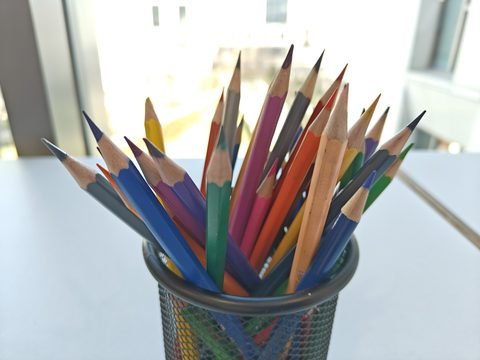
This Art curriculum encourages creative expression and an appreciation for the arts, with the activities categorised as Art or Music and Movement. Art Materials include folding or cutting paper, drawing, painting, crafting, collage and moulding clay. Music and Movement helps the child to develop physical coordination and a sense of rhythm, while engaging in a range of active and stimulating activities such as singing, dancing or stretching. It also provides children with opportunities to refine their auditory discrimination while playing musical instruments such as bells, drums, etc. The children are also introduced to three-part cards of musical instruments or famous composers, fostering an awareness of how music is created and an appreciation of the rich heritage of music.
The English Language Curriculum

Children are uniquely primed to acquire vocabulary, grammar, and syntax with effortless ease, and Maria Montessori designed a curriculum to unfold the child’s linguistic potential, guiding them from oral expression to the abstract complexities of reading and grammar through a hands-on, multi-sensory journey. Unlike traditional education, where children are taught to read and write through rote memorization -following a rigid syllabus of worksheets and drills- and which often separates reading, writing, and spelling into distinct subjects, the Montessori curriculum treats language as a holistic continuum, a carefully sequenced progression that moves from the concrete to the abstract, honouring the child’s developmental timeline and respecting their innate desire to communicate and comprehend the world. In the carefully prepared environment of a Montessori classroom, the acquisition of language is not a subject to be taught, but a natural process to be nurtured.
The Foundation: Oral Language and Auditory Preparation

The journey begins long before a child ever sees a letter of the alphabet. Upon entering a Montessori Children’s House (ages 3-6), the environment is saturated with spoken language, and the primary goal in the early stages is the enrichment of vocabulary and the development of phonemic awareness. The adult’s role is to speak with clarity, precision, and to provide the child with a wealth of vocabulary, constantly enriching the child’s internal dictionary. Teachers use exact terminology through naming lessons with objects from the natural and cultural world, e.g. calling a flower's parts pistil and stamen rather than "flower parts" using Nomenclature Cards which categorize the world, giving the child precise language to describe their environment. Conversations are encouraged and songs, stories, and poetry are woven into the daily fabric of classroom life. This oral foundation is the bedrock upon which all future literacy is built.
“A child must go where he can hear people speaking. But he is more fortunate if he has little children speaking around him because they talk incessantly and he will hear a great deal more.”- Maria Montessori, The 1946 London Lectures, p. 77. (2010)
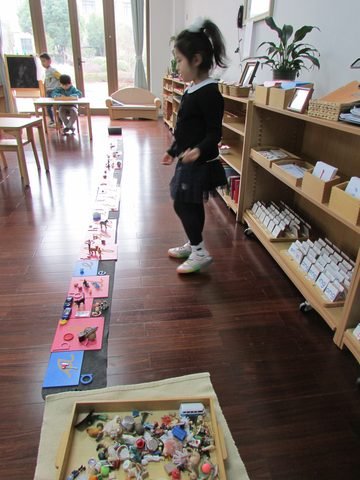
Simultaneously, children play The Sound Game (aka I Spy), wherein I isolate the initial sounds of words (e.g., "I spy something that begins with the sound 'mmmmm'"), thereby training the ear and developing an awareness that words are made up of individual units of sound (phonemes). After progressing through increasingly challenging stages of the Sound Game, the child develops the ability to analyse a word into its component sounds. Only then are they introduced to letters.
The Hand and the Mind: Writing Before Reading
Perhaps the most distinctive feature of the language curriculum is its counterintuitive discovery that for the young child, writing naturally precedes reading, as the physical and intellectual processes required for writing (encoding) are simpler for the young child than those required for reading (decoding), for two reasons:
- Writing is a concrete, physical act and thus easier to master before the abstract, intellectual act of reading, and
- Writing is the process of recording a known internal thought, while reading is the more complex task of deciphering an external, unfamiliar coded message.
To facilitate this, the curriculum separates the mechanical skill of handwriting from the intellectual skill of composing words.
To indirectly prepare the hand for writing, the child spends a great deal of time engaged with the exercises of practical life activities -pouring, polishing, grasping- in order to develop fine motor control and develop the control and coordination essential for the physical act of writing. The iconic Sensorial materials, like the Pink Tower or the Rough and Smooth Boards, further refine the child’s visual and tactile discrimination, preparing the mind to perceive the subtle differences between shapes like 'b' and 'd'. Direct preparation is provided by the Metal Insets, geometric tracing tools that help the child to develop a pincer grip and learn to control a pencil within a boundary, so that while they create geometric art, the child is also training their muscles for the fine motor control required for writing.


To prepare the mind, the child is introduced to the Sandpaper Letters, tablets with letters made of rough sandpaper mounted on smooth boards. The child traces the letter with their fingers while making the corresponding phonetic sound (not the name) a multi-sensory approach in which the child sees the symbol, feels the shape, and hears the sound simultaneously, thereby creating a powerful muscular and visual memory of the letters whilst making the connection between the physical symbol and the abstract sound it represents. This kinesthetic experience bypasses the abstract nature of two-dimensional print and engraves the letter’s form into the child’s muscle memory. It is a quintessentially Montessori approach: making the abstract concrete and allowing knowledge to be gained through the hand.
The next stage is to combine these letters into words, a process of abstract writing that is done with the Moveable Alphabet, a box containing cut-out letters. The guide invites the child to build a word, such as "cat", the child analyses the sounds - /c/ /a/ /t/- and locates the corresponding symbols and places them together. Crucially, the Moveable Alphabet allows the child to "write" (encode their thoughts) before their hand has the strength to use a pencil, thereby separating the intellectual process of word construction from the physical challenge of handwriting. Children experience the thrill of composition, discovering that they can encode their own thoughts into a permanent form; they become writers first, and in doing so, they create their own first reading material.
This often leads to an ‘explosion into writing,’ where children joyfully construct sentences and stories on the floor, expressing their inner thoughts without the frustration of poor motor skills. As the child spends time encoding words with the Moveable Alphabet and tracing Sandpaper Letters, they gradually discover that the process can be reversed and that the symbols (i.e. the letters) can be interpreted back into sounds. This moment, often sudden, is known as the ‘explosion into reading.’
The Transition to Reading
Reading development in Montessori is a carefully sequenced continuum, not a single event. It begins with Mechanical Reading - decoding the symbols into sounds and blending them into words. When the child begins to read, the curriculum supports them with a three-stage, colour-coded system that provides a simple, accessible pathway through the complexities of the English language:
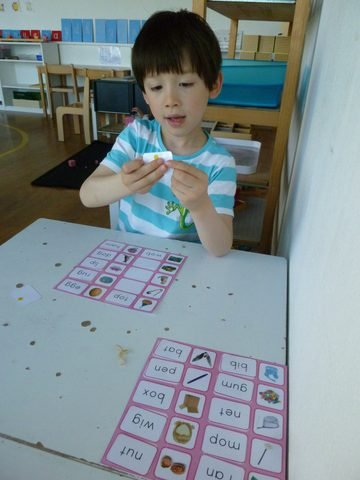
This is the beginning stage, focusing on short, phonetic words (Consonant-Vowel-Consonant, or CVC), such as "cat," "pig," or "box." The materials include object boxes, pictures, word labels and lists, and small, decodable books are simple and strictly phonetic, turning decoding into a captivating game of discovery.
Once the child masters CVC words, they move to the Blue Series, which introduces longer phonetic words and consonant blends like "flag," "milk," or "stamp". The words are still phonetic, but they require the child to hold more sounds in their memory as they decode.
Finally, the child encounters the irregularities of the language -phonograms and digraphs, where two letters make a new sound, like 'sh', 'th', 'ee', or 'oa', and their growing store of ‘puzzle words’ allows the child to unlock the full code of reading.
Total Reading - Grammar and Syntax

Once decoding is secure, the focus shifts to Reading for Interpretation, where the child moves beyond simply sounding out words to understanding their meaning. This is the bridge to true literacy, and the Function of Words grammar curriculum is central to this stage. Children are introduced to grammar through concrete symbolism with each of the ten parts of speech represented by a specific 3D shape and colour -a noun, for example, is a large black pyramid, representing the stability of matter, while a verb is a red sphere, representing energy and motion- and children play games where they label phrases and sentences with these symbols. By manipulating these concrete objects, a five-year-old can often identify nouns, verbs, adjectives, articles, and prepositions with a level of comprehension that exceeds that of many older students in traditional settings. This is followed by Word Study, where children explore compound words, prefixes, suffixes, and word families, and Reading Analysis, both of deepen their appreciation for the etymology and flexibility of language.
The Mathematics Curriculum

Maria Montessori demonstrated that if a child has access to mathematical materials during their early years, they can easily and joyfully assimilate the facts and skills of arithmetic. After she observed that the child who becomes interested in counting likes to touch or move things as they enumerate them, Montessori designed concrete materials to represent quantities. In a Montessori environment, a child not only sees the symbol for 1, 1000, or ½, they can hold each of the corresponding quantities in his hand. Later, by combining, separating, sharing, counting and comparing them, the child is able to assimilate the basic operations of arithmetic.
The Montessori Mathematics curriculum thus provides children with a deep understanding of mathematical concepts through a combination of tactile materials, exploration, and discovery, emphasising the importance of allowing children to learn at their own pace and motivated by curiosity.
The curriculum is meticulously divided into several stages, each building on the previous one, allowing for a progressive understanding of mathematical ideas. The first stage focuses on numeracy, where children learn about numbers through the use of materials such as the Number Rods and Sandpaper Numerals. These materials provide tactile experiences that help children develop a solid foundation in number recognition and counting.
As children progress, they are introduced to more complex concepts such as the decimal system using materials like the Golden Beads, which enable children to physically manipulate quantities, fostering a concrete understanding of place value and the decimal system. This foundational understanding is crucial as children move on to operations such as addition, subtraction, multiplication, and division, the curriculum encouraging a deep understanding of mathematical concepts, rather than rote memorization.
The curriculum also incorporates geometry and measurement: through the use of Geometric Solids and the Geometric Cabinet, children learn the names and properties of various shapes, while also introducing the concepts of weight and volume.A key feature of Montessori mathematics is the use of self-correcting materials, which allow children to learn from their mistakes without the direct intervention of a teacher, fostering problem-solving skills and independence. The curriculum is designed to be flexible, allowing each child to progress at their own pace, an individualized approach which ensures that each child's unique learning style and cognitive development are respected and supported.
In summary, the Montessori method makes Math tangible. The materials are hands-on tools designed to help children understand abstract mathematical concepts such as quantity, place value and operations in a tangible way, by manipulating a range of specially designed materials. Children handle physical representations of numbers -79, 3000, ½- and by physically handling, combining, and sharing the quantities they construct an understanding of fundamental arithmetic concepts such as addition, subtraction and division. They learn through their senses, an idea which can be traced back to Greece, 2300 years ago.
The Six Groups of Mathematics

Mathematics is organised into six groups, with the materials beginning as concrete representations of quantities but growing increasingly abstract:
Group 1 - Numbers from 1-10
Group 2 - The Decimal System
Group 3 - Counting
Group 4 - The Essential Combinations
Group 5 - Passage to Abstraction
Group 6 - Fractions
Group 1 - Numbers from 1-10
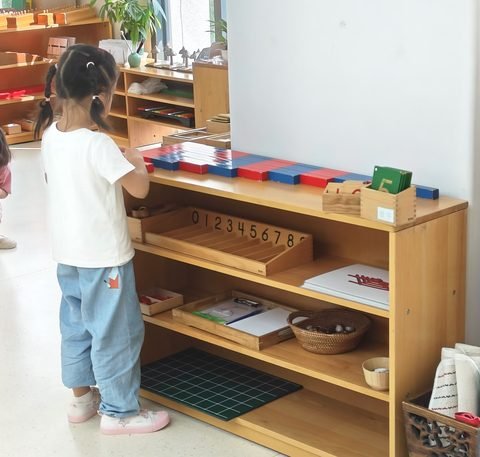
Group 1 lays the foundation for all later mathematical learning. Children discover that numbers are not just abstract figures but representations of real, countable objects, a multi-sensory approach whereby the materials facilitate exploration of quantity and symbol. When a child holds the Number Rods, for example, they can physically see and feel the difference between “three” and “seven,” while the Sandpaper Numerals introduce the written symbols in a tactile, memorable way. Through repetition and exploration, children learn one-to-one correspondence, quantity recognition, numerical order, and the association between number symbols and their values. This multisensory learning process ensures that abstract concepts are firmly rooted in concrete understanding. By the end of Group 1, the child not only knows how to count from 1 to 10 but also understands what these numbers truly represent. This confidence and clarity provide a strong mathematical foundation, preparing the child for the next stages of Montessori math, where they will explore the decimal system and operations with larger numbers.
Group 2 - The Decimal System

Group 2 introduces children to the Decimal System, a foundational concept that helps them understand how numbers are organized and related by place value. Through concrete, hands-on materials, children explore the hierarchy of numbers -units, tens, hundreds, and thousands- building a clear and intuitive understanding of our base-ten system. They manipulate actual units, bars, squares, and cubes to represent 1’s, 10’s, 100’s, and 1000’s, forming a tangible bridge between the abstract and the concrete. This work develops both conceptual understanding and mathematical language. Children learn to name and combine quantities (e.g., one thousand, two hundred, thirty-four), practice exchanging (ten units for one ten bar), and eventually perform the four operations-addition, subtraction, multiplication, and division-within the decimal framework. By progressing from concrete exploration to abstract reasoning, the materials nurture precision, independence, and joy in mathematical discovery, laying the groundwork for a deep and lasting understanding of place value and operations, empowering children to move confidently into higher mathematical thinking.
Group 3 - Counting
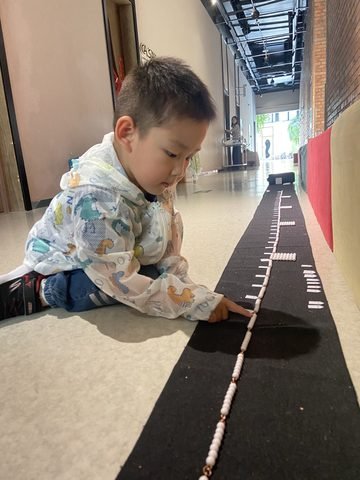
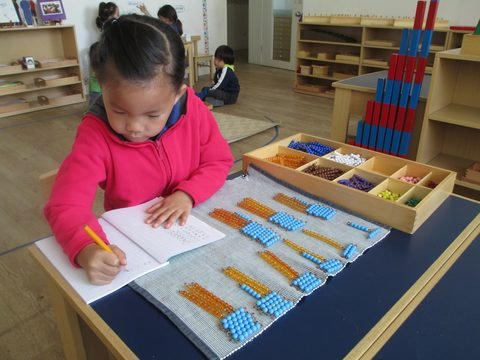
Typically introduced around ages 4½ to 5, this group focuses on linear and skip counting, helping children move beyond simple enumeration to recognize numerical patterns and relationships. Key materials include the Teens and Tens Boards, which visually and tactilely demonstrate how numbers from 10 to 19, then up to 100, and then up to 1000 are constructed from combinations of units and tens. The Golden Beads and Number Cards are used together to reinforce the association between quantity and symbol, while the Hundred Board and Bead Chains (short and long) support linear and skip counting (e.g., counting by 2s, 5s, or 10s). These activities not only solidify number recognition but also lay the groundwork for multiplication and later work with the decimal system.
Group 4 - The Essential Combinations
Group 4 provides the child with a sensorial impression of the different ways to make numbers, along with experience with materials to aid with memorisation of the essential combinations of addition, subtraction, multiplication and division. The materials include Beads, Boards and Charts for each of the operations.

Group 5 - Passage to Abstraction.
In Group 5, the child works towards abstract addition, subtraction and multiplication, using materials that encompass a small and large abacus, seven wooden solids representing hierarchical values from one to one million, and a set of racks, tubes and dishes in the decimal colours, in tandem with the Unit Division Board.
Group 6 - Fractions

A set of 10 red Fraction circles in green frames - one whole, the others sectioned into halves, thirds, fourths, fifths, sixths, sevenths, eights, ninths and tenths. Because they are introduced at the same age, the Fractions are often placed on the same shelf as Group 1. The Mathematics Curriculum is a transformative approach to teaching mathematics, which utilizes tactile materials and a child-cantered learning philosophy to foster a deep understanding and appreciation of mathematical concepts. By allowing children to explore and discover mathematical ideas at their own pace, the curriculum not only supports the development of mathematical skills but also prepares children to be confident and competent learners, capable of tackling more complex mathematical challenges with ease and enthusiasm.
Maria Montessori argued that “The goal of early childhood education should be to activate the child’s own natural desire to learn” and the Montessori Curriculum nurtures and supports this process, trusting in the child’s natural developmental timeline, facilitating guided exploration and emphasising choice and autonomy. Because children choose their activities and set their own pace, motivation becomes intrinsic, cultivating perseverance and a lifelong appetite for learning. The mixed-age community nurtures empathy and collaborative problem-solving, while the focus on process over product cultivates resilience and deep concentration. Ultimately, the curriculum aims not merely at academic proficiency but at nurturing self-directed, compassionate, lifelong learners - individuals equipped with critical thinking, creativity and confidence, fostering not only strong academic outcomes but also empathy, creativity, and the executive-function skills required for success at every stage of a child’s educational journey.