Introduction
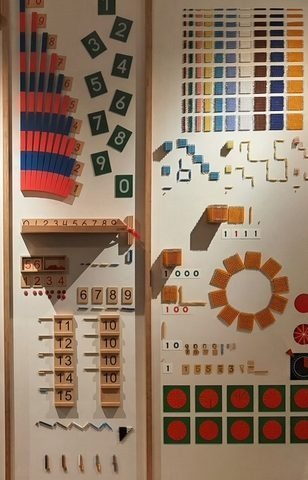
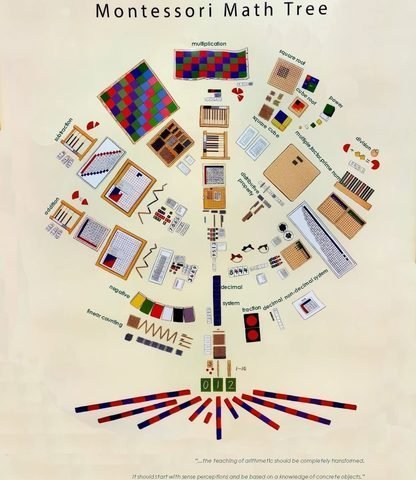
The Montessori Mathematics curriculum provides children with a deep understanding of mathematical concepts through a combination of tactile materials, exploration and discovery by creating opportunities for them to learn at their own pace, driven by their innate curiosity and motivation. The curriculum is divided into distinct groups and stages, each building on the previous one, allowing for a progressive understanding of mathematical ideas. The first stage focuses on numeracy, where children learn about numbers through the use of materials such as the Number Rods and Sandpaper Numerals, which provide tactile experiences that help children develop a solid foundation in number recognition. As children progress, they are introduced to more complex concepts such as the decimal system using materials like the Golden Beads, which enable them to physically manipulate quantities, fostering a concrete understanding of place value. This foundational understanding is crucial as children move on to operations such as addition, subtraction, multiplication, and division, the curriculum encouraging a deep understanding of mathematical concepts, rather than rote memorisation.
A key feature of Montessori mathematics is the use of self-correcting materials, which allow children to learn from their mistakes without the direct intervention of a teacher, fostering problem-solving skills and independence. The curriculum is designed to be flexible, allowing each child to progress at their own pace, an individualised approach which ensures that each child's unique learning style and cognitive development are respected and supported.
In summary, the Montessori method makes maths tangible. The materials are hands-on tools designed to help children understand abstract mathematical concepts such as quantity, place value and operations in a tangible way, by manipulating a range of specially designed materials. Children handle physical representations of numbers (79, 3000, ½) and by physically handling, combining, and sharing the quantities they construct an understanding of fundamental arithmetic concepts such as addition, subtraction and division. They learn through their senses, an idea which can be traced back to Greece, 2300 years ago.

The Peripatetic Axiom
In 335BC, Aristotle founded the Peripatetic School of philosophy in Athens and argued that universal meanings could be drawn from specific empirical data. Thomas Aquinas, an Italian monk priest and theologian to Pope Clement IV, described as the most influential medieval thinker in the western tradition, drew on the Aristotelean tradition when in 1259 he wrote:
"Nihil est in intellectu quod non sit prius in sensu."
“There is nothing in the intellect that didn´t first pass through the senses.”
Maria Montessori placed herself firmly in this intellectual lineage:
"The senses, being explorers of the world, open the way to knowledge. Our apparatus for educating the senses offers the child a key to guide his explorations of the world, they cast light upon it which makes visible to him more things in greater detail than he could see in the dark, or uneducated state."
- Maria Montessori, The Absorbent Mind, p.167. (1949)
Adult-directed / Abstract
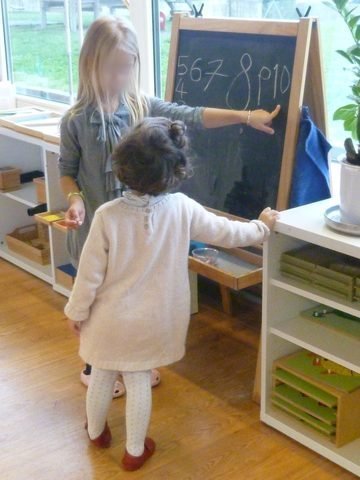
Child-directed / Concrete
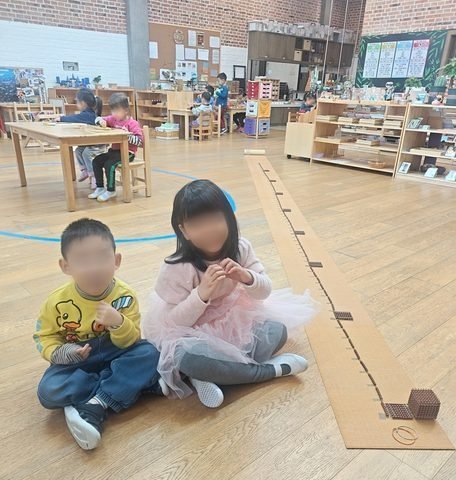
This is quite a different approach to traditional methods of educating children.
Traditional Education v’s the Montessori Approach
Montessori mathematics puts the child at the centre of their learning, creating opportunities for them to explore concrete materials.
Characteristics of the Mathematics Materials
Multi-Sensory
Promote experiential learning and movement
Whole and complete
Appealing, child-sized and accessible
Sequenced and ordered
Isolate Concepts
Concrete to Abstract
The Importance of Indirect Preparation
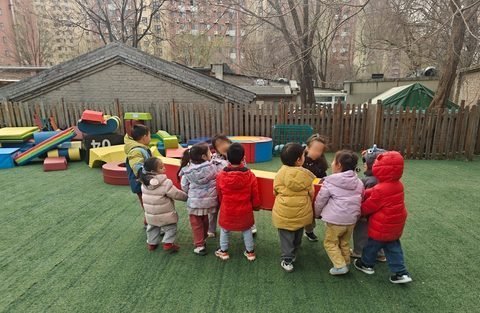
Montessori classes divide children according to mixed-age groups: 3 to 6, 6 to 9, and 9 to 12. In a primary classroom, the children are generally introduced to mathematics at the end of their first year or (more often) at the beginning of the second year, when they are aged 4. Before then, a great deal of preparation takes place, in the following areas:
- Fine Motor Skills
- Control and Coordination of Movement
- Logic and Sequencing
- Teamwork
- Base 10
- Measurement
- Squares and Cubes
- Geometry
- Pre-Algebra
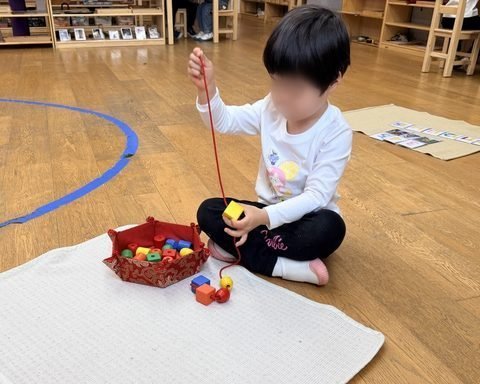
Fine Motor Skills
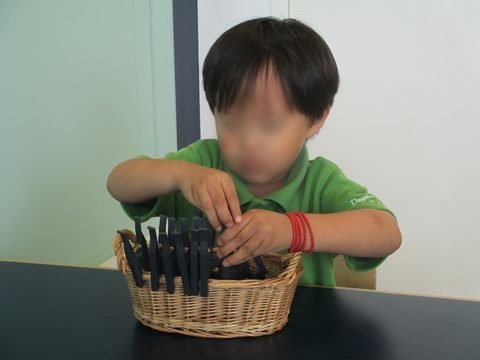
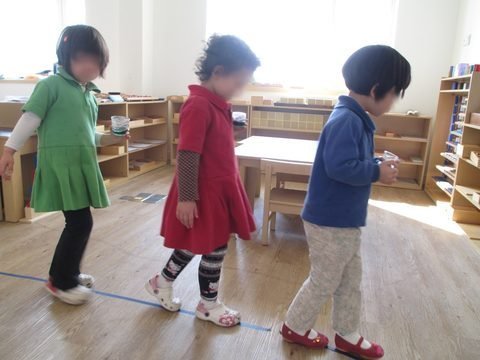
Control and Coordination of Movement
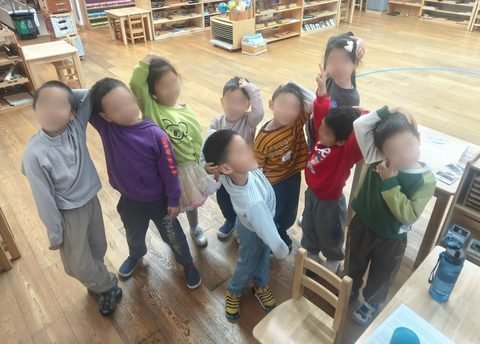
Logic and Sequencing
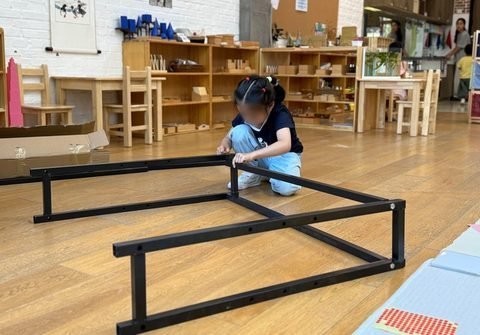

Teamwork
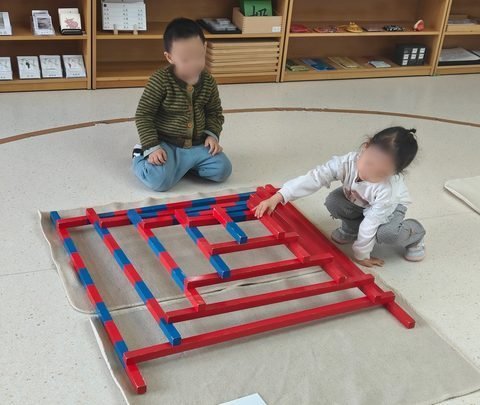
Base 10
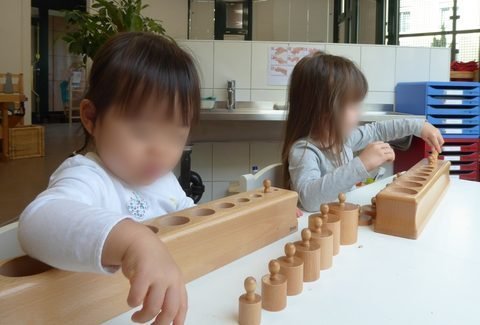
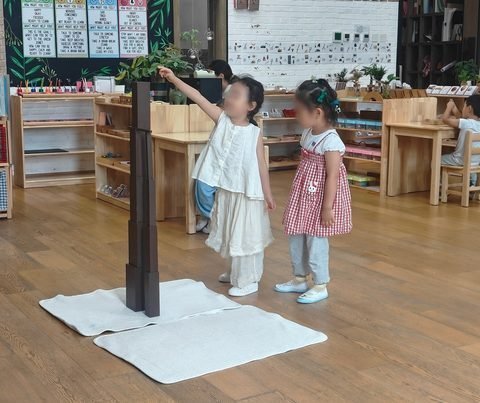
Measurement
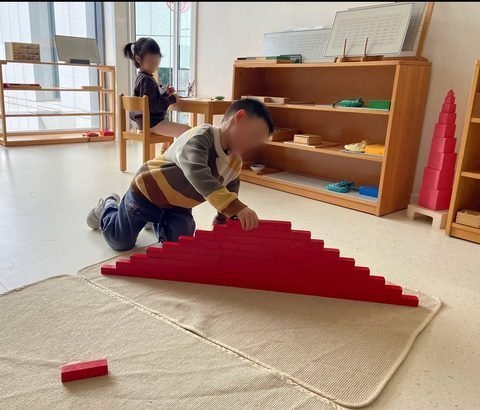
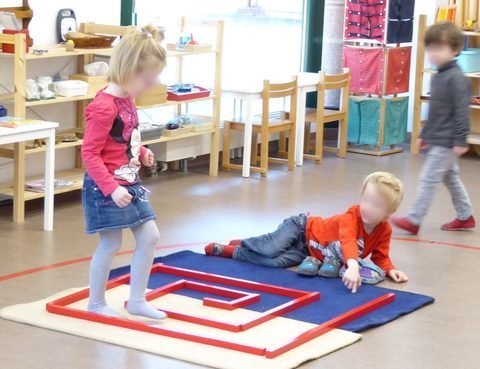
Squares, and Cubes
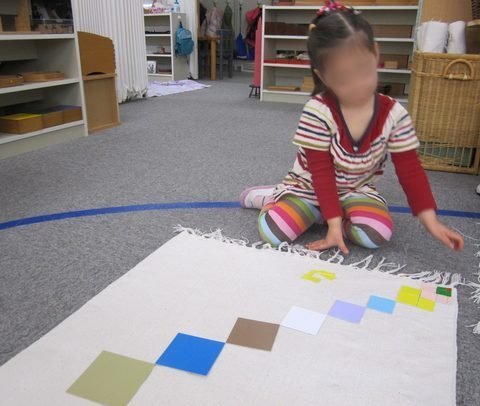
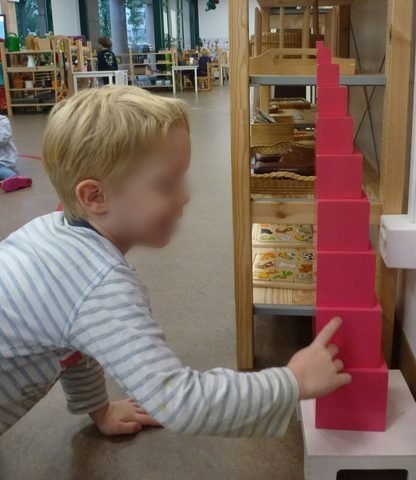
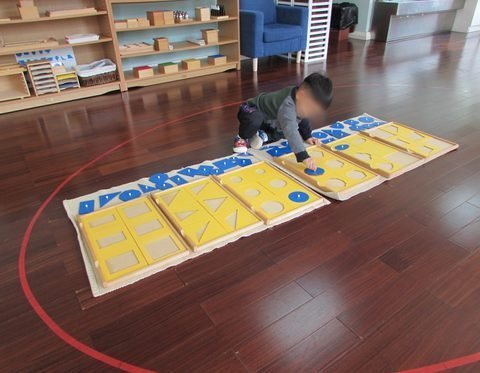
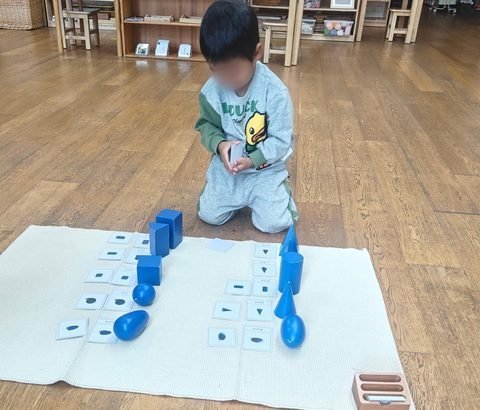
Geometry
(a + b)2
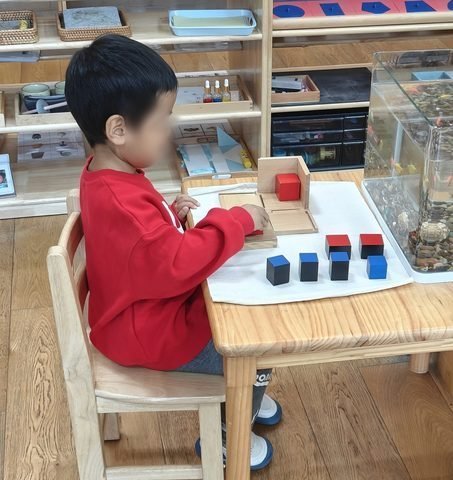
Pre-Algebra
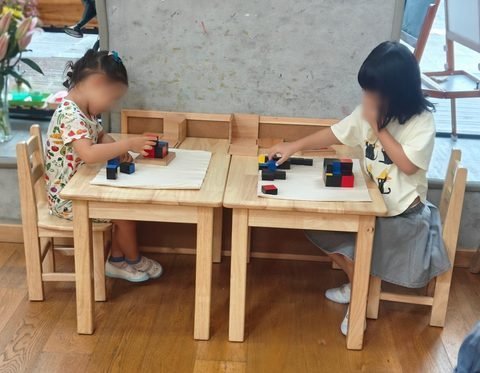
(a + b + c)3
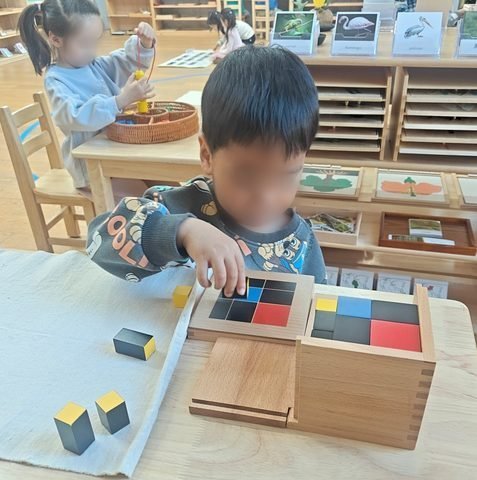
I once worked in a school where a pair of 3-year-old twins joined in August; one of the boys was placed in my class and his brother was placed in another class. At Christmas we had the first Parent-Teacher conference and the parents asked why the boy in my class hadn’t yet begun mathematics, while his brother had already been presented with the chains in Group 3. What to say? Because of professional courtesy I couldn’t tell them the truth, but the words did go through my head: “Because his brother’s teacher is a fool.”
Many teachers begin mathematics when the child isn’t ready and hasn’t had enough experience with the exercises of Practical Life and the Sensorial activities, because the teacher feels pressure from management or parents or both. This is a pity and one of many examples of what for me is the biggest failing in the Montessori world: a lack of guidance. Teachers don’t receive the right guidance at the right time, and as a consequence the children don’t receive the right guidance at the right time.
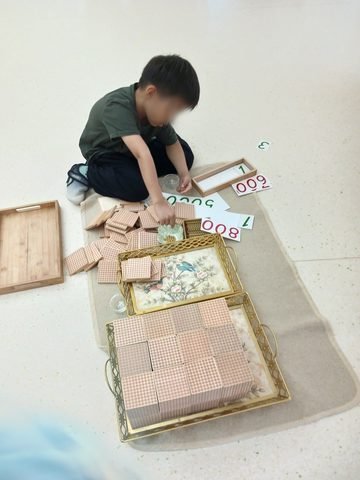
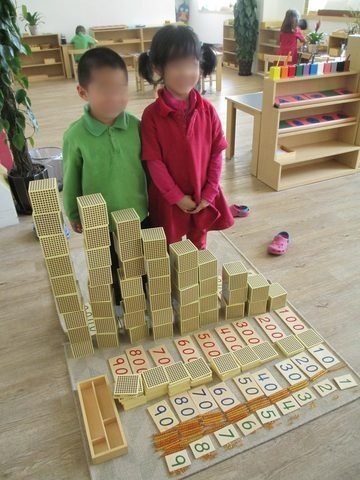
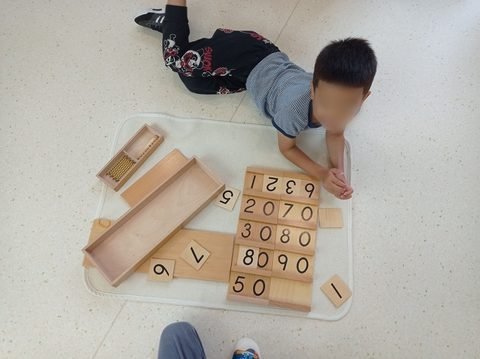
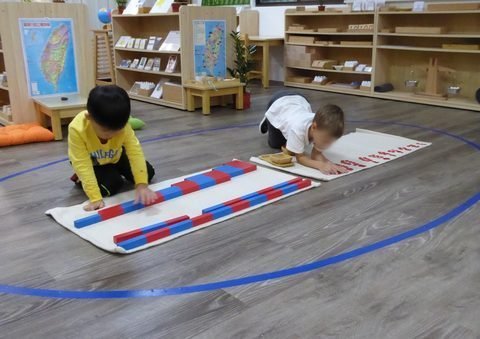
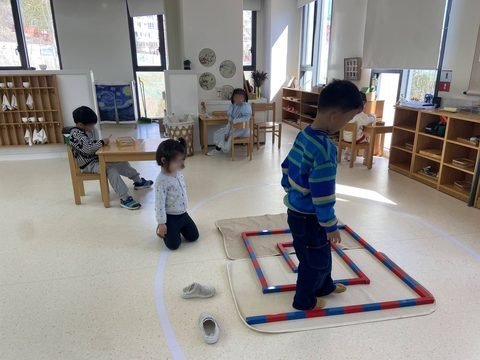
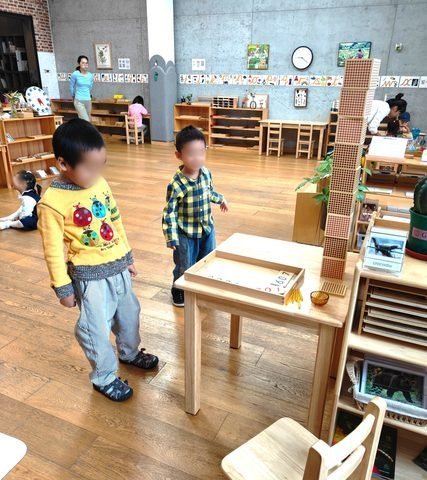
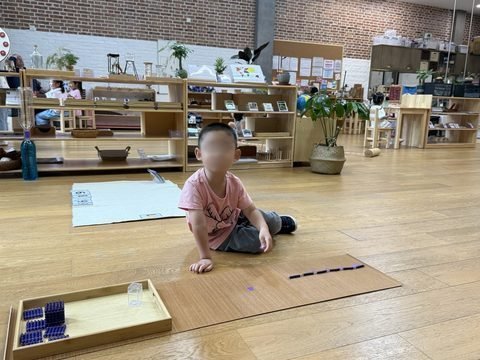
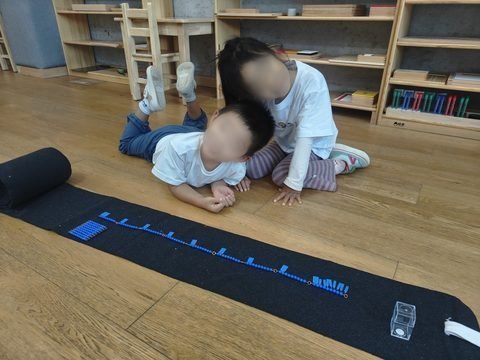
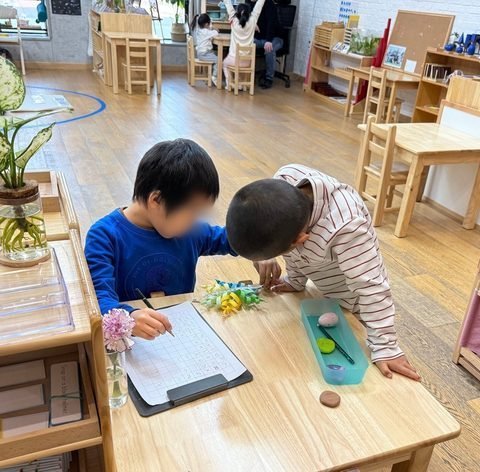
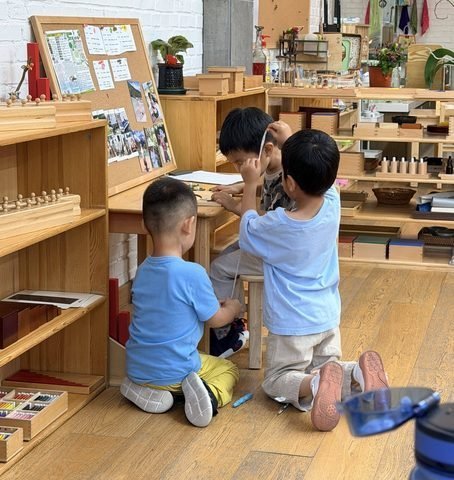
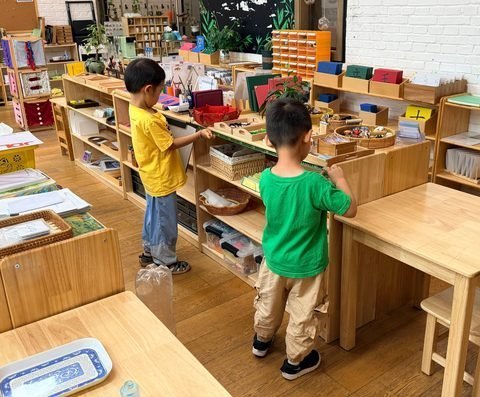
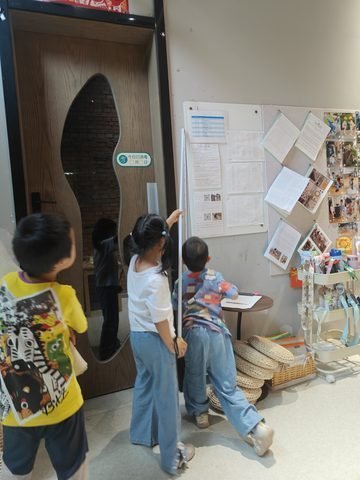
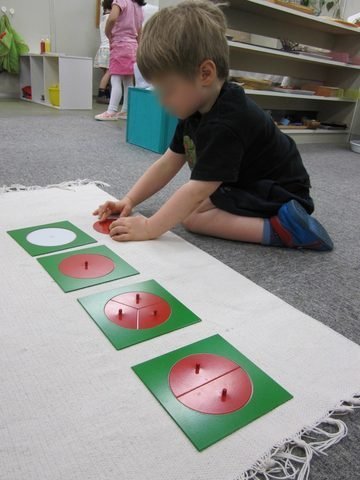
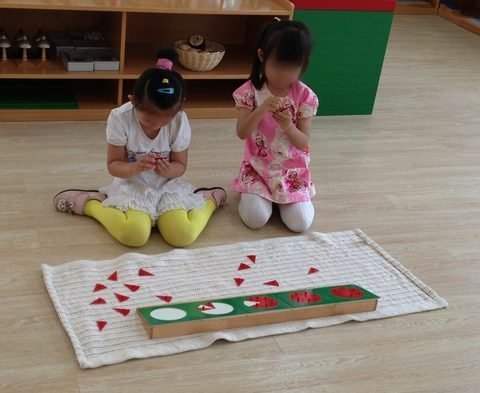
As chance would have it, the following summer the class with the other twin was mixed with my class for a month (because most families had gone on holiday, so the school preferred to pay half the teachers and assistants while the other half took an unpaid break) so I had an opportunity to see for myself what unprepared children look like. The results weren’t pretty, as seen in the photos to the right.
The children in my class all began Mathematics in their second year, but they made great progress in a very short amount of time because they were well-prepared during their first year. During that year I had faith in what they could achieve, and while I understand why many Montessori teachers have doubts, I also believe that if they had more faith in the Montessori approach (and knew how to implement it), they’d be much happier, as would the children they guide.
Unprepared
Prepared
Unprepared
Prepared

The Six Groups of Mathematics
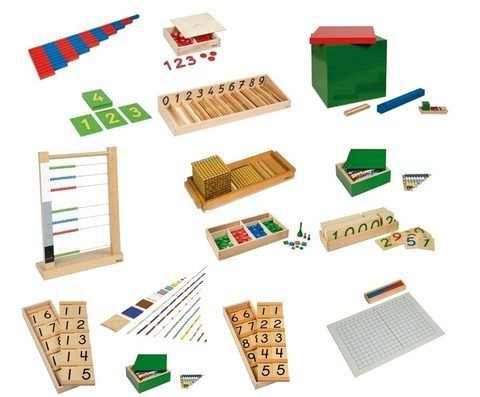
Mathematics is organised into six groups, with the materials beginning as concrete representations of quantities and growing increasingly abstract.
Group 1 Numbers from 1-10
Group 2 The Decimal System
Group 3 Counting
Group 4 The Essential Combinations
Group 5 Passage to Abstraction
Group 6 Fractions
Group 1 - Numbers from 1-10
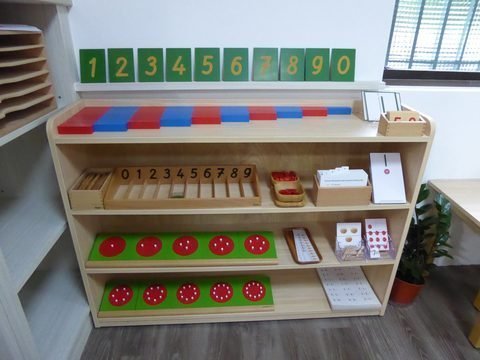
Group 1 lays the foundation for all later mathematical learning. Children discover that numbers are not just abstract figures but representations of real, countable objects, a multi-sensory approach whereby the materials facilitate exploration of quantity and symbol. When a child holds the Number Rods, for example, they can physically see and feel the difference between “three” and “seven,” while the Sandpaper Numerals introduce the written symbols in a tactile, memorable way.
Through repetition and exploration, children learn one-to-one correspondence, quantity recognition, numerical order, and the association between number symbols and their values. This multisensory learning process ensures that abstract concepts are firmly rooted in concrete understanding. By the end of Group 1, the child not only knows how to count from 1 to 10 but also understands what these numbers truly represent. This confidence and clarity provide a strong mathematical foundation, preparing the child for the next stages of Montessori maths, where they will explore the decimal system and operations with larger numbers.
Group 1 consists of the following presentations:
Number Rods
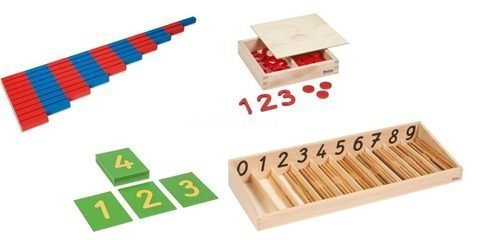
Sandpaper Numerals
Number Rods and Cards
Spindle Boxes
Zero Game
Numbers and Counters
Memory Game
A Mathematics Album is made up of a sequence of presentations, each containing the following categories.
Materials A precise description of the materials used for that presentation.
Aims Every piece of material has a specific aim, the reason we present that material to the child.
Presentation The sequence of steps to demonstrate the material to the child.
Exercises Different tasks that introduce different concepts, using the same materials.
Control of Error A way for the child to self-correct any mistakes they make.
Games Ways for the child to gain practice, using the materials with another child or children.
Age An approximation of when the presentation should be given.
Number Rods
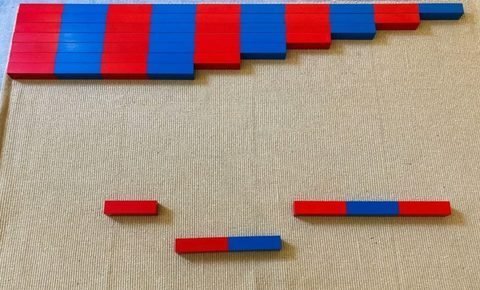
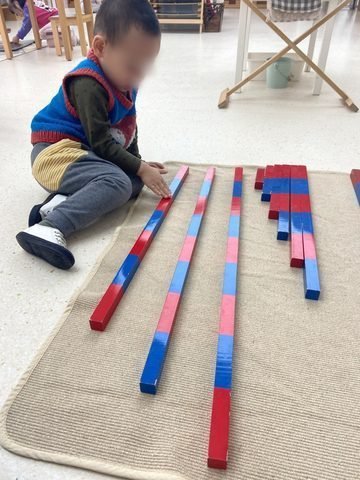

A concrete representation of quantities from 1 to 10.
10 wooden rods identical to the Red Rods in dimension; the shortest rod is red, and the successive rods are red and blue in alternate decimetres, the number of sections representing the number of rods.
Sensorial experience of the quantities of each number and their names.
Understanding that each number is represented by a single object, as a whole separate from the others.
Memorisation of the sequence of numbers from 1 to 10.
Begins with rods placed at random on the mat.
- Invite child to lay out the rods in sequence.
- Begin with the rod of one, keeping red rods aligned on the left.
- When all rods are in order, have a three-period lesson, using the first three rods.
Exercise 1 - Ask for a rod
For example Bring me 2. After the child brings the rod, have her check by counting it.
Exercise 2 - Identify a rod
Choose any rod and ask the child, What is this?
The segments of the rod act as a guide.
Around 4, after much sensorial work.
The remaining rods are introduced three at a time, in sequence and re-presenting any numbers that the child has forgotten. Finish presenting all 10 rods before progressing to Exercise 1.
Sandpaper Numerals
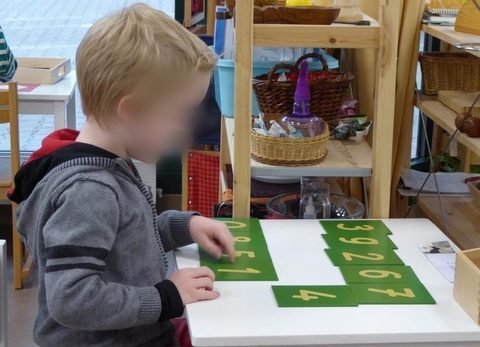
An abstract representation of quantities from 1 to 10.
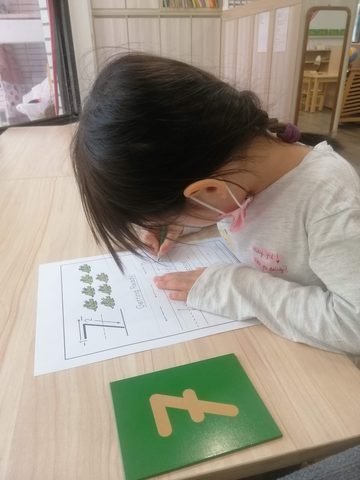
Sandpaper Numerals from 0 to 9 on boards.
Sensitising Tray.
Learning the symbols for the numbers already known.
Preparation for writing.
- Wash hands, then sensitise fingers.
- Choose three numerals, contrasting in shape and sound.
- Present by means of a three-period lesson, frequently encouraging the child to trace as well as say the numerals.
The child’s own activity with the numerals, as per the presentation.
None, but the sandpaper acts as a guide.
Around 4, after the Number Rods, but zero is presented after Spindle Boxes.
Number Rods and Cards
Makes the link between quantity and symbol, between concrete and abstract.
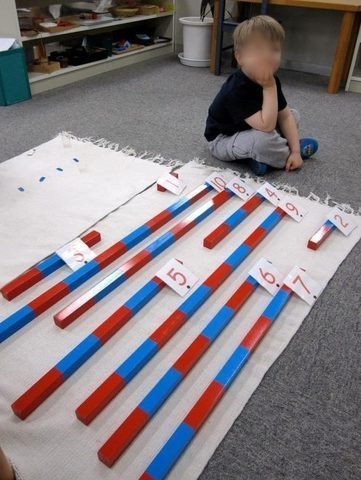
10 wooden rods identical to the Red Rods in length; the shortest rod is red, and the successive rods are red and blue in alternate decimetres, the number of sections representing the number of rods.
Memorisation of the sequence of symbols.
Relation of the symbols to the quantities.
Preparation for addition, subtraction and -remotely- multiplication and division.


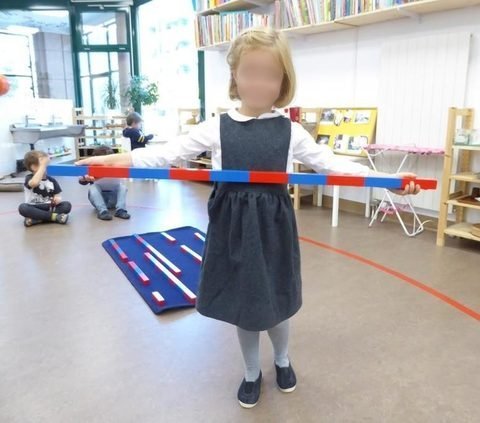
Ex. 1 - Bring Rods to Cards
- Ask the child to bring the rods and show how to place at random on the mat.
- Remove a few cards and ask the child to identify them.
- Ask the child to remove and name the remaining cards, placing each at random on the mat.
- Remove and introduce 10, saying This is ten.
- Ask the child to find the rod of ten by counting off the segments on the rods
- Match by placing the card upon the last segment of the rod.
- Repeat, choosing random cards and asking the child to:
- identify the symbol,
- count the segments and
- match the card with a rod.
- Continue until all rods and cards are matched.
- Remove cards from rods and place at random on the mat.
- Invite the child to again match the rods and cards.
Exercise 1 - Find a Rod (Bring Rods to Cards).
Set up two mats at a distance from each other with rods placed on one and cards on the other.
Have the child:
- Isolate one card and identify the numeral,
- Fetch the matching rod,
- Check by counting the segments and match the card to the rod.
Exercise 2 - Find a Card (bring cards to rods).
Same steps as exercise 1 but bringing cards to rods.
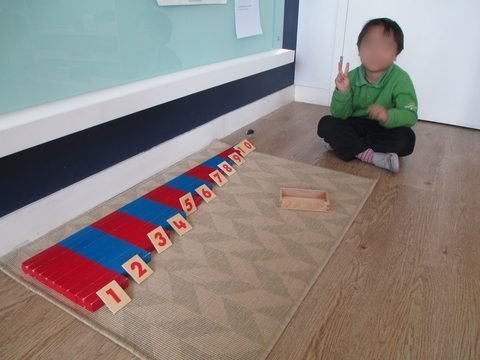
Ex. 3 - Sequence
Exercise 3 - Sequence.
- Ask the child to arrange the rods in order.
- Remove the cards at random and place upon the mat so they can all be seen.
- Isolate one card and find the matching rod by counting off the segments.
- Repeat, choosing cards at random and matching with rods.
- At the end, ask the child to read the numbers, first ascending from 1 to 10 and then descending from 10 to 1.
- Remove the cards and invite the child to again match cards and rods.
At the end, encourage the child to read the numbers both ascending and descending.
Exercise 4 - Sensorial Impression of Addition, Multiplication and Division.
- Ask the child to place the rods on the lower part of the mat and place the matching card upon the last segment of each.
- Identify the rod and card of 10 and isolate by placing at the top of the mat.
- Identify the rod and card of 9, placing beneath the 10-rod.
- Ask the child which number we need to add to the 9-rod in order to make 10.
- After he identifies it, place the 1 rod next to the 9-rod, demonstrating that they combine to make 10.
- Place the 8-rod beneath the 9 and ask which number you must add to it in order to make 10.
- After he identifies it, move the 2-rod next to the 8-rod, demonstrating that they combine to make 10.
- Continue in this way until only the 5-rod remains.
- Ask child what number we need to add to 5 in order to make 10.
- If he replies five, say Yes, five and five make ten and there are two fives in ten, flipping the rod over by pivoting it on its end as you say it.
- Remove the rod of 10.
- Invite the child to choose any number and explore it by placing at the top of the mat and then checking which combination of rods can form that number.
Exercise 5 - Subtraction
For example, after the child has made the 10’s (exercise 4) remove the rod of four and ask him to count what remains.
The sections on the rods act as a guide.
About 4, immediately after the Sandpaper Numerals, when the child has developed familiarity with the symbols.
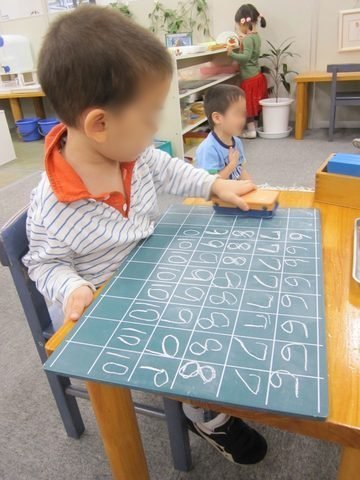
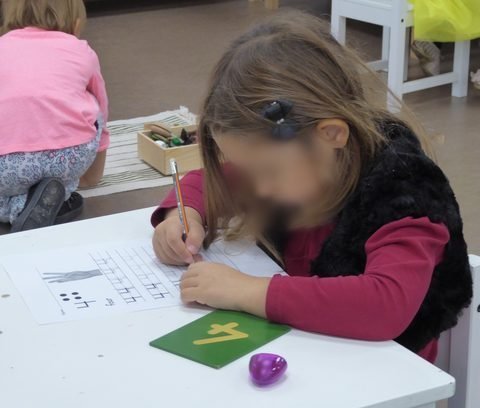
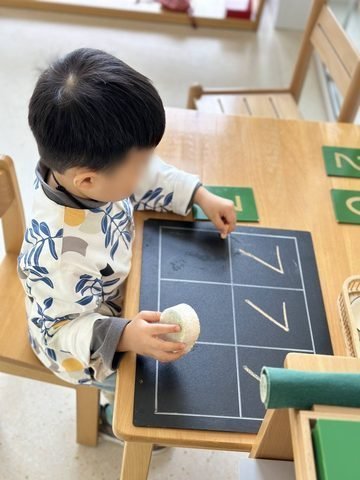
Tracing, Copying and Writing Numerals
Children require practice in writing the numerals, and we provide them with it in a variety of ways, some AMI-sanctioned, many not.
The remaining presentations in Group 1 give the child experience in connecting the quantities with the symbols.
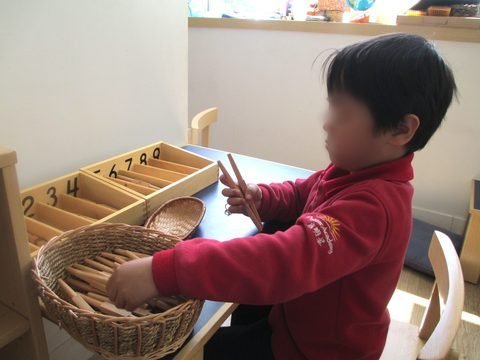
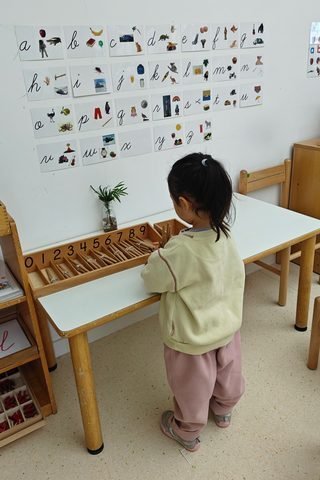
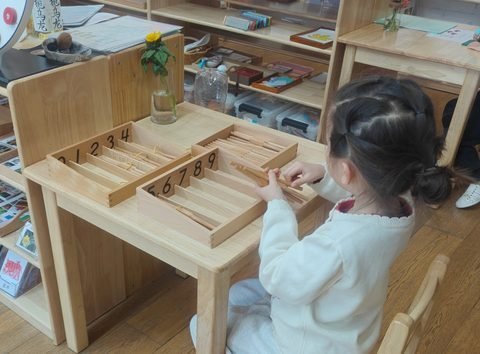
Spindle Boxes
The aims of The Spindle Boxes are:
Understanding that each symbol represents a separate quality of separate objects.
Understanding of zero and its symbol 0.
Reinforcement of the sequence of symbols.
Comprehension that there are no symbols apart from those between 0 and 9.


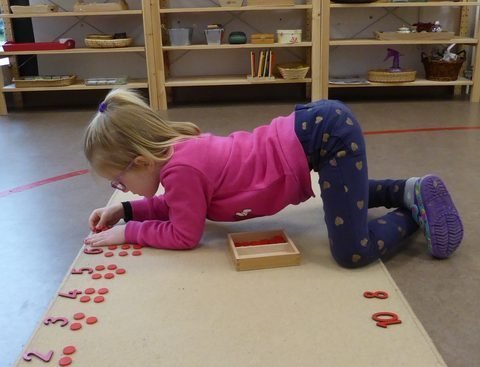
Numbers and Counters
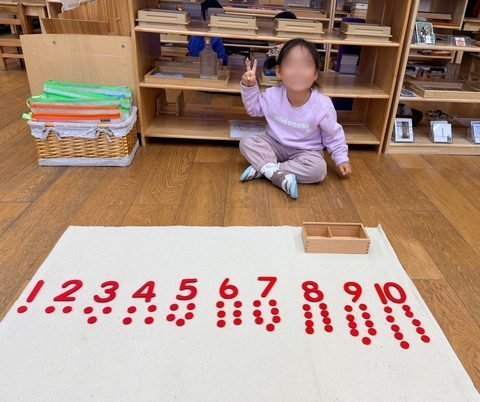
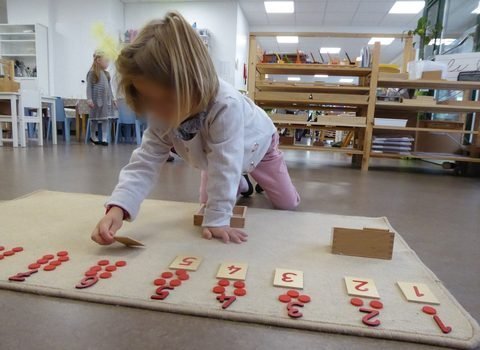
The aims of Numbers and Counters are:
Reinforcement of the knowledge that each number is made up of separate quantities.
A verification of the sequence of numbers and how many separate units form each number.
Awareness of odd and even numbers.
Preparation for divisibility of numbers.

The Memory Game
11 pieces of paper folded up, each one with a number from 0 - 10.
55 small identical objects.
- Introduce materials and form a group: up to a maximum of 11 children.
- Place the objects at a distance.
- Ask each child to choose a piece of paper and not to open it.
- When all have chosen, ask the first child to look at their paper, not revealing the number, then go get that quantity of objects.
- When they return, show them where to place the objects on the mat.
- Repeat the steps with the remaining children, keeping objects separate and numbers secret.
- At the end, the children take turns to individually reveal numbers and check by counting each other’s objects.


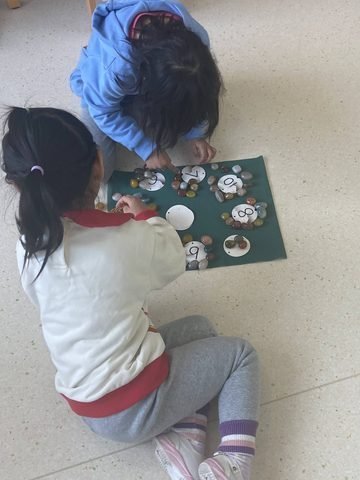
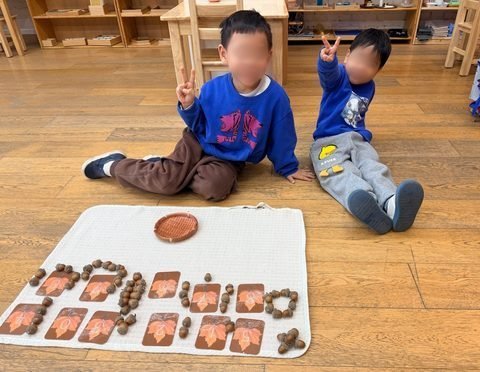
The Three-Period Lesson
The three-period lesson is a way of introducing new vocabulary.
In Group 1, we teach the names of the numbers using a three-period lesson, choosing three numbers differing in shape and sound.
First PeriodIntroductionThis is … 7 / 4 / 9
In the first period, we introduce the new name or information. During this period, the teacher must by definition play the most active role.
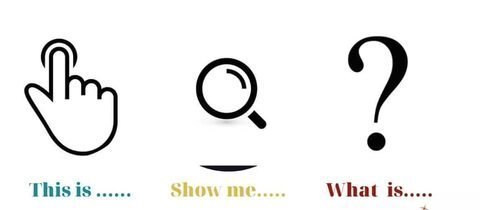
Second Period ExperienceShow me … 7 / 4 / 9
In the second period, the child gains experience with the names or materials, touching and moving them (put 7 here, touch 9, trace 4, give me 9 etc.). The teacher should aim to limit the vocabulary to the target language, by gesturing and only saying 7, 9 or 4, thus making it as clear as possible for the child by removing all superfluous language.
Third PeriodRecallWhat is this? “7.” And this? “9”. And this? “4”.
In the third period, the teacher checks whether the child has memorised the information.
Each of the groups of Mathematics functions as a three-period lesson, with the first presentations introducing the child to new information, the middle presentations giving the child opportunities to experience this new information, and the final presentation(s) checking whether the child has integrated this new information, as in this example using the activities in Group 1:
Number Rods
Sandpaper Numerals
Number Rods and Cards
Spindle Boxes
Zero Game
Numbers and Counters
The Memory Game
Group 2 - The Decimal System
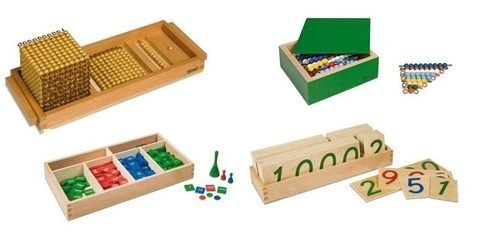
Group 2 introduces children to the Decimal System, a foundational concept that helps them understand how numbers are organised and related by place value. Through concrete, hands-on materials, children explore the hierarchy of numbers -units, tens, hundreds, and thousands- building a clear and intuitive understanding of our base-ten system. They manipulate actual units, bars, squares, and cubes to represent 1’s, 10’s, 100’s, and 1000’s, forming a tangible bridge between the abstract and the concrete.
This activity develops both conceptual understanding and mathematical language. Children learn to name and combine quantities (e.g., one thousand, two hundred, thirty-four), practise exchanging (ten units for one ten bar), and eventually perform the four operations-addition, subtraction, multiplication, and division-within the decimal framework. By progressing from concrete exploration to abstract reasoning, the materials nurture precision, independence, and joy in mathematical discovery, laying the groundwork for a deep and lasting understanding of place value and operations, empowering children to move confidently into higher mathematical thinking.
General Group Aims

Consolidation of the meaning of the actions, i.e.
Addition means putting together.
Subtraction means removing a quantity so that a smaller quantity remains.
Multiplication means adding together the same number more than once.
Division means sharing equally.
The following are the presentations of Group 2 and how they function as part of a three-period lesson:
Introduction / Input
Decimal Beads
Decimal Cards
Decimal Beads and Cards
Experience / Practice
Decimal Operations
Stamp Game
Dot Game
Recall / Output
Word Problems
Exercises
There are seven presentations listed above, but many Montessori presentations also have a range of exercises wherein the children get to practise (to exercise), with the materials. In Group 2 there are 37 unique lessons that each child has to receive; and that the guide has to present:
Decimal Beads
Presentation - Three-Period Lesson
Exercise 1 - Bring a quantity
Exercise 2 - Identify a quantity
Decimal Cards
Presentation - Three-Period Lesson
Exercise 1 - Ask for a card
Exercise 2 - Identify a card
Decimal Beads and Cards
Presentation
Exercise 1 - Bring beads for a card
Exercise 2 - Bring a card for beads
Exercise 3 - Formation of numbers
Decimal Operations
Introduction
Presentation 1 Static Addition
Presentation 2 Dynamic Addition + Changing Game
Presentation 3 Static Subtraction
Presentation 4 Dynamic Subtraction
Presentation 5 Continuous Subtraction
Presentation 6 Static Multiplication
Presentation 7 Dynamic Multiplication
Presentation 8 Static Division
Presentation 9 Dynamic Division
Presentation 10 Long Division
The Stamp Game
Introduction
Presentation 1 Static Addition
Presentation 2 Dynamic Addition
Presentation 3 Static Subtraction
Presentation 4 Dynamic Subtraction
Presentation 5 Static Multiplication
Presentation 6 Dynamic Multiplication
Presentation 7 Static Division
Presentation 8 Dynamic Division
Presentation 9a Long Division With a 2- digit divisor
Presentation 9b Long Division With a 3- digit divisor
Presentation 10 Division with 0 in the middle of the divisor
Presentation 11 Division with 0 at the end of the divisor
Presentation 12 Group Division
Dot Game
Presentation
Exercise 2 - Counting by categories
Word Problems
Presentation
Games and Extensions
The previous list doesn’t include any of the games and extensions which help the children to extend their interest in materials they have already mastered. Here are some examples:
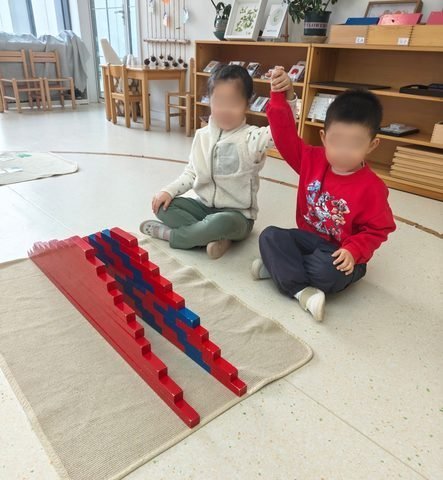
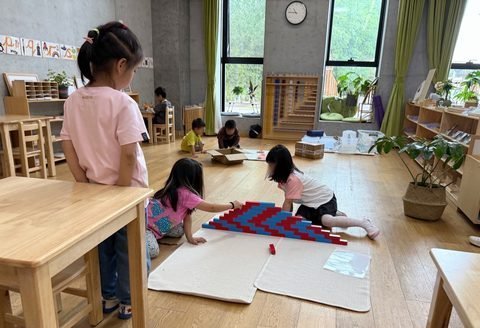
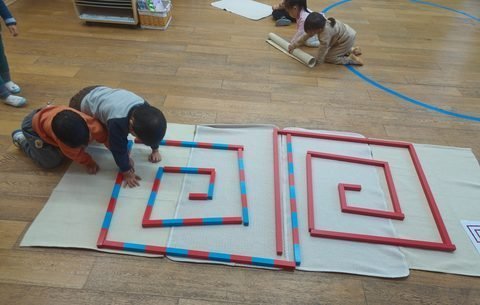
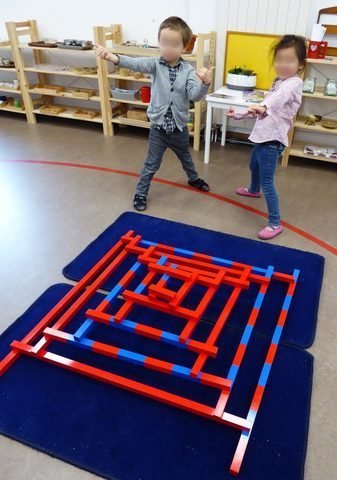


Concrete to Abstract
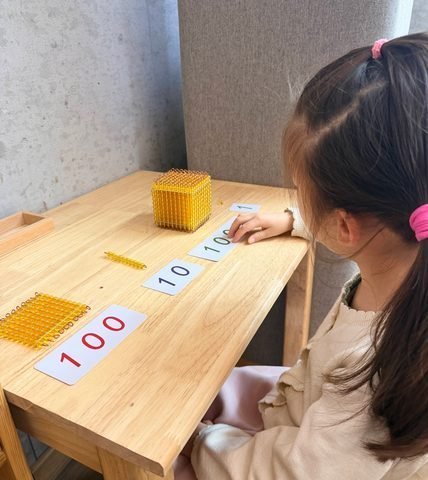
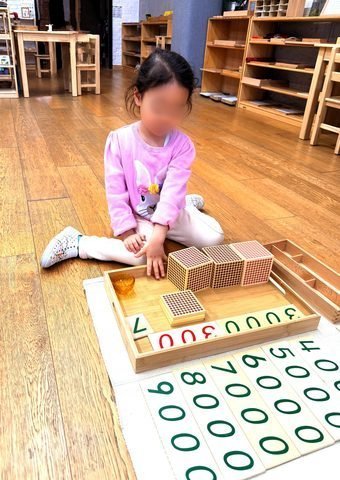
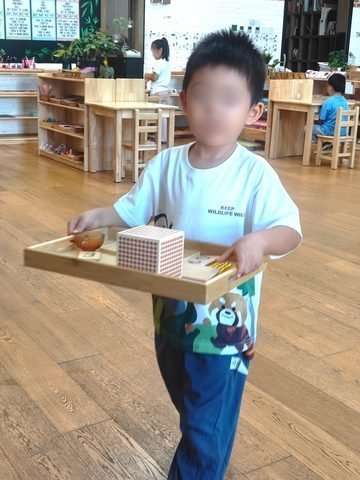
Decimal Beads are a concrete representation of quantities from 1 to 1000, made up of:
- Individual golden beads, each representing 1 unit,
- Bars of 10, each bar made up of 10-unit beads,
- Squares of 100, each square made up of 10 bars of 10, and
- Cubes of 1000, each cube made up of 10 squares of 100.
Decimal Cards are an abstract representation of quantities from 1 to 1000, made up of a large set of cards with the symbols/numerals in the decimal colours:1-9 in Green 10-90 in Blue100-900 in Red 1000-9000 in Green
Decimal Beads and Cards are a combination of the two previous presentations, establishing the link between the concrete beads and the abstract numerals.
Decimal Operations
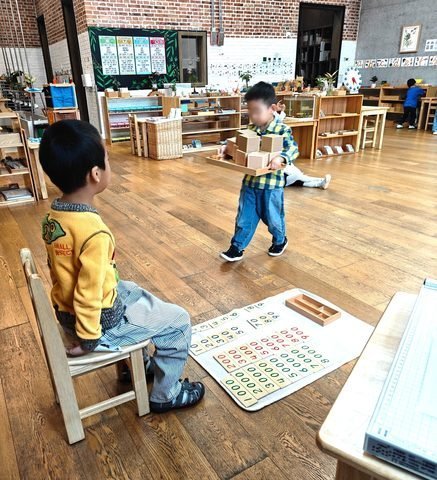
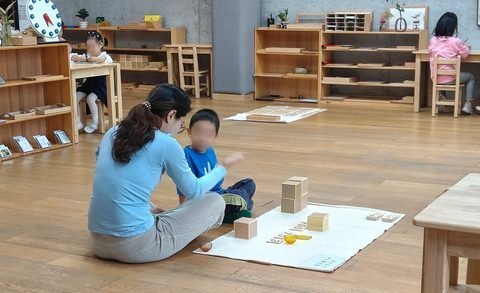
Once the child has assimilated the concrete and abstract quantities, they are introduced to the operations - addition, multiplication, subtraction and division. These are group exercises, with 2, 3 or 4 children collaborating to find the answer to an equation.
Dynamic Addition e.g. 2412 + 1253 + 3161 =
- The children each lay out the decimal cards (on individual mats) while the guide prepares a card with a maths problem on it and gives it to the children.
- Child A goes to their mat and gets the cards representing 2412, then collects that quantity of beads on a tray.
- Child B goes to their mat and gets the cards representing 1253, then collects that quantity of beads on a tray.
- Child C goes to their mat and gets the cards representing 3161, then collects that quantity of beads on a tray.
- At the working mat, the children check the beads of the other children and -if they’re correct- places them on the mat. Once all of the numbers have been checked, the guide introduces the sign for addition [ + ] and says, “This is the sign for addition: addition means putting things together.”
- The children combine the units, count the sum, and get a Large Number Card to represent that sum ( 6 ).
- Next, they combine the tens:
- demonstrate how to exchange ten bars of 10 for one square of 100,
- count the remaining units
- get a Large Number Card to represent that sum ( 2 ).
- The children combine the hundreds, count the sum, and get a Large Number Card to represent that sum ( 8 ).
- They combine the thousands, count the sum, and get a Large Number Card to represent that sum ( 6 ).
- The guide puts the cards together and verbalises the process of addition:
“You brought two thousands, four hundreds, one ten and two units
You brought one thousand, two hundreds, five tens and three units
You brought three thousands, one hundred, six tens and one unit.
We put them together and now we have six thousands, eight hundreds, two tens and six units. Addition means ‘putting things together’.”
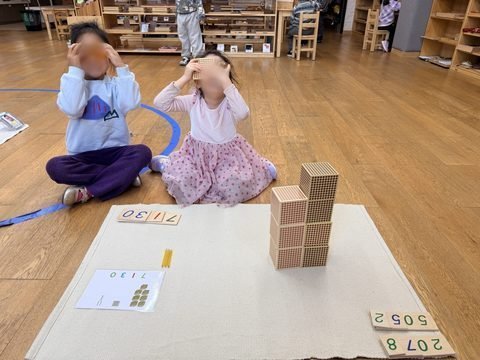
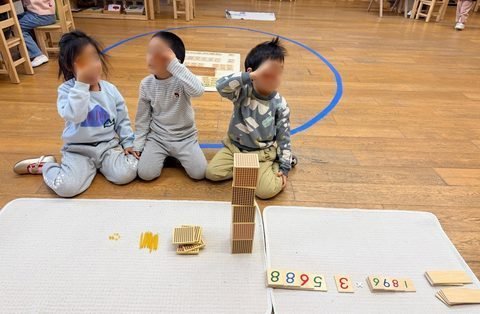
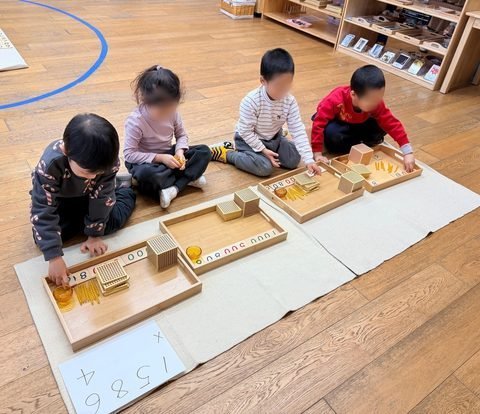
"This system in which a child is constantly moving objects with his hands and actively exercising his senses, also takes into account a child's special aptitude for mathematics. When they leave the material, the children very easily reach the point where they wish to write out the operation. They can thus carry out an abstract mental operation and acquire a kind of natural and spontaneous inclination for mental calculations."
- Maria Montessori, The Discovery of the Child, p. 279.
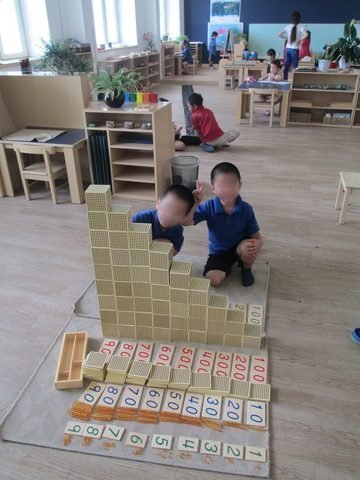
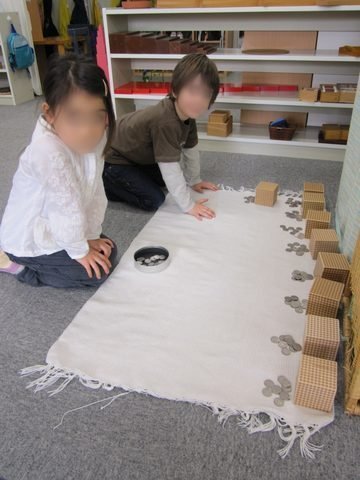
The photos below were taken in my class in Tokyo during one of the charitable fundraising events that the school held throughout the year. This group of children ranged from age 4 to 6 and had just counted all of the money (coins and notes) they’d raised. They used The Decimal Beads to count each of the categories (units, tens, hundreds and thousands) -converting them to the higher category as needed- then used the Large Number Cards to record the total, and then double-checked the total by counting everything again using The Stamp Game. Their grasp of mathematics was admirable, but more impressive was their ability to collaborate, each assuming a role in the team, working in harmony to achieve their goal.
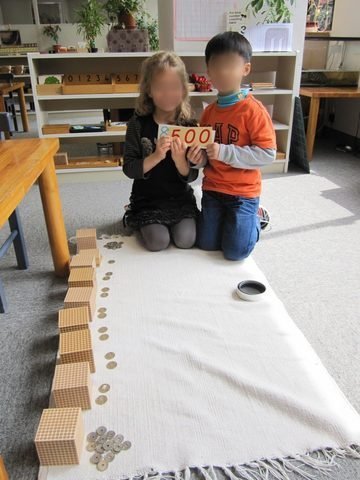

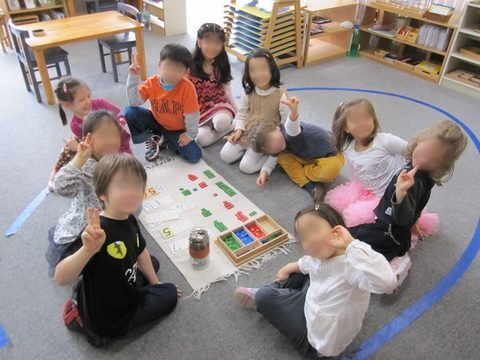

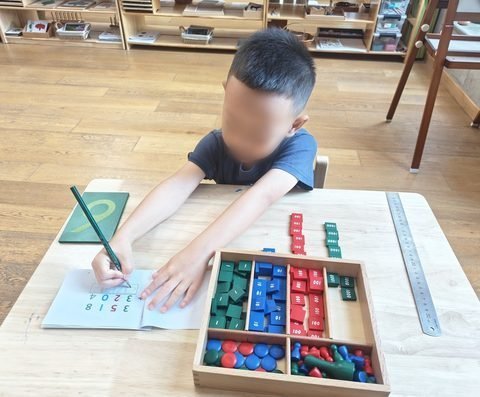
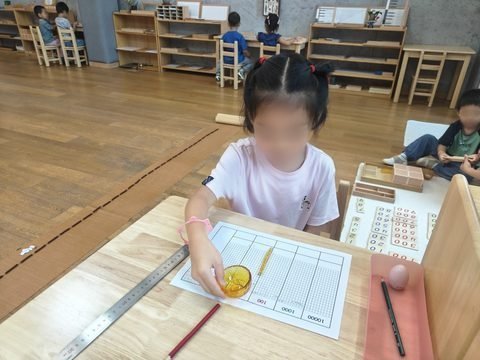
The next Decimal System presentation is The Stamp Game, in which the 1’s, 10’s, 100’s and 1000’s are represented by different coloured stamps, so the materials are becoming increasingly abstract, and this process continues in the following presentation, The Dot Game, where the 1’s, 10’s, 100’s and 1000’s are represented by dots.
The Stamp Game

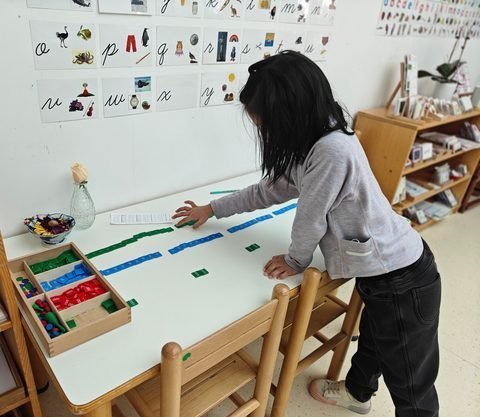

The Dot Game
Word Problems
- Choose a word problem.
- Read it with the child.
- Set it up with the stamps, performing the operations as per the previous exercises.
- Continue as long as the child is interested.
- Nandini drives to Pallavakum four times every month. If she has been going for 11 months, how many times has Nandini driven to Pallavakum?
- Laura’s hens laid 54 eggs, and she wants to share them equally with her three friends. How many eggs will each friend receive?
- Peter had 6 balls and then he found 3 more. How many balls does he have now?
- Sean wants to read 7 books this summer. He has already read 4. How many more books does he have to read to meet his goal?
- Roger picked 7 apples from the tree. Each apple has 6 seeds. How many seeds are there in total?
- There were 49 leaves on the ground. If 7 children each picked up the same number of leaves, how many leaves did each child get?
Group 3 - Counting
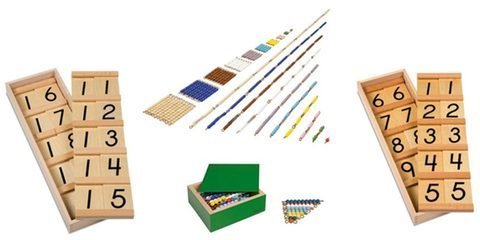
Typically introduced around ages 4½ to 5, this group focuses on linear and skip counting, helping children move beyond simple enumeration to recognise numerical patterns and relationships. Key materials include the Teens and Tens Boards, which visually and tactilely demonstrate how numbers from 10 to 19, then up to 100, and then up to 1000 are constructed from combinations of units and tens. The Golden Beads and Number Cards are used together to reinforce the association between quantity and symbol, while the Hundred Board and Bead Chains (short and long) support linear and skip counting (e.g., counting by 2s, 5s, or 10s). These activities not only solidify number recognition but also lay the groundwork for multiplication and later work with the decimal system.
Teen Beads
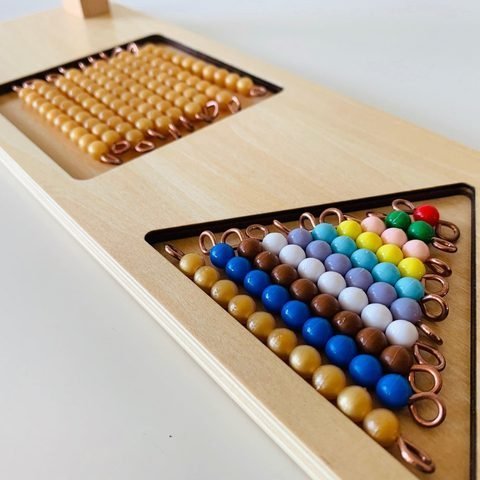
Nine coloured bead bars, each representing a number from 1 to 9, with each quantity distinguished by a different colour:
1. Red 2. Green. 3. Pink. 4. Yellow 5. Light blue 6. Purple 7. White 8. Brown 9. Blue
Nine golden bars of 10.
Understanding that teen numbers are made by combining a ten and a number from 1 to 9.
Sensorial impression of the quantities of teen numbers and their names.

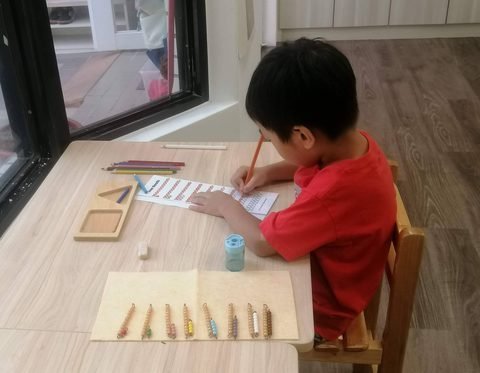
Introduction Bead Triangle
Presentation Three-Period Lesson.
Exercise 1 Ask for a quantity.
Exercise 2 Identify a quantity.
Exercise 3 Definition.
Teen Boards
Two wooden slotted boards, each divided into five sections with a large 10 printed within nine of the sections, along with Cards with the numbers 1-9 which fit into each section of the boards. Montessori named these The Seguin Boards in honour of their creator.

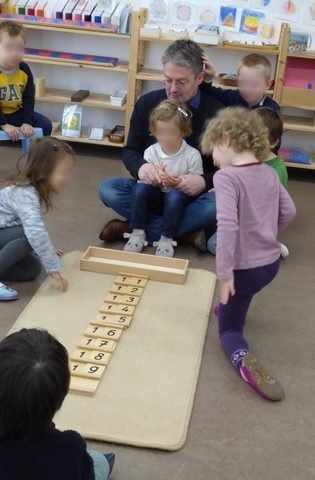
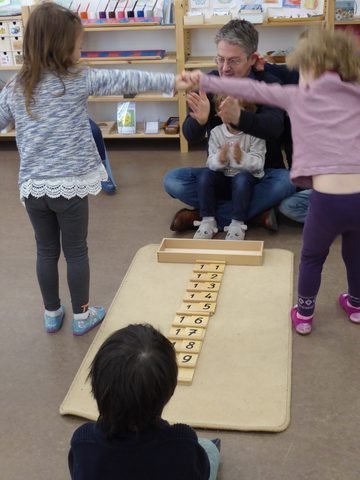
Learning the symbols for the letters which he already knows.
Presentation Three-Period Lesson.
Exercise 1 Make a number.
Exercise 2 Identify a number.
Teen Beads and Boards
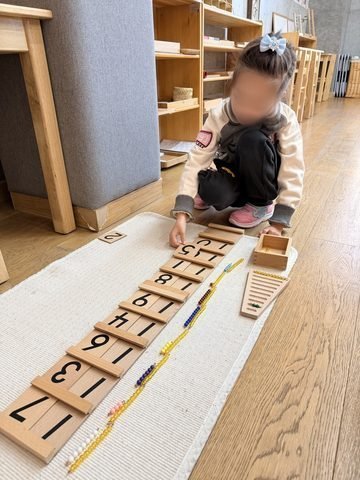
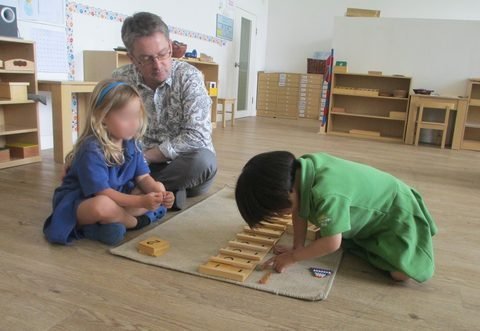
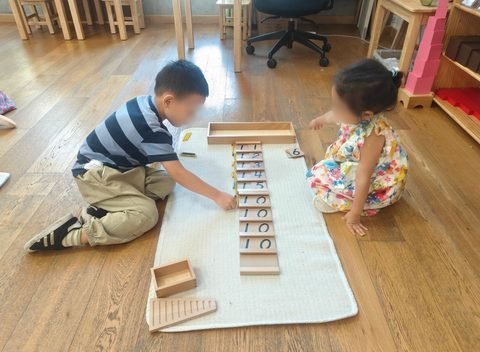
Teen Beads.
Teen Boards.
Connection of quantity, name and symbol.
Reinforcement of sequence of numbers from 11 to 19.
Presentation.
Ten Beads and Boards
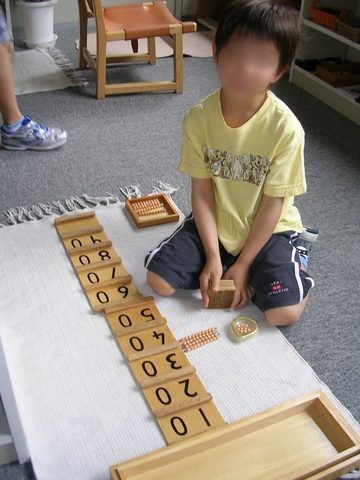
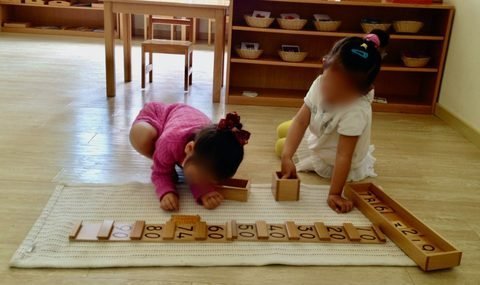
Two wooden slotted boards each divided into five sections with numbers from 10 to 90 printed in nine of the sections
Cards with the numbers 1 to 9 which fit into each section of the boards
9 bars of ten golden beads
10 golden unit beads
Learning the traditional names of the groups of ten, from ten to ninety.
Understanding of the progression of numbers from 11 to 99 particularly from one ten to the next.
10 Beads and Boards again makes the connection between the concrete beads and the abstract numerals, after which the child gains practice in connecting the two by counting the Chains.
Presentation - Tens.
Exercise 1 - 1 to 100.
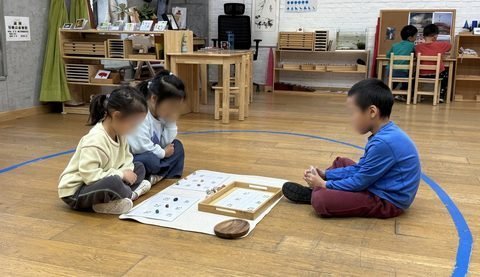


Linear Counting

A 100-chain made of ten bars of 10 joined together.
A 100 square.
9 narrow green arrows with the numbers 1-9.
9 medium blue arrows with the numbers 10-90.
1 wide red arrow with the number 100.
A 1000-chain made of 100 bars of ten joined together.
Ten 100 squares.
A 1000 cube.
9 narrow green arrows with the numbers 1-9.
90 medium blue arrows with the numbers 10-90, 110-190, 210-290…910-990.
9 wide red arrows with the numbers 100-900.
1 extra wide green arrow with the number 1000.
Practice in counting.
Consolidation of the knowledge of counting.
Awareness of the striking difference between 100 and 1000.
Presentation - 100 Chain.
Exercise - 1000 Chain.
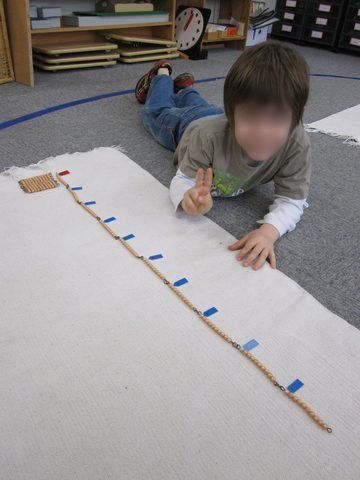
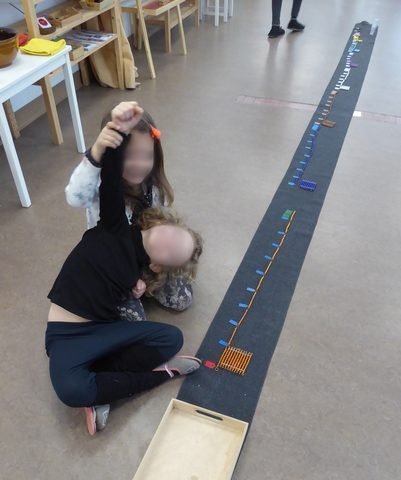


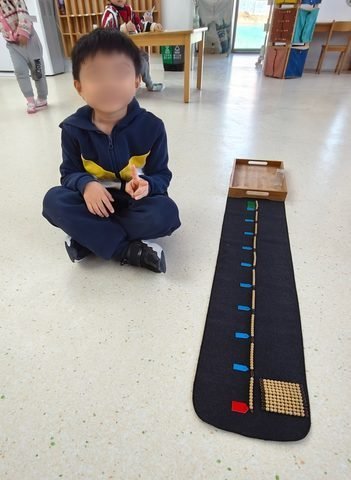
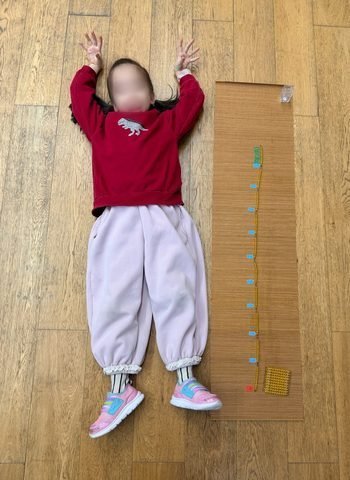
Once the child has counted all of the short chains one by one, they are encouraged to count all of them at the same time.


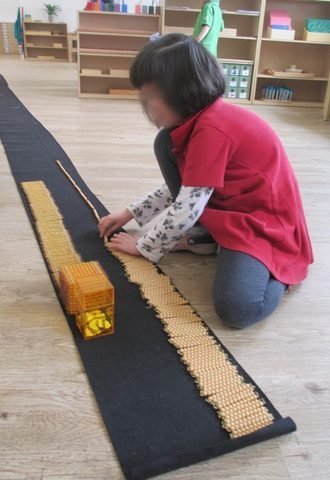
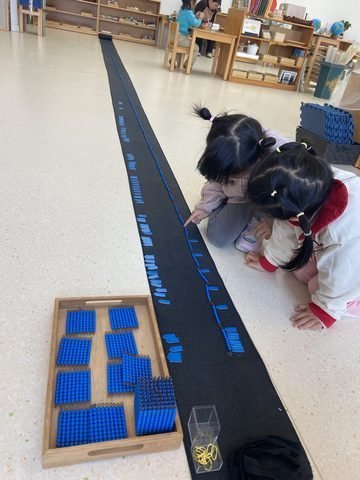
"I have had a chain made by joining ten ten-bead bars end to end. This is called the "Hundred Chain". Then, by means of short and very flexible connecting links I had ten of these hundred chains put together, making the "thousand chain" These chains are of the same colour as the ten-beads. The difference in their reciprocal length is very striking. Let us first put down a single bead; then a ten-bead bar, which is about 7 cm. long; then a hundred-bead chain, which is about 70 cm. long; and finally, the thousand-bead chain which is about 7 meters long. The great length of this thousand-bead chain leads directly to another idea of quantity. The flexible connections between the different hundred lengths of the 1000 bead chain permit its being folded so that the "hundred chains" lie one against the other, forming in their entirety a long rectangle. The same quantity which formerly impressed the child by its length is now, in its broad, folded form, presented as a surface quantity."
- Maria Montessori, ‘The Advanced Montessori Method’, Vol. II’, pp. 189-190. (1916)
Skip Counting
Squares and the chains of squares of the numbers 1-10.
Cubes, enough squares to make the cube and the chains of cubes of the numbers 1-10.
The colour of the beads for each number correspond to the colours of the short bead triangle.
Arrows with the multiples for each chain in corresponding colours.

Giving the child further practice in linear counting.
Giving the child experience in skip counting i.e. in a non-linear fashion.
Preparation for multiplication.
Presentation -The child counts any short chain.
Exercise 2 - The child counts any long chain.



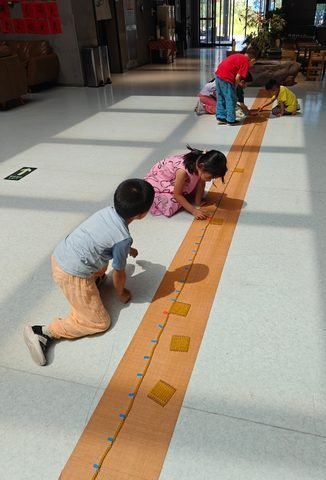
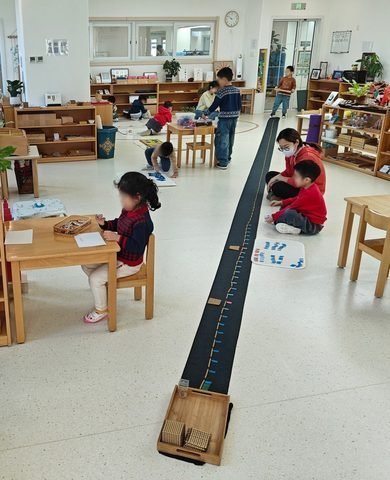

Exploration With Chains
All the short and long chains.
Presentation.
Two presentations that are not in my AMI album but which I have found to be very useful and much enjoyed by the children are the 100 Board and How to use a Measuring Tape.
100 Board
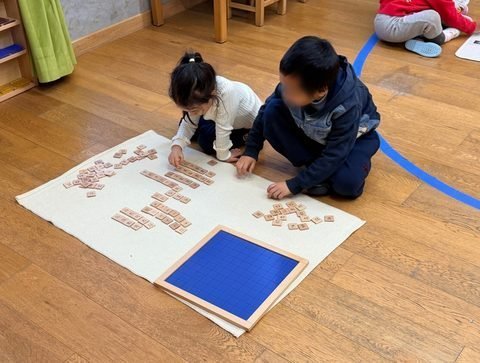
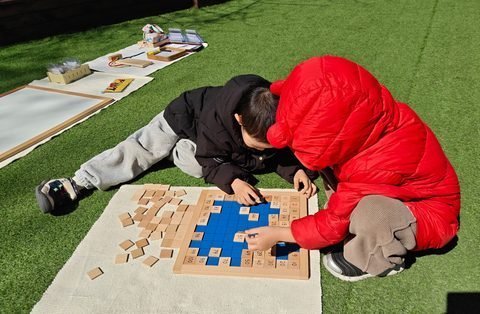
This is one of those activities that you see in every AMS classroom but never in AMI classrooms, which I really don’t understand: in Group 2 Decimal Beads transition into stamps, but in Group 3 the beads in the chains shouldn’t transition into the tiles of the 100 board? I prefer to follow the child, and the way the children universally enjoy this activity and create interesting variations upon it demonstrates its utility. Some examples:
Image 1 Using the materials as in the presentation
Image 2 This boy took the tiles out, mixed them up, laid them out in sequence on the table, then put them back on the board
Image 3 This pair decided to return the tiles to the box not by 10’s, but starting 1, 11, 21, etc.
Image 4 This girl did something similar when she decided to lay out the tiles vertically instead of horizontally
Image 5 This pair turned the 100 Board into a variation on a Memory Game


How to use a Measuring Tape
When they begin measuring, the children will invariably start off small, measuring a tray or a lid of a box, and then proceed to measuring everything in the room, including tables, doors, windows, walls and even their classmates, if they sit still for a moment. So, this activity is a wonderful and fun way to demonstrate the practical utility of numbers.


Group 4 - The Essential Combinations
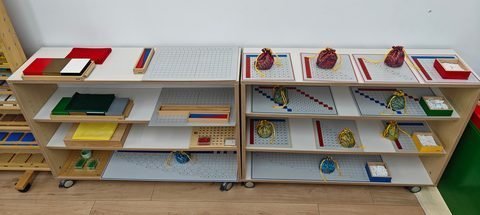
Group 4 provides the child with a sensorial impression of the different ways to make numbers, along with experience with materials to aid with memorisation of the essential combinations of addition, subtraction, multiplication and division. The materials include Beads, Boards and Charts for each operation.
Addition Snake Game
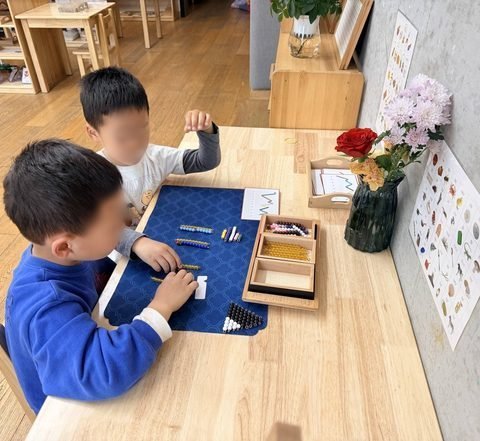
Large quantity of coloured bead bars from 1- 9.
Black and white bead triangle: beads 1 - 5 in black, 6 - 9 in white on each bar. Large quantity of golden ten bars.
A notched red card.
Sensorial Impression of the different ways to make ten.
Memorisation of the essential combinations of addition.
Reinforcement of the knowledge that addition and multiplication are part of the same concept.
Memorisation of the essential combinations of multiplication
Addition Strip Board
Memorisation of the essential combinations of addition
Indirect Aim
Awareness of the commutative law of addition
Addition Charts
Memorisation of the essential combinations
Subtraction Snake Game
Memorisation of the essential combinations of Subtraction
Subtraction Strip Board
Memorisation of the essential combinations
Subtraction Charts
Memorisation of the essential combinations
Multiplication Bead Bars
Memorisation of the essential combinations i.e. the multiplication tables
Reinforcement of the concept of multiplication i.e. addition of the same number
Reinforcement of the idea that the multiplier is not a quantity, but is an indication of the
number of times a quantity has to be taken
Indirect Aims
Preparation for Division
A sensorial impression of the geometrical form of multiplication.
Preparation for work with factors.
Multiplication Board
Memorisation of the Multiplication tables
Multiplication Charts
Memorisation of the Multiplication Tables
Unit Division Board
Memorisation of Division combinations
Division Charts
Memorisation of the Division Tables
Addition Snake Game

Addition Boards

Addition Charts

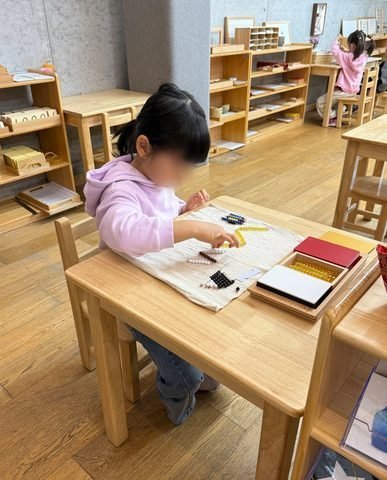
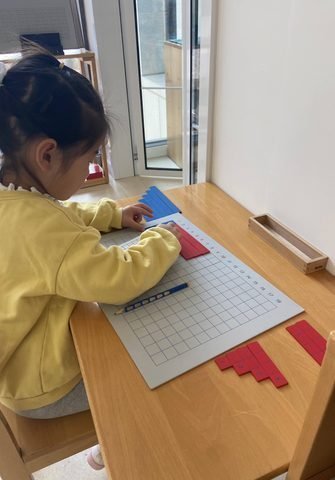
Group 5 - Passage to Abstraction
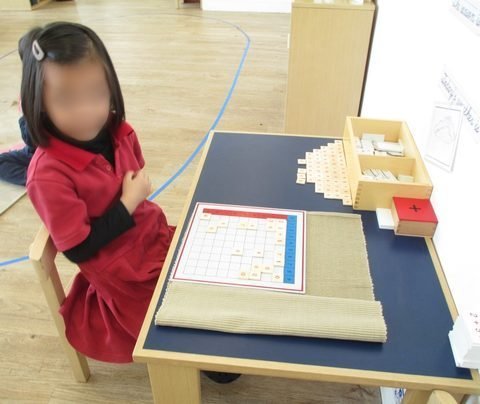
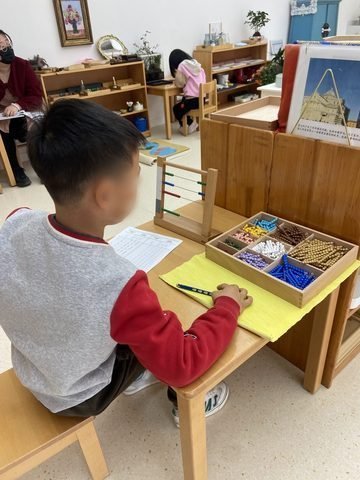
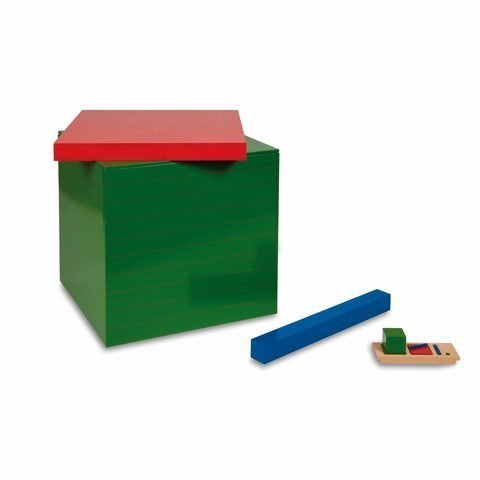
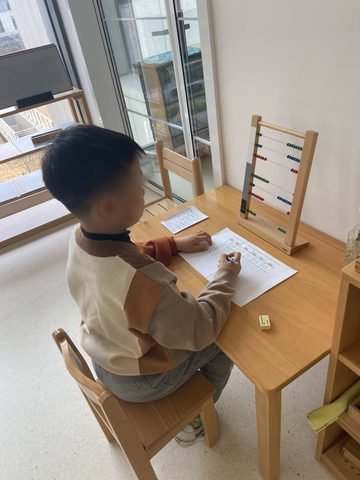
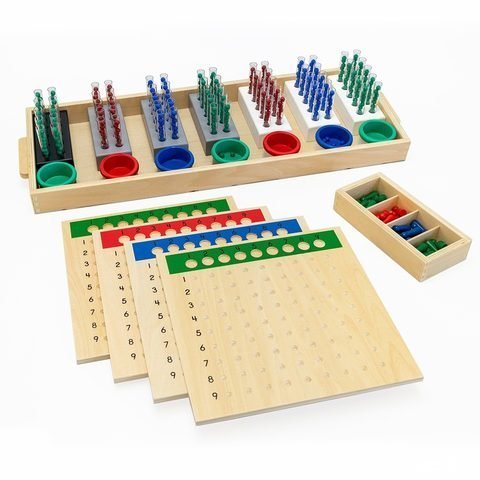
In Group 5, the child works towards abstract addition, subtraction and multiplication, using materials that encompass a small and large abacus, seven wooden solids representing hierarchical values from one to one million, and a set of racks, tubes and dishes in the decimal colours, in tandem with the Unit Division Board.
Short Bead Frame
Working towards abstract addition and subtraction.
Material for the Hierarchies
Sensorial experience of the hierarchies and their names.
A sensorial impression of the relationship between one hierarchy and the next and their relative sizes.
Learning the symbols for the quantities.
Long Bead Frame
Working towards abstract addition, subtraction and multiplication.
Division with Racks and Tubes
Working towards abstract division.
Group 6 - Fractions
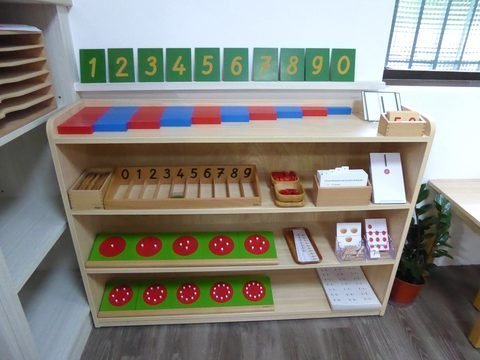
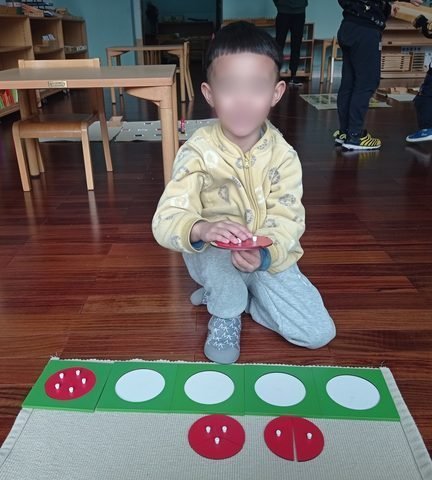
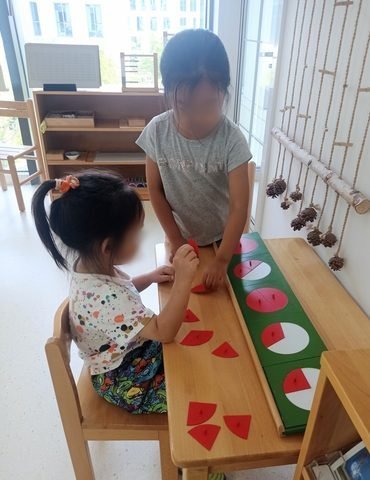
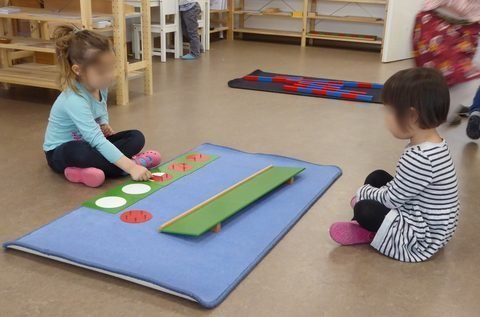
A set of 10 red Fraction circles in green frames: one whole, the others sectioned into halves, thirds, fourths, fifths, sixths, sevenths, eighths, ninths and tenths.
Because they are introduced at the same age, the Fractions are often placed on the same shelf as Group 1.
A sensorial impression of fractions.
Understanding the concept of equivalence.
Understanding the operations with fractions.

The Montessori Mathematics Curriculum is a radically different approach to teaching mathematics, utilising tactile materials and a child-centred learning philosophy to foster a deep understanding and appreciation of mathematical concepts. By creating opportunities for children to explore and discover mathematical ideas at their own pace, the curriculum not only supports the development of mathematical skills but also instils a lifelong love of learning, preparing them to be confident and competent learners, capable of tackling future complex mathematical challenges with enthusiasm and curiosity.