A Parent Handbook is a document that should contain answers to most or all of the most common questions that parents have about the school. A Staff Handbook including this information, along with extra answers to the most common questions that teachers have, including rules, regulations, and duties and responsibilities.
A Parent Handbook provides a written reference for parents about the school’s educational approach, daily operations, policies, and expectations and serves as a single document that consolidates information parents need for enrolment, participation, and ongoing communication with the school. A Handbook is invaluable as the rules and routines of the school are clearly detailed in advance of the parents (or teachers) joining the school, so there’s less chance of miscommunication or misunderstanding, and the owners and/
Handbooks can contain as much detail as each school decides, and because many schools make their Handbooks freely available to download, studying a Handbook is a useful way to gauge the standards and professionalism of the school. The following are some of the key elements that a Handbook should contain.
Philosophy and Educational Foundation
The school’s mission statement and, where applicable, a brief history of the school.
An introduction to Maria Montessori and the pedagogic basis of her work.
A description of the Montessori method, including key concepts: the absorbent mind, sensitive periods, the prepared environment, the role of the adult, and freedom within limits.
For schools with multiple age groups, a description of developmental characteristics and educational goals for each programme level (Infant/
Programme Structure and Daily Routine
Arrival and departure times and procedures.
The daily schedule, including the work cycle, outdoor time, meals, snacks, and rest periods.
The mixed-age classroom configuration and the use of Montessori materials through individual choice and teacher-guided lessons.
Curriculum areas (Practical Life, Sensorial, Language, Mathematics, Cultural Studies) with examples of activities in each area.
Information about extended care options (before and after school programmes), if offered.
Parent‑School Partnership
The roles of parents and teachers in supporting the child’s development.
Procedures for classroom observation, parent‑teacher conferences, and parent education events.
Suggestions for implementing Montessori principles in the home environment, such as setting up a prepared space, encouraging independence, and responding to developmental needs.
Policies and Procedures
Admissions and enrolment: Application process, registration requirements, immunisation records, and nutrition policies.
Health and safety: Sick‑child policy, medication administration, first aid, allergy management, sanitation protocols, emergency and evacuation plans, and child protection policies.
Daily operations: Drop‑off and pick‑up procedures, authorised persons for child collection, attendance reporting, and dress code.
Communication: Contact points for academic, administrative, and leadership concerns.
Financial policies: Tuition, fees, payment schedules, late payment procedures, and withdrawal or termination terms.
Behaviour and discipline: The school’s approach to guiding behaviour, discipline procedures, and code of conduct.
Additional policies: Field trips, photo releases, internet use, substitute teachers, volunteers, pets, and holiday or cultural celebrations.
Practical Implementation
The handbook is written in clear, accessible language, with Montessori terminology defined where used.
It is distributed in both print and digital formats.
Parents are asked to sign an acknowledgement page confirming receipt and understanding.
The handbook is reviewed and updated at regular intervals (e.g., annually) to reflect current practices.
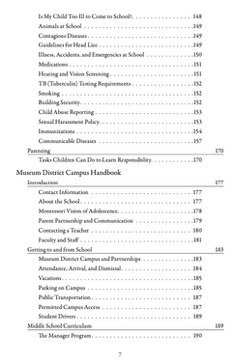
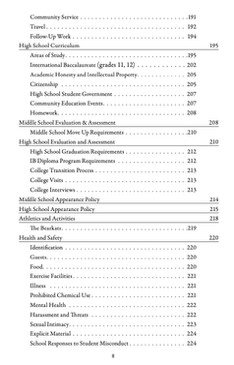
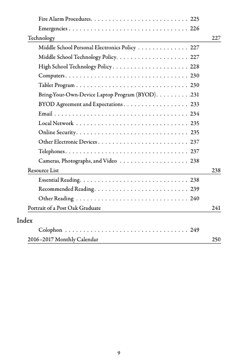
The handbook produced by The Post Oak School -in Houston, Texas, USA- is one of the most detailed I’ve seen, with the PDF running to 249 pages. There is an A to Z of topics available online, containing a detailed Table of Contents which gives a pretty good sense of which information a Handbook should include:


Resources
The following are a sample of Handbooks from Montessori schools around the world.
Europe
The Montessori Place, Brighton & Hove, UK.
Ecole Montessori Bilingue de Saint-Cloud, Paris, France.PDF
International Montessori School of Berlin, Germany.PDF
Montessori International Preschool, Valby, Denmark.PDF
Elckerlyc International School & Montessori, Leiderdorp, Netherlands.PDF
Casa Bilingual Montessori School, Pijnacker-Nootdorp, Netherlands.PDF
The 6th Montessori School Anne Frank, Amsterdam, Netherlands.PDF
North America
Brilliant Star Montessori School, Saskatoon, Canada.PDF
Maria Montessori Academy, British Colombia, Canada.PDF
Cornerstone Montessori, British Colombia, Canada.PDF
Aidan Montessori School, Washington, DC, USA.PDF
Chantilly Montessori, North Carolina, USA.PDF
Cornerstone Elementary Montessori, Minnesota, USA.PDF
Montessori School of Brentwood, California, USA.PDF
Portland Montessori School, Oregon, USA.PDF
The Montessori Children’s School, California, USA.PDF
Austin Montessori School, Texas, USA.PDF
Chesterfield Montessori School, Montana, USA.
The Montessori Academy Of Arlington, Texas, USA.PDF
Spruce Tree Montessori School, Arkansas, USA.PDF
Northwest Montessori School, Seattle, USA.PDF
Southern Ute lndian Montessori Academy, Colorado, USA.
The Montessori Elementary & Middle School, New Mexico, USA.PDF
Casa Montessori School, Georgia, USA.PDF
The Woods, A Montessori School, Virginia, USA.PDF
Rest of the World
Qingdao Amerasia International School, Qingdao, China.PDF
The Montessori School of Tokyo, Japan.PDF
The School of Modern Montessori, South Africa.PDF
École Montessori Casablanca, Morocco.
Learning Ladder Montessori School, Lagos, Nigeria.
Beehive Montessori School, Mosman Park, Australia.PDF
Burnham Country Montessori, Canterbury, New Zealand.PDF
Meraki Montessori, Wainui, New Zealand.PDF
Learning Links Montessori, Dunedin, New Zealand.PDF