Mixed-Age Groups - Resources
There are three texts that were hugely beneficial in helping me clarify the reflections on mixed-age groups that have been simmering in my brain for more than two decades.
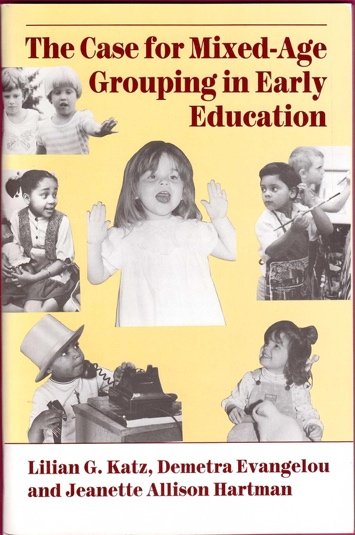
By Lilian Katz (1990). A 6-page digest of the book is also available: PDF
The following are her reasons for advocating for mixed-age groups:
‘Executive Summary
Mixed-age grouping of young children in schools and child care centers is explored and advocated in this book. Although it is not a new idea in education, the practice of teaching young children of varying ages together runs counter to the typical pattern of education in the United States, which separates children into single-age classes. Mixed-age grouping is supported here for the following reasons:
- Mixed-age grouping resembles family and neighborhood groupings, which throughout human history have informally provided much ofchildren’s socialization and education. Many young children now spend relatively little time in either family or neighborhood settings and consequently are deprived ofthe kind of learning made possible by interage contact.
- Research, although incomplete, indicates that social development can be enhanced by experiences available in mixed-age grouping. Leadership and prosocial behaviors have been observed to increase.
- Current concepts of cognitive development—the“zoneof proximal development” and “cognitive conflict”— imply that children whose knowledge or abilities ares imilar but not identical stimulate each other’s thinking and cognitive growth.
- Research on peer tutoring and cooperative learning indicates that interaction between less able and more able children (“novices” and “experts”) benefits all individuals both academically and socially.
- Mixed-age grouping relaxes the rigid, lock-step curriculum with its age-graded expectations,which are inappropriate fora large proportion of Furthermore, mixed-age grouping might also lead to a reduction of screening and standardized testing in the early years.
- Mixed-age grouping has been used successfully with young children in the United States and abroad (e.g., Britain and Sweden).
Produced by the Queensland Studies Authority, Australia, a collection of readings on multi-age education,
- Learning and Teaching in a Multi-Age Classroom, by Nina Lister
- The Multiage Concept Explained, by Marion Leier
- My Thesis, by Michelle Pancoe
- Effect Size Research, by Steve Dinham and John Hattie
- The Benefits of Mixed-Age Grouping, by Lilian Katz
- A Multiage Approach, by Marion Leier
- Enhancing Learning Through Multiage Grouping, by Debra Johnson, with Cheryl L. Fox
- Multiage And Multi-Grade: Similarities And Differences, by Dennis M. Mulcahy
Later sections deal with Queensland education policy documents focused on system-wide achievement targets, teaching quality, and school improvement. © State of Queensland (QCAA) 2023 www.qcaa.qld.edu.au/copyright.
Wherein Sharon Caldwell argues that authentic Montessori education requires mixed-age groups (typically three-year spans, e.g., 3–6, 6–9, 9–12), larger class sizes (ideally 30–40 children), and a low adult-to-child ratio (often one teacher plus an assistant). She distinguishes true multi-age grouping from multi-grade or split-grade classes, emphasizes free movement between age groups, and links age configuration to developmental curriculum, continuous progress, and child-led transitions. The document includes extensive quotes from Maria Montessori, summaries of research on social and academic benefits, and practical notes on deviations from ideal structures. I haven’t shared it because,
“© Sharon Caldwell (2015). This document is intended for private use and may not be published, reproduced or circulated without the express written permission of the author.” See below for another article by Sharon Caldwell on this topic.
Recommended Reading
Maria Montessori
A lecture on mixed-ages, given in London in 1927.
South African Montessori Association
A series of articles in the National Newsletter of October 2011, including:
Benefits of Vertical Age Grouping in Montessori Schools, by Charl du Toit, SAMA President
The Beauty of MultiAge Groupings, by Lakshmi Kripalani
The Benefits Of Mixed-Age Grouping, by Lilian G.Katz
Age Groupings, Class Size and Adult to Child Ratios, by Sharon Caldwell
Occupations: Opportunities for Collaboration
Learning from Peers 1
Learning from Peers 2
Collaborative Learning/Cooperative Learning
Why the 3-year-cycle and its relevance to both children and teachers in all environments.
The Role of the Third Year Student in the Montessori Classroom
The Stages of Development in Teachers
I found this latter document to be particularly thought-provoking, examining as it does the way the adult develops in parallel with the children over the course of the three years.
Koorana Primary School
This brochure from Koorana Primary School in Warnbro, Western Australia is a detailed, practical list of the benefits of multi-age grouping, assuring parents that placement does not reflect ability, children work at their own pace, helping others aids learning, and teachers provide individual attention. A table compares mixed-age and traditional classrooms, highlighting differences in expectations, curriculum integration, grouping, and teaching roles.
Angeline Stoll Lillard
Montessori: The Science Behind the Genius
Chapter 7 – ‘Learning from Peers’ Summary – “Children in Montessori classrooms have ample opportunity for learning by imitating models, through peer tutoring, and in collaboration. Montessori education is built on these forms of learning supplementing interaction with the material and teacher lessons. Research in schools and psychology laboratories has shown that learning occurs in these situations. Furthermore, peer tutoring and collaborative arrangements are superior to conventional whole-class teaching for both the learning and the social climate that they support.”
John Taylor Gatto
The text of a speech he made while accepting the New York City Teacher of the Year Award on January 31, 1990, printed in The Sun newspaper, June 1990, p. 24.
Nancy Walser
An article in ‘The Harvard Education Newsletter’, arguing that “Despite mounting challenges, the multi-age classroom continues to be an attractive option for educators.”
Early Education Reform Group
A 36-page booklet structured as a parent-friendly FAQ, created to explain and advocate for the then-progressive educational model of multi-age grouping, also known as “family grouping.” Published in November 1987 by the Queensland-based EERG.
Mixed-Age Groups and Play
Peter Gray
A research professor in Psychology and Neuroscience at Boston College, whose recent work focuses primarily on children’s natural ways of learning and the value of play from an evolutionary perspective. This site includes pages where you can download some of my academic articles, find out about books I’ve authored, and view videos of some of my talks.
“I review research indicating that play involving children who differ considerably in age is more nurturing, less competitive, more creative, and more conducive to learning than is play among children very similar in age.”
Professor Grey has also written three letters on the value of providing opportunities for children to play and otherwise interact in age-mixed groups, available on his Substack, ‘Play Makes Us Human.’ The following three-part series come from this source.
When children of different ages play together, the older ones elevate the level of play of the younger ones and learn to nurture, teach, and lead, so children learn more in play with those who differ from them in age than in play with age-mates.
Age-mixed play is especially valuable for social development: it reduces bullying, promotes empathy, helps socially inhibited kids overcome inhibitions, provides extra care for little ones, and provides parenting practice for older children.
When children who differ widely in age play a game together, the focus shifts from winning to having fun: age-mixed play is less competitive, more creative, and more conducive to experimentation than is age-segregated play. In short, age-mixed play is more fully playful than age-segregated play.
A guest post by Laura Kriegel, co-founder and executive director of a summer camp, Camp Stomping Ground, in Middle Grove, NY, “a place where children of a wide range of ages play freely, where children’s rights are respected, and where the major lessons—learned largely in play—are lessons of personal responsibility, empathy, and conflict resolution.”
Dennis M. Mulcahy Articles
Dr. Mulcahy is a member of the Faculty of Education, Memorial University of Newfoundland and Labrador, Canada.
“The primary focus of my research and development work is Rural Education and Small Schools. Topics included in this work: multi-grade classrooms and multiage pedagogy; the viability and value of small community schools; school closure and consolidation; distance education and e-learning; teacher education, recruitment and retention; bussing; and rural policy development.”
Research
AMS Research Committee White Paper, by Barbara Ervin and Christine Sacerdote, Ed.D.
This AMS Research Committee white paper series summarizes mainstream education literature related to authentic Montessori practices.
‘This implementation guide by Bruce A. Miller examines practices and issues involved in the implementation of multiage programs, includes ideas, stories and experiences of educators who have created multiage classrooms and researchers who have studied the multiage concept. Originally published in 1994.’
By S Khurram Khan Alwi, Zobia Zaman, Romana Bano Ghaffar, Saima Tabasum, Syed Waqarul Hasan
Children’s Social Behavior in Relation to Participation in Mixed-Age or Same-Age Classrooms
‘This study by Diane E. McClellan & Susan J. Kinsey found that mixed-age classrooms -where children span at least two age levels- can positively influence students’ social development compared to same-age classrooms. The research included 649 students from 29 classrooms in Chicago and Milwaukee, controlled for factors like the child’s age, sex, and the teacher’s educational background to isolate the effect of the classroom environment. The key findings indicate that, in mixed-age classrooms, children display significantly more prosocial behaviors (such as sharing and helping) and less aggressive behavior, while also experiencing less social isolation. Significantly, these benefits appear to have a lasting effect: when researchers conducted follow-up assessments of the same children in third grade (after they had returned to same-age classrooms), those who had previously been in mixed-age classes were still rated as less aggressive and more prosocial than their peers who had always been in same-age classes.’
This 2007 Research Summary was written by Larry G. Daniel for the National Middle School Association (NMSA) as a service to middle level educators, families, and policymakers. It evaluates how blending multiple grade levels into a single learning community structurally and instructionally aligns with the developmental needs of young adolescents and the core philosophy of middle school education.
By Zoe Cronin University of Cambridge: “A 2019 systematic review that critically examines the academic and social outcomes of mixed-age grouping in primary schools. The paper highlights the limitations of using standard comparative studies to evaluate success, noting that ambiguous empirical findings often stem from researchers grouping structurally different mixed-age classrooms under a single definition. Cronin advocates for clearer definitions and more thorough, contextual descriptions in future educational research to truly determine the efficacy of mixed-age groupings as a tool for school reform.”
Nicole Black, Hamline University Saint Paul, Minnesota May 2022.
Nadeem Saqlain: “Multi-grade schooling has been used in many countries around the globe. It is a cost effective model of schooling especially in rural areas where teacher retention and recruitment is a major problem. The findings of various research studies indicate that multi-grade education is as effective as single-grade schooling in terms of academic achievement and better in terms of social learning. The success of multiage education greatly depends on teaching techniques. Our universities prepare teachers for single-grades. Therefore, teachers in multi-grade settings face many challenges such as inadequate training, social and cultural isolation, instructional, lack of time, lack of community understanding, and rural nature of most of the multi-grade settings. Some of the issues can be overcome through proper pre-service and in-service teacher training.”
By Rebecca A. Proehl, Shelese Douglas, Dean Elias, Anthony H. Johnson, Wendy Westsmith.
By Anne Davies and Colleen Politano: “A 168-page, highly regarded resource for educators, blending theory with classroom-tested methods for organizing learning and assessment and providing practical, research-based strategies for managing multi-age, multi-ability, and multi-interest classrooms.”
The following overview and list of resources come from this school in Washington state, USA.
“What are the benefits of mixed age classrooms in early learning?
Mixed age classrooms support children in developing at their own pace. Between 3 and 5 children’s development is at it’s most diverse in all areas – language, cognitive, social-emotional, gross and fine motor, in addition to their diversity in terms of temperament, family culture and experience outside the home.
Teachers and parents, in a mixed age classroom community, are more likely to direct their attention and efforts on effectively understanding and supporting each child’s unique development. This focus also builds community and a sense of belonging for the whole group, by reducing competition and comparison.
Children’s social and emotional development is key to all future learning, and is strengthened through supported long-term interactions with all types of diversity, including age ranges.
Regular routines and responsive relationships decrease stress and therefore increase learning. In mixed age classrooms children may remain with the same teacher and many of their friends for 2 years.
Mixed age groups resemble family life – all children experience being the youngest, the middle and the oldest. Children who have the opportunity to learn and to teach between children, not exclusively from adults, retain more knowledge at the level of mastery, instead of just exposure.
Mixed age interactions sharpen receptive and expressive communications skills in all children.
Being in a mixed age classroom reduces the frustration children feel when they are expected to master something they are not developmentally ready for, or not given the opportunity to do what they are developmentally ready based on an age label. For example, imagine the effects of rushing, a child learning to crawl, walk or speak! Or alternatively, delaying a child who is ready by not giving them the opportunity.
Some of the Benefits Particular to Younger Children:
- Higher rates of participation in complex play
- More sophisticated expressive language (descriptions, vocabulary, conversations)
- Exposed to more mature problem-solving strategies
- View themselves as strong and supportive members of classroom community
Benefits Particular to Older Children:
- Development of responsibility, leadership, and pride
- Builds empathy, ability to nurture, problem-solving skills
- Motivation to model positive social behavior
- Children experiencing difficulty regulating their own behavior improve when encouraged to help younger classmates